

Who is eligible
The index is meant to hold 100 of the largest non-financial companies listed on Nasdaq. Nasdaq's methodology sets the gates:
- Listing. The company must be primarily listed on a US Nasdaq-affiliated exchange. The Nasdaq Capital Market tier is excluded.
- Industry. Companies classified in the Financial industry under the Industry Classification Benchmark are excluded. Real estate companies can qualify if they are not organized as a REIT.
- Security type. Common stock, tracking stock and ADRs are eligible. REITs, SPACs and when-issued securities are not.
- Liquidity. At least $5 million in three-month average daily value traded.
- Seasoning. Generally three full calendar months of trading on an eligible exchange, not counting the month of listing. For the December review, a company normally must be listed by the last trading day of August. A SPAC's trading history before its merger does not count.
There is no minimum market capitalization; the ranking decides.
How the selection works
Once eligible companies are ranked by full market capitalization on the reference date, Nasdaq fills the 100 places in this order:
- The top 75 companies are selected.
- Current members ranked within the top 100 are kept.
- Current members ranked 101st to 125th are kept, in rank order, if they were in the top 100 at the previous reconstitution or were added since then.
- Any remaining places go to other companies ranked in the top 100, in rank order.
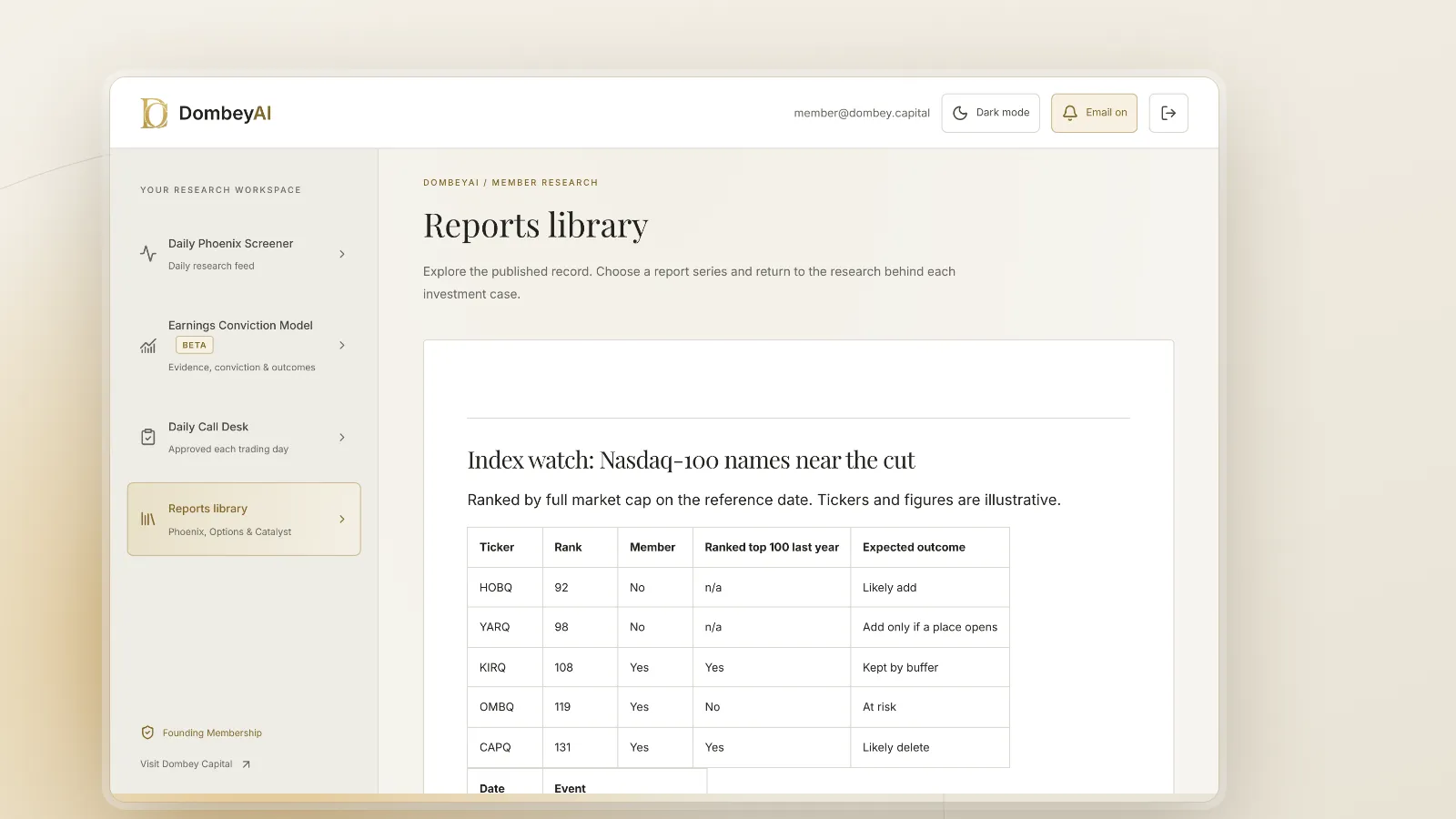
The buffer in step 3 matters. A member that slips to 110th is usually kept for a year, so a company just outside the top 100 often has to wait for a weak member to fall below 125th, or to fall twice in a row, before a place opens. Turnover is therefore lower than a simple top-100 cut would produce.
The 2026 calendar
| Date | Event | What to check |
|---|---|---|
| Last trading day of August | Seasoning cut-off for new listings | Recent IPOs and spin-offs listed after this date are not eligible this year |
| November 30, 2026 | Reconstitution reference date | Rank eligible companies by full market capitalization at the close |
| December 11, 2026 (expected) | Announcement after the close | Compare the published list with your estimate |
| December 18, 2026 | Last trading day before the change | Index funds trade at or near the close |
| December 21, 2026 | Changes effective at the open | New weights and members apply |
The dates are derived from the methodology's rules. Confirm them against Nasdaq's announcement, which can shift for holidays.
How weights are set
The Nasdaq-100 is weighted by modified market capitalization, with caps so that a few giant companies do not dominate:
- If any company's weight would exceed 24%, weights are adjusted so no company exceeds 20%, and if companies above 4.5% add up to 48% or more, that group is cut back to 40%.
- Security-level caps limit any one security to 14% if it would otherwise exceed 15%, and cut the five largest back to 38.5% combined if they reach 40%.
- Low-float stocks have their share count for weighting capped at three times their free float.
A special rebalance can be triggered between reviews if no company may exceed 24% or the over-4.5% group exceeds 48% at the end of a day. That is why heavy concentration in the largest technology companies can produce weight changes outside December.
Why the reconstitution moves stocks
Funds that track the Nasdaq-100 must hold the new members and drop the old ones by the effective date. Many trade at the closing auction on the last trading day before the change, to match the index exactly. Managers who are benchmarked to the index, and options and futures hedgers, add to the flow.
For an addition, that is a block of buying that does not depend on the company's prospects. For a deletion, it is forced selling, often into a stock that has already fallen enough to drop in the ranking. Our explainer on index deletions covers why that selling can push a stock below what the business is worth.
The example shows the pattern that matters: because the rules are published, the most likely changes can be estimated weeks in advance, and the price effect is spread across the reference date, the announcement and the final close.
How it compares with other index events
| Event | Timing | Selection basis |
|---|---|---|
| Nasdaq-100 reconstitution | Annual, December | Full market capitalization, with a 101 to 125 buffer |
| Russell reconstitution | Semiannual from 2026 (June and December) | Total market capitalization ranking; see the Russell reconstitution |
| S&P 500 changes | As needed, plus quarterly rebalances | Committee decision using size, liquidity, profitability and other criteria; see S&P 500 inclusion |

The Nasdaq-100 is the most rules-based of the three on membership. The S&P 500 leaves more to its committee, which makes its changes harder to predict.
What to watch around the reconstitution
- Names near the cut. Non-members ranked in the 90s and members ranked near 125 on the reference date are the likeliest changes.
- Eligibility edge cases. Recent listings that miss the seasoning cut-off, companies reclassified into or out of the Financial industry, and stocks moving to Nasdaq from another exchange.
- Pending deals. A member being acquired may be removed early, and a replacement named, outside the December cycle.
- Liquidity relative to demand. The price effect is larger when index demand is large compared with the stock's normal trading volume.
Trackers that list announced and expected index changes are covered in our review of the best index change trackers. A catalyst calendar with the reference, announcement and effective dates keeps the steps in order.
Where this goes wrong
Assuming the announcement is the event. If the change was predictable from the November 30 ranking, the price may already reflect it by December 11.
Ignoring the buffer. A non-member ranked 95th does not get in if continuing members fill the places. Run the full selection order, not just the top 100.
Overestimating the flow. The largest companies are so heavily held that index demand is small relative to their trading. The effect is usually larger for the smaller members near the cut.
Forgetting the reversal. Prices pushed by index trades can retrace once the effective date passes and the forced buyers are done.
Using stale rules. Nasdaq changes the methodology from time to time, including the weighting caps. Check the current document each year.
The bottom line
The Nasdaq-100 reconstitution ranks eligible Nasdaq-listed non-financial companies by full market capitalization each December, keeps the top 75, protects current members down to 125th and fills the rest in rank order. For 2026 the reference date is November 30, with the announcement expected on December 11 and changes effective December 21. Because the rules are public, likely changes can be estimated early, and the price effect is spread over several weeks. For stocks moving on events now, see the market coverage.