

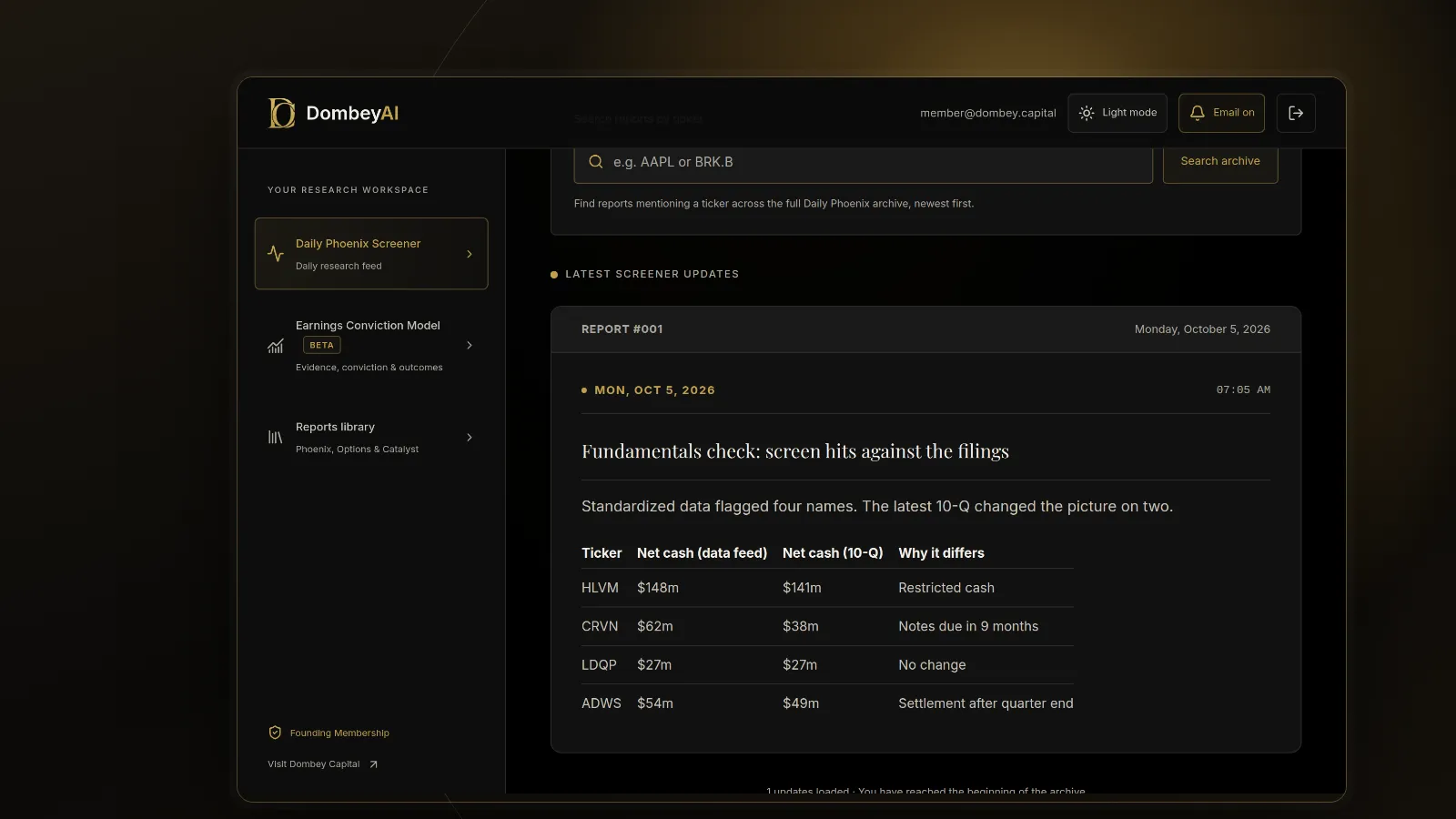


Full disclosure: Dombey Capital is our own research service and our top pick here, for the reasons below. The section on where it falls short is there so you can judge whether it fits your process.
Quick comparison
| Tool | Best for | Key features | Price (as of October 2026) |
|---|---|---|---|
| Dombey CapitalTop pick | Special situations with dated catalysts | Weekly Phoenix Report, weekly Options Research, Biweekly Catalyst Briefing, DombeyAI Portal with the Daily Phoenix Screener and Earnings Conviction Model | Founding Membership $1,200/year; Standard Access $6.67/month; Public Archive free |
| TIKR | Long global financial history and transcripts | 100,000+ global stocks, S&P Global Capital IQ data, up to 30 years of financials, valuation model builder, superinvestor holdings | Free; Plus $24.95/month; Pro $54.95/month; Ultimate $119.95/month (annual billing offered) |
| Koyfin | Dashboards, macro data and custom formulas | 100K+ global securities, 5,900+ screener filter criteria, macro dashboards, searchable transcripts, custom formulas on Premium | Free; Plus $39/month; Premium $79/month; Advisor Core $209/month; Advisor Pro $299/month (billed annually; monthly billing costs more) |
| Stock Rover | Deep screening and portfolio analysis | 400+ to 800+ metrics, up to 20 years of fundamentals, equation-based and historical screening, research reports, brokerage linking | Free plan; Premium $348/year or $34/month; Premium Plus $588/year or $70/month; Ultimate $948/year or $99/month; Ultimate Pro $1,788/year or $199/month |
How we compared these tools
We compared these tools from vendor documentation, pricing pages and public product pages, read on October 5, 2026. We did not run trials of the paid plans. Where a vendor page did not state a fact, we left it out.
The job is fundamental research on special situations: companies whose value depends on a balance sheet and a dated event such as an earnings release, a vote, a tender or a court ruling. That job puts more weight on history, filings and cost than on charting.
| Criterion | Weight | What it measures |
|---|---|---|
| Catalyst context | 25% | Whether the tool connects the numbers to a dated event, or leaves that to you |
| Financial history and filings | 25% | Years of statements, quarters, and access to filings and transcripts |
| Screening depth | 20% | Filter count, custom formulas, historical screening |
| Coverage | 15% | US only or global, and how many securities |
| Cost and friction | 15% | Price of the plan you would need and the limits of the free tier |
If you weight screening depth and coverage above catalyst context, the order among the data platforms matters more than the top pick, and Stock Rover or Koyfin moves up. If you mainly read statements, TIKR's lead widens.
We gave no weight to claims about data accuracy or investment performance, because no vendor publishes evidence we could check, and we make no such claims.
Quick picks by job
Best for special situations with dated catalysts: Dombey Capital
Dombey's Founding Membership is written research: the weekly Phoenix Report, weekly Options Research, the Biweekly Catalyst Briefing and the DombeyAI Portal. It is for readers who already have a data source and want an analyst's view of a narrow set of catalysts, with each thesis published before the event and kept in the archive.
Best for long financial history per dollar: TIKR
TIKR's Plus plan opens global data and 10 years of financials at $24.95 a month on the pricing page, and Ultimate reaches 30 years. The data is powered by S&P Global Capital IQ. If most of your work is reading income statements, balance sheets and cash flows across many years, it is the cheapest route of the three.
Best for dashboards, macro and custom formulas: Koyfin
Koyfin pairs company data with macro dashboards, government yields from 40 countries, indices, currencies and commodities. Premium adds unlimited custom formulas, which is how you would build a debt-adjusted cash measure across a screen. It suits the reader who wants markets and companies in one window.
Best for deep screening and portfolio tools: Stock Rover
Stock Rover's plans scale from 15 screeners and 400+ metrics on Premium to 120 screeners and 800+ metrics on Ultimate, with equation-based and historical screening from Premium Plus. It also links brokerage accounts and tracks portfolios. It suits the reader who screens often and wants to see their holdings in the same tool.
Full reviews
1. Dombey Capital
What it does. Dombey publishes independent research on special situations and event-driven equities: stocks priced below cash or book, cheap on sales, or facing a legal or corporate catalyst. Founding Members get the weekly Phoenix Report, weekly Options Research, the Biweekly Catalyst Briefing, valuation and execution analysis, priority access and the DombeyAI Portal, which holds the Daily Phoenix Screener and the Earnings Conviction Model.
Best for. Readers who already pull their own data and want written analysis of dated events, with the reasoning shown.
Pricing. Founding Membership is $1,200 a year and includes the reports and the DombeyAI Portal described above. Standard Access is the lower-cost option at $6.67 a month and includes the Biweekly Catalyst Briefing and the complete public-research archive. The Public Archive is free.
Pros
- It is built for the step a data platform leaves to you: what a balance sheet means for a dated event, such as how much net cash per share is likely to remain when the catalyst arrives.
- Theses are published before the catalyst, priced on the day and kept in the archive, so you can compare the case with the outcome.
- Founding Membership pairs the written research with the Daily Phoenix Screener and Earnings Conviction Model, and Standard Access is cheaper than the entry paid plan of every data platform here.
Cons
- It has no database of financials, no charting and no self-serve screener of the whole market.
- Coverage is a short list of situations, not thousands of companies.
Verdict: Our top pick for special situations with dated catalysts. Pair it with one of the three data platforms below.
2. TIKR
What it does. TIKR is a global stock research platform covering more than 100,000 stocks across 92 countries and 136 exchanges, with financial data powered by S&P Global Capital IQ. It has a global screener with thousands of filters, a valuation model builder, analyst estimates, filings, transcripts, watchlist news feeds and holdings for more than 10,000 investors, including disclosures outside US 13F filings.
Best for. Readers who mostly read financial statements and transcripts and want long history without paying for dashboards they will not use.
Pricing. Free is $0 with no credit card and covers US stocks with 5 years and 8 quarters of financials. Plus is $24.95 a month with global data and 10 years and 20 quarters. Pro is $54.95 a month with 10 years and 40 quarters, 20 years of charting, 10 years of transcripts and audio and slides. Ultimate is $119.95 a month with 30 years of financials and full transcript history. Annual billing is offered and every plan carries a 14-day money-back guarantee.
Pros
- The lowest entry price of the three for global data and 10 years of statements.
- Up to 30 years of financials on Ultimate, the longest stated history here.
- Transcripts, filings and estimates in the same place as the financials, with transcript history scaling from 90 days on Free to full history on Ultimate.
- Superinvestor and fund holdings, from the top 40 funds on Plus to more than 10,000 on Ultimate.
Cons
- The free plan is US only and allows 1 saved screen.
- The pricing page does not describe data export, so confirm it before paying if you work in spreadsheets.
- Charting and macro data are thinner than on Koyfin.
Verdict: The best value for readers whose research starts with the financial statements.
3. Koyfin
What it does. Koyfin is a market data and analytics platform covering more than 100,000 global securities, with an equity screener of 5,900+ filter criteria, custom dashboards, macro dashboards, charting, analyst estimates, keyword-searchable earnings call transcripts and portfolio analysis. It also covers ETFs, mutual funds, yields, indices, currencies, commodities and economic data.
Best for. Readers who want company and market data in one configurable workspace, and who want to write their own formulas.
Pricing. Free is $0 with 2 years of financials, 1 year of estimates, 2 watchlists, 2 screens and 2 dashboards. Plus is listed at $39 a month with 10 years of financials and estimates, unlimited watchlists, screens and dashboards, and press releases, filings and transcripts. Premium is listed at $79 a month and adds unlimited custom formulas and custom data. Advisor Core is $209 a month and Advisor Pro is $299 a month. The page defaults to annual billing and says annual plans save up to 30%.
Pros
- The broadest stated universe and the widest mix of asset classes and macro data of the three.
- Unlimited custom formulas on Premium let you compute your own ratios across a screen.
- Filings, transcripts and premium news are included from Plus.
- Dashboards can be built around a watchlist of situations, with news and estimates in view.
Cons
- The free plan's 2 years of financials and 2 screens are tight for fundamental work.
- Stated history tops out at 10 years on the individual plans, shorter than TIKR or Stock Rover at their top tiers.
- Custom formulas, the feature that matters most for net cash work, start on Premium.
Verdict: The best fit when you want macro context and custom formulas next to company data.
4. Stock Rover
What it does. Stock Rover is a research, screening and portfolio platform. Premium covers 8,500+ stocks, 7,000+ ETFs and 40,000+ funds, with 400+ metrics and 5 years of fundamentals. Higher plans add more metrics, longer history, equation-based and historical screening, research reports on 7,000+ stocks, fair value and ratings, insider and option metrics, and brokerage linking for portfolio tracking.
Best for. Readers who screen often, want to test how long a ratio has held, and want their portfolio in the same product.
Pricing. A free plan covers basic research on individual stocks. Premium is $348 a year (about $29 a month) or $34 month to month. Premium Plus is $588 a year or $70 month to month. Ultimate is $948 a year or $99 month to month. Ultimate Pro is $1,788 a year or $199 month to month. Two-year billing is cheaper, and every paid plan has a 14-day free trial.
Pros
- Equation-based and historical screening from Premium Plus, so you can build a debt-adjusted cash ratio and see how long a stock has passed it.
- Up to 20 years of fundamentals and 800+ metrics on Ultimate.
- Portfolio management with brokerage linking, from 2 brokerages on Premium to 30 on Ultimate Pro.
- Data export from Premium.
Cons
- Premium carries only 5 years of fundamentals and 15 screeners; the features that matter most here start on Premium Plus.
- The vendor pages we read do not state global coverage, so confirm coverage before relying on it for non-US names.
- The interface is dense, which takes time to learn.
Verdict: The best choice for readers who want screening depth and portfolio tools in one product.
Where Dombey falls short
We hold our own product to the same standard, and for this comparison its limits are real.
- Narrow coverage. Dombey covers a short list of special situations. It will miss most companies a data platform would show you.
- No broad stock data terminal. There is no financial statements database, no charting, no custom formulas and no whole-market screener. You will still need TIKR, Koyfin, Stock Rover or EDGAR.
- Small team. A small team limits how many situations it can follow at once.
- Pen-name author. Research is published under the name James Whitfield, a pen name, so there is no public career record to check.
- Short history. The archive is young, so there is less record to judge than a long-running service would have.
Free vs paid
All three data platforms have a free tier. For special situations the limits bite in different places.
| Tool | Free tier for this job | What paying adds |
|---|---|---|
| TIKR | US only, 5 years and 8 quarters, 90 days of transcripts, 1 saved screen | Global data, up to 30 years, full transcripts, fund holdings, more screens |
| Koyfin | 2 years of financials, 2 screens, 2 watchlists, 2 dashboards | 10 years, unlimited screens, filings and transcripts, custom formulas on Premium |
| Stock Rover | Basic research on individual stocks | 400+ to 800+ metrics, up to 20 years, historical and equation screens, export |
| Dombey | Public Archive of published research | Founding Membership adds the weekly reports and the DombeyAI Portal; Standard Access, the lower-cost option, adds the Catalyst Briefing |
How to choose
| Your situation | Pick | Add later when |
|---|---|---|
| You follow special situations and want written analysis of each catalyst | Dombey CapitalTop pick | You want your own data: add TIKR Plus |
| You mainly read statements and transcripts | TIKR | You want macro dashboards: add Koyfin Free |
| You want markets and companies in one workspace | Koyfin | You need custom formulas: move to Premium |
| You screen often and track a portfolio | Stock Rover | You want catalyst research: add Dombey |
| You want to spend nothing yet | TIKR Free plus SEC EDGAR | Your ideas go global: move to TIKR Plus |
- If your ideas are mostly US small caps and you read filings anyway, start with TIKR Free and EDGAR.
- If you want to compute net cash across many names at once, choose Koyfin Premium or Stock Rover Premium Plus, both of which support custom formulas or equations.
- If you hold positions and want to see exposure next to the research, choose Stock Rover.
- If you want the analysis done on a narrow set of dated events, choose Dombey and keep one data platform beside it.
For a wider view of screeners, see Finviz vs TradingView vs Koyfin vs Stock Rover, and for research services that sit on top of the data, see Seeking Alpha alternatives.
Where this goes wrong
Data platforms share three limits for this job. Standardized statements arrive after the filing and can mis-map an unusual line item, such as restricted cash folded into another account. They do not read the notes, so a debt maturity or a contingency can sit outside every field you screen on. And they have no view on the event: a stock can look cheap for a decade without a catalyst to close the gap. Use the platform to find and track, and the filing to decide what is real.
The bottom line
Dombey Capital is our top pick for readers whose fundamental work is aimed at special situations with dated catalysts, as long as you accept that it is written research on a narrow list and not a data terminal. Among the three data platforms, TIKR gives the most financial history per dollar, Koyfin gives the widest workspace and custom formulas, and Stock Rover gives the deepest screening and portfolio tools. Most readers need one platform and one research source, not three platforms. Whichever you choose, confirm the numbers that matter in the filing before the catalyst.