

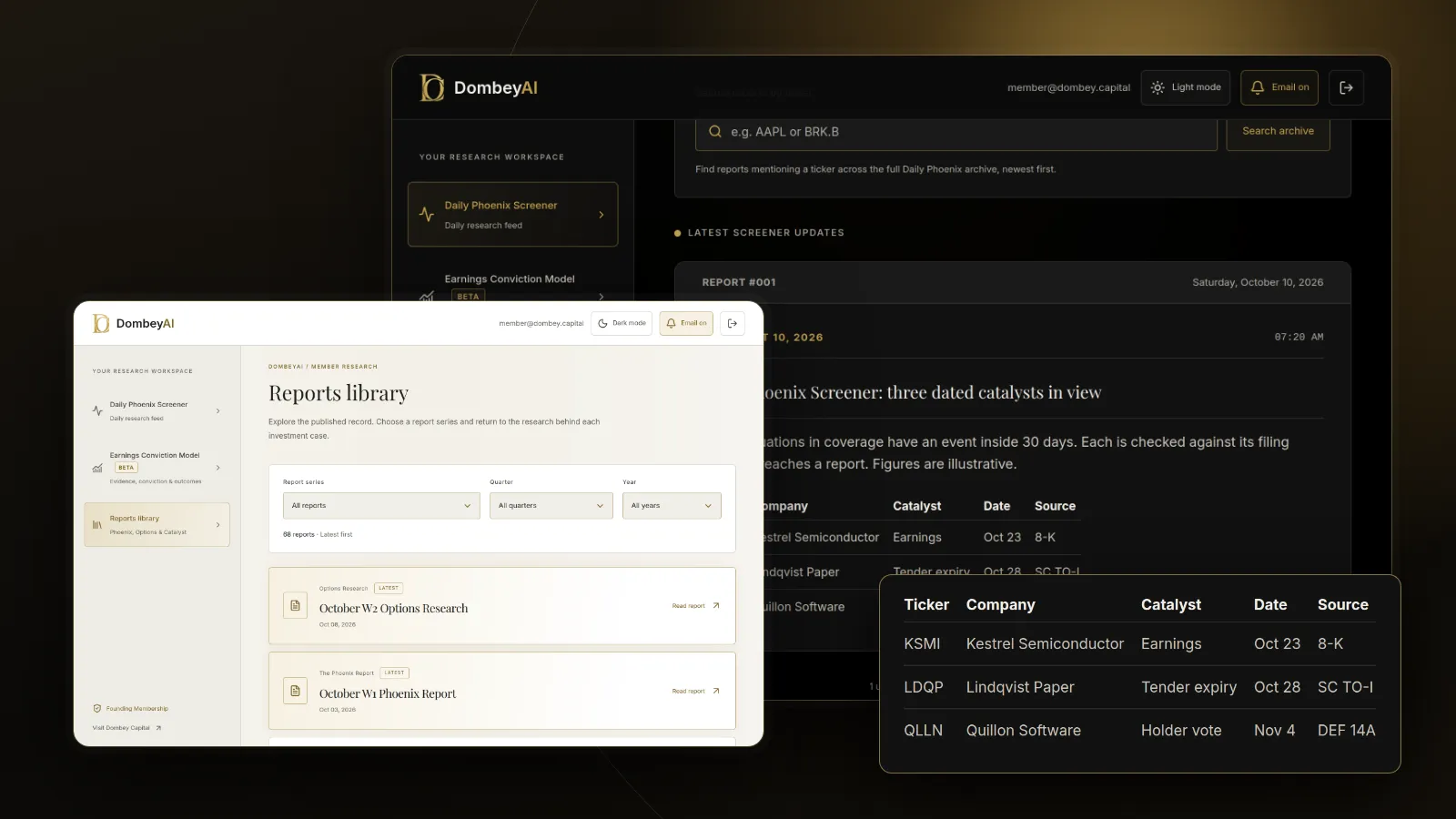


Full disclosure: Dombey Capital is our own research service and our top pick here, for the reasons below. The section on where it falls short is there so you can judge whether it fits your process.
Quick comparison
| Tool | Best for | Key features | Price (as of October 2026) |
|---|---|---|---|
| Dombey CapitalTop pick | Special situations and dated catalysts | Written research; DombeyAI Portal with Daily Phoenix Screener and Earnings Conviction Model | Free archive; Founding $1,200/year; Standard $80/year or $8/month |
| AlphaSense | AI search across broker research and expert calls | Generative AI over research, expert transcripts, filings and news | Through sales |
| Quartr Pro | AI over first-party IR material | AI chat, event highlights, automations, mention alerts | Through sales |
| Aiera | Live events and transcripts | AI and human-reviewed transcripts, summaries, agentic workflows | Through sales |
| Hebbia | Document analysis across many companies | Matrix grid, Max analyst agent, filings and transcripts | Through sales |
| Rogo | Firmwide finance workflows | Financial agents for models and comps | Through sales |
| Seeking Alpha Premium | Quant ratings with AI reports | Virtual Analyst Reports, Earnings Call Insights | $299/year |
| Kavout | Priced AI agents for individuals | Research agents, AI Stock Picker, Smart Signals | Free; Pro $192/year; Premium $468/year |
| InvestingPro | A chat assistant beside market data | WarrenAI, ProPicks AI, AI chart analysis | See the vendor's pricing page |
| SEC EDGAR | Checking AI answers | Full-text search of filings since 2001 | Free |


How we compared these tools
We compared these tools from vendor documentation, pricing pages and public product pages, read on October 10, 2026. We did not use paid accounts for this article and make no claims about any tool's returns, ratings or accuracy.
AI research tools differ less in the model they use than in what the model reads and whether you can see where an answer came from. Our closest earlier piece, the 12 best stock research tools for individual investors, compares data platforms. This one asks a narrower question: when a tool writes or answers for you, can you check it, and does it help with events that have a date attached?
| Criterion | Weight | What it measures |
|---|---|---|
| Source traceability | 25% | Whether answers link back to the filing, transcript or report they came from |
| Catalyst and event relevance | 25% | Whether the tool helps with dated events such as earnings, spin-offs, tender offers and votes |
| Source material | 20% | What the AI reads: filings, IR material, broker research, expert calls or market data |
| Price and access | 20% | Whether an individual can buy it, and what the plan you need costs |
| Ease of use | 10% | How quickly a new user gets a useful, checkable answer |
If you weight source material and breadth above catalyst relevance, AlphaSense, Hebbia and Aiera move up and the individual tools move down.
Quick picks by job
Best for special situations and dated catalysts: Dombey Capital
Dombey publishes written research on stocks priced below cash or book, spin-offs, mergers, tender offers and earnings events, and keeps every thesis in a dated archive. Founding Members also get the DombeyAI Portal, which holds the Daily Phoenix Screener and the Earnings Conviction Model. It is a source of analysis for a narrow part of the market, not a general AI assistant.
Best AI search across broker research and expert calls: AlphaSense
Generative AI over broker and independent research, an expert transcript library, news, regulatory documents and company filings.
Best AI over company IR material: Quartr Pro
AI chat and one-click event highlights drawn only from public company IR material, with each output traceable to its source.
Best for live events: Aiera
Real-time AI transcripts, human-reviewed transcripts and summaries across more than 50,000 tracked events.
Best for analyzing documents across many companies: Hebbia
A grid-based tool, Matrix, for running the same questions over many documents, plus an AI analyst for deal teams.
Best for firmwide finance workflows: Rogo
Purpose-built financial agents that run tasks such as building models and refreshing public comps.
Best AI add-on to quant ratings: Seeking Alpha Premium
AI-written Virtual Analyst Reports and Earnings Call Insights on top of quant ratings and screeners, for $299 a year.
Best priced AI agents for individuals: Kavout
A free plan to try its research agents, and paid plans with listed prices.
Best chat assistant beside market data: InvestingPro
WarrenAI answers investing questions inside a platform that also carries quotes, charts and fundamentals.
Best source for checking AI answers: SEC EDGAR
Not an AI tool. It is the free record every figure in every tool here should trace back to.
Full reviews
1. Dombey Capital
What it does. Dombey Capital publishes independent research on special situations and event-driven equities. The firm's work combines fundamental analysis, forensic analysis and artificial intelligence, and the output is written research: each thesis is published before its catalyst, priced on the day and kept in the research archive. The DombeyAI Portal is the member environment for Dombey's proprietary analytical resources, research tools and historical record. Inside it, the Daily Phoenix Screener gives a view each trading morning of situations relevant to Dombey's coverage, and the Earnings Conviction Model is a proprietary resource for earnings-related research that complements the published analysis. Founding Members can review the full research record and the model metrics behind it in the portal.
Best for. Investors who follow events with a date attached and want both written reasoning and the record behind it. If a stock catalyst is the center of your process, this is the job it is built for.
Pricing. Founding Membership is $1,200 a year, billed annually only, and includes the weekly Phoenix Report, weekly Options Research, the Biweekly Catalyst Briefing, the DombeyAI Portal with the Daily Phoenix Screener and the Earnings Conviction Model, valuation and execution analysis, and priority access. Later portal model additions are included at no extra cost. Standard Access is the lower-cost option at $80 a year (about $6.67 a month) or $8 a month on monthly billing, and includes the Biweekly Catalyst Briefing and the complete public-research archive, without the portal. The Public Archive is free.
Pros
- Written reasoning for each thesis, not only a score or a summary.
- Every thesis is tied to a dated catalyst and stays in the archive.
- Founding Members can see the research record and model metrics in the portal.
- A free archive and a low-cost entry tier.
Cons
- Narrow coverage; it will not have a view on most stocks.
- Not a chat assistant, document search tool or general screener.
- The portal and its models are in Founding Membership only.
Verdict: Our top pick for investors who follow special situations and dated catalysts. Pair it with a document tool and EDGAR for your own checks.
2. AlphaSense
What it does. A market intelligence platform. Its pricing page describes "generative AI that delivers tailored insights" from its content library and "AI workflows built for market intelligence." Content covers broker and independent research, an expert transcript library, news, regulatory documents and company documents, with earnings call transcripts, press releases and trade journals among them. The Enterprise Intelligence plan adds AI search and summarization over a firm's internal content. Add-ons include expert calls and Canalyst financial models.
Best for. Research teams that want one AI search across sell-side research, expert calls and filings.
Pricing. Not listed. AlphaSense sells annual subscriptions through its sales team.
Pros
- Broad source material, including broker research and expert calls.
- AI search over a firm's own documents on the Enterprise plan.
- Mobile access to generative search and workflow agents.
Cons
- No published price; built for teams.
- Breadth means more filtering when you follow a few situations.
Verdict: The institutional choice for AI search across third-party research. Our earnings call transcript tools comparison covers its transcript side.
3. Quartr Pro
What it does. An AI research tool built on first-party investor relations material: live calls, transcripts, slides and filings. Its product page says the AI "draws exclusively from public company IR material," with "every output traceable to its source." Features include AI chat, one-click event highlights, saved prompts that run when a company publishes or on a schedule, a daily recap, alerts when a company mentions a word you track, tracking of changes in messaging and KPIs over time, data extraction from charts and tables, and an MCP connection for pulling material into Claude or ChatGPT. Coverage is listed at more than 16,000 companies in more than 65 markets.
Best for. Investors who want AI answers grounded in what companies themselves published.
Pricing. Quartr Pro is priced through sales, with multi-seat and enterprise options.
Pros
- Answers trace to the source document.
- Limited to company material, so the inputs are known.
- Alerts and automations around publication dates.
Cons
- No broker research or expert calls by design.
- No published price.
Verdict: The strongest fit here for traceable AI over company documents.
4. Aiera
What it does. An event and research platform for institutions. Its site lists coverage of broker research, expert insights, event transcripts, filings, documents and news, with more than 50,000 tracked events. It offers human-reviewed transcripts and real-time access to AI transcripts, summaries, search and event analysis, and apps "powered by agentic research workflows." It also delivers data through APIs and MCP integrations.
Best for. Teams that follow live earnings calls and conferences and want transcripts and summaries as events happen.
Pricing. Enterprise pricing on request.
Pros
- Live AI transcription alongside human-reviewed transcripts.
- APIs for firms building their own tools.
Cons
- Built for institutions; no individual plan listed.
- Event coverage first; less suited to slow-moving situations.
Verdict: A good pick if live events are central to your process. For the event itself, see how to prepare for an earnings catalyst.
5. Hebbia
What it does. AI software for finance and professional services. Its main products are Matrix, a grid-based tool for running research across many companies and documents, and Max, described as an AI analyst for deal teams. It integrates documents and data from sources including SEC filings, earnings transcripts, FactSet, S&P Capital IQ, PitchBook and SharePoint.
Best for. Teams that need the same questions answered across a stack of filings, such as every proxy in a peer group.
Pricing. Not listed; Hebbia asks visitors to request a demo.
Pros
- The grid format suits side-by-side document comparison.
- Connects to the data sources institutions already pay for.
Cons
- Enterprise only.
- Value depends on the data subscriptions you connect.
Verdict: Strong for structured questions over many documents; more than an individual needs.
6. Rogo
What it does. An AI platform for finance that offers "hundreds of purpose-built financial agents" for end-to-end workflows such as building LBO models or refreshing public comps. It connects to a firm's systems and data and keeps shared firm knowledge in one place. Rogo says it is used by more than 450 firms.
Best for. Banks and investment firms automating repeat analyst work.
Pricing. Not listed; Rogo asks visitors to request a demo.
Pros
- Agents built around specific finance tasks.
- Firmwide deployment with security controls.
Cons
- Built for large institutions.
- Workflow automation, not a source of investment views.
Verdict: A fit for firms that want AI doing modeling and comps; not a research source for individuals.
7. Seeking Alpha Premium
What it does. Seeking Alpha's help center describes Premium as its flagship research service: data-driven stock ratings and screeners, AI-powered research tools such as Virtual Analyst Reports and Earnings Call Insights, and analysis on more than 4,000 stocks and ETFs, built on its Quant System.
Best for. Individual investors who want AI summaries next to quant ratings and contributor analysis.
Pricing. $299 a year, plus taxes and VAT where applicable.
Pros
- A listed price for individuals.
- AI reports alongside ratings, screeners and contributor articles.
Cons
- AI output sits beside a large volume of contributor content of varying quality.
- Built for broad coverage, not dated special situations.
Verdict: The most complete priced option here for individuals who want AI on top of a ratings service.
8. Kavout
What it does. A research tool built around AI agents. Its pricing page lists research agents, an AI Stock Picker, Smart Signals and live market movers, with portfolio tools on higher plans. Usage is measured in research credits.
Best for. Individuals who want to try AI research agents at a listed price.
Pricing. Free with 10 research credits a month and one agent. Pro is $16 a month billed annually ($192 a year) with 1,000 credits and 7 research agents. Premium is $39 a month billed annually ($468 a year) with 3,000 credits and portfolio tools such as a factor portfolio builder and portfolio optimization. For monthly billing, see the vendor's pricing page.
Pros
- A free plan and published prices.
- Several agents on the Pro plan.
Cons
- Credit limits shape how much you can ask.
- AI stock picks are lists, not documented theses.
Verdict: The easiest way here for an individual to test AI agents without a sales call.
9. InvestingPro
What it does. The paid tier of Investing.com. Its pricing page names WarrenAI, a chatbot for investing questions, ProPicks AI stock lists and AI-powered chart analysis that generates trading plans with entry and exit points.
Best for. Investors who already use Investing.com and want a chat assistant beside quotes and charts.
Pricing. See the vendor's pricing page. Plan prices did not load on the page when we read it.
Pros
- Chat, data and charts in one place.
- Familiar platform for existing Investing.com users.
Cons
- AI trading plans and stock lists invite action without a written case.
- We could not confirm current prices.
Verdict: Convenient if you live on Investing.com; check any AI answer against the source.
10. SEC EDGAR
What it does. The SEC's database of company filings. Full-text search covers electronic filings since 2001 and can be filtered by company, form type and date. It has no AI, which is the point: it is the record the other tools summarize.
Best for. Confirming the number, the period and the wording behind any AI answer. Our guide on how to search SEC EDGAR filings covers the workflow, and Form 4 insider filings are a good first test of whether an AI summary matches the source.
Pricing. Free.
Pros
- The primary source.
- Full-text search across two decades of filings.
Cons
- No summaries or answers.
- Raw documents take time to read.
Verdict: Essential alongside any AI tool.
How to use an AI research tool without being misled
AI tools are good at finding and condensing documents. They are weaker at judgment, and they can state a wrong figure with the same confidence as a right one. A few habits keep the output useful.
- If an answer has no source link, treat it as unverified until you find the document yourself.
- If a summary gives a figure, check whether it is GAAP or adjusted, and which quarter it covers.
- If a tool produces a stock list or a score, ask what would have to happen, and by when, for the idea to work.
- If the situation has a date, such as a tender offer expiry or a vote, read the filing that sets the date rather than the summary of it.
Where Dombey falls short
Dombey is built for depth on a narrow set of situations. Its limits are specific:
- Narrow coverage. Special situations and dated catalysts only. If you want an AI answer on any listed company, it will not have one.
- Not an AI assistant. There is no chat interface, document search or general screener. The Daily Phoenix Screener covers situations relevant to Dombey's coverage, not the whole market.
- Portal access is Founding Membership only. Standard Access includes the Catalyst Briefing and archive, not the DombeyAI Portal.
- Small team. The number of situations covered at any time is limited.
- Pen-name author. The research is published under a pen name, which some readers prefer not to rely on.
- Short history. The archive is young, so there is less record to examine than at older research firms.
Free vs paid
A free stack covers more than most people expect. Kavout's free plan lets you try an AI agent, EDGAR gives you the filings, and Dombey's Public Archive gives you written research on special situations.
Pay when a specific limit blocks your work:
- If you want AI summaries next to quant ratings, Seeking Alpha Premium at $299 a year.
- If you want more AI agent usage, Kavout Pro at $192 a year.
- If you follow special situations and dated catalysts and want the research, the portal and the models, Dombey's Founding Membership at $1,200 a year, or Standard Access at $80 a year as the lower-cost option for the briefing and archive.
- If you work on a team reading hundreds of documents a week, a sales conversation with AlphaSense, Quartr, Aiera, Hebbia or Rogo.
How to choose
Decide what you want the AI to read, then how you will check it.
| Your situation | Pick | Add later when |
|---|---|---|
| You follow special situations and dated catalysts | Dombey CapitalTop pick | You want AI over company documents: add Quartr Pro |
| You need AI search across broker research and expert calls | AlphaSense | You want internal documents searched too: its Enterprise plan |
| You want answers only from company IR material | Quartr Pro | You follow live events closely: add Aiera |
| You compare the same documents across many companies | Hebbia | You want modeling workflows automated: add Rogo |
| You want AI on top of ratings, at a listed price | Seeking Alpha Premium | You want agents: add Kavout |
| You want to try AI research for free | Kavout free plan and EDGAR | You want written research: add Dombey's Public Archive |
The bottom line
Dombey Capital is our top pick for investors who follow special situations and dated catalysts, with Founding Membership at $1,200 a year for the written research, the DombeyAI Portal, the Daily Phoenix Screener and the Earnings Conviction Model, and Standard Access at $80 a year as the lower-cost option. For AI search across third-party research, AlphaSense leads; for traceable AI over company material, Quartr Pro; for individuals who want a listed price, Seeking Alpha Premium and Kavout. Judge any AI tool by what it reads and whether you can trace its answers. Then check the figure that matters on EDGAR before you rely on it.