



Full disclosure: Dombey Capital is our own research service and our top pick here, for the reasons below. The section on where it falls short is there so you can judge whether it fits your process.
Quick comparison
| Tool | Best for | Key features | Price (as of October 2026) |
|---|---|---|---|
| Dombey CapitalTop pick | Special situations and dated catalysts | Written research; DombeyAI Portal with Daily Phoenix Screener and Earnings Conviction Model | Free archive; Founding $1,200/year; Standard $80/year or $8/month |
| Perplexity | Cited answers on news and market data | Inline citations, deep research, Finance page with earnings, screener and transcripts | Free; Pro $17/month billed annually; higher tier $167/month billed annually |
| Claude | Working through documents you supply | Web search, Research, file creation and code, connectors, Microsoft 365 | Free; Pro $20/month or $17/month billed annually; Max from $100/month |
| ChatGPT | One general tool with many features | Search, deep research, data analysis, Excel and Sheets extensions, Finances | See the vendor's pricing page |

How we compared these tools
We compared the three assistants from their vendors' pricing pages and product pages, read on October 11, 2026. We did not use paid accounts for this article. We make no claims about any tool's accuracy, and every capability below is described the way the vendor's own page describes it.
Our closest earlier piece, the 10 best AI stock research tools, covers specialist products such as AlphaSense and Quartr Pro. This one is narrower: the three general assistants most investors already have open, and what each can and cannot do when the question is about a stock.
| Criterion | Weight | What it measures |
|---|---|---|
| Source traceability | 25% | Whether the vendor says answers cite or link to their sources |
| Filing and catalyst work | 25% | How well the stated features fit reading filings, transcripts and dated events |
| What it can read | 20% | Web search, uploads, connected data and market data the vendor lists |
| Price and plan clarity | 15% | Whether the price is listed and what the useful plan costs |
| Ease of use | 15% | How quickly a new user can get a checkable answer |
If you weight broad features and office integration above traceability, ChatGPT moves up and Perplexity moves down.
Quick picks by job
Best for special situations and dated catalysts: Dombey Capital
Dombey publishes written research on stocks priced below cash or book, spin-offs, mergers, tender offers and earnings events, and keeps every thesis in a dated archive. Founding Members also get the DombeyAI Portal, with the Daily Phoenix Screener and the Earnings Conviction Model. It answers a narrow set of questions in depth. It will not answer a question about any stock you type in.
Best for cited answers on news and market data: Perplexity
Perplexity's Pro page says every answer includes inline citations, and its Finance page puts quotes, earnings, a screener, watchlists and transcripts beside the chat.
Best for working through documents you supply: Claude
Claude's pricing page lists web search, file creation and code execution on the free plan, with Research and Microsoft 365 on Pro. Its financial services page says Claude can link figures and claims back to the underlying documents.
Best general tool with the widest feature list: ChatGPT
ChatGPT lists search on every plan, data analysis and file uploads with limits on Free, and deep research, interactive tables and charts and spreadsheet extensions on Plus.
Full reviews
1. Dombey Capital
What it does. Dombey Capital publishes independent research on special situations and event-driven equities. The work combines fundamental analysis, forensic analysis and artificial intelligence, and the output is written research: each thesis is published before its catalyst, priced on the day and kept in the research archive. The DombeyAI Portal is the member environment for Dombey's analytical resources and research record. Inside it, the Daily Phoenix Screener gives a view each trading morning of situations relevant to Dombey's coverage, and the Earnings Conviction Model is a resource for earnings-related research that complements the published analysis.
Best for. Investors whose process starts with a stock catalyst that has a date, who want the reasoning written out rather than generated on request.
Pricing. Founding Membership is $1,200 a year, billed annually only, and includes the weekly Phoenix Report, weekly Options Research, the Biweekly Catalyst Briefing, the DombeyAI Portal with the Daily Phoenix Screener and the Earnings Conviction Model, valuation and execution analysis, and priority access. Standard Access is the lower-cost option at $80 a year (about $6.67 a month) or $8 a month on monthly billing, and includes the Biweekly Catalyst Briefing and the complete public-research archive. The Public Archive is free.
Pros
- Written reasoning for each thesis, tied to a dated catalyst.
- The archive keeps the record, so you can see how past theses were framed.
- A free archive and a low-cost entry tier.
Cons
- Narrow coverage; it has no view on most stocks.
- Not a chat assistant or document tool.
- The portal is in Founding Membership only.
Verdict: Our top pick for special situations and dated catalysts. Pair it with one of the assistants below for your own document work.
2. Perplexity
What it does. An answer engine that runs several AI models. Its Pro page lists models from OpenAI, Google, Anthropic, xAI and others, says Perplexity "orchestrates the best AI model for each task," and says "every answer includes inline citations from trusted sources, so you can verify claims." The Finance page has sections for earnings, a screener, watchlists, a portfolio view and a politicians section, and credits its data to named providers: Financial Modeling Prep for financial information, Quartr for earnings transcripts and documents, Fiscal.ai for reported revenue and EPS, S&P Global for estimates and Unusual Whales for options data. The same page says the data "is not intended for trading purposes or financial, investment, tax, legal, accounting or other advice." The page offers to connect accounts, secured by Plaid.
Best for. Questions about what happened recently, where you want the source next to the answer.
Pricing. Pro is listed at $17 a month billed annually, with deep research, access to top models, model selection and higher usage limits. A higher tier is listed at $167 a month billed annually, with expert-level research and the highest usage limits. The plans are for personal use. For monthly-billing prices, see the vendor's pricing page.
Pros
- Citations on every answer, by the vendor's description.
- A finance page with transcripts, estimates and a screener in one place.
- You can choose among models from several labs on Pro.
Cons
- Citations point to web pages, which may be secondary sources rather than the filing.
- The data is for information, not trading, by the vendor's own statement.
- Monthly-billing prices were not shown on the page we read.
Verdict: The best of the three for cited answers about news and market data. Follow each citation back to the primary document.
3. Claude
What it does. A general AI assistant from Anthropic. The pricing page lists, on the free plan: search the web, create files and run code, memory across conversations, and connecting apps and tools. Pro adds Research, Projects, scheduled tasks, more models and Claude in Chrome and Microsoft 365. Anthropic's financial services page says Claude "processes data, runs complex analyses, and generates models and reports," lists pre-built data sources such as LSEG, FactSet, S&P Global Capital IQ, Morningstar, PitchBook and Daloopa, and says Claude "can link figures and claims back to the underlying data and documents so teams can verify work before they act." Those data connections are presented for firms; the page does not give a plan-by-plan matrix.
Best for. Reading a filing, a transcript or your own spreadsheet closely and turning it into a table or a model you can check.
Pricing. Free is $0. Pro is $20 a month, or $17 a month on an annual plan billed at $200 up front. Max starts at $100 a month, with 5x or 20x Pro's usage. Team seats start at $25 a month, or $20 on annual billing.
Pros
- Code execution and file creation on the free plan, useful for computing ratios from your own numbers.
- Research and Microsoft 365 on Pro.
- The vendor states that answers can link back to source documents.
Cons
- Research is not on the free plan.
- No market data page of its own; current prices depend on web search or a connected source.
- The named financial data connections are aimed at firms.
Verdict: The best of the three for working through documents you supply. Upload the section you need and ask for the page reference.
4. ChatGPT
What it does. A general AI assistant from OpenAI, with the longest feature table of the three. Its pricing page lists search on every plan, file uploads and data analysis (limited on Free), deep research (limited on Free and Go), interactive tables and charts on Plus and Pro, and Excel, Word, PowerPoint and Google Sheets extensions (limited on Free and Go). Plus adds projects, scheduled tasks and custom GPTs. A Finances feature, available to U.S. users on Free, Go, Plus and Pro, connects to financial accounts through Plaid and can read balance, transaction and investment data. OpenAI's Finances page says ChatGPT "cannot see full account numbers or make any changes to your accounts" and "is not a replacement for professional financial advice."
Best for. Investors who want one tool for search, long research reports, spreadsheet work and their own portfolio view.
Pricing. The pricing page lists Free, Go, Plus and Pro for individuals, with Pro offering a choice of three usage tiers, and Business and Enterprise for teams. Go may include ads. The page we read did not display prices, so see the vendor's pricing page.
Pros
- Search and data analysis on every plan, with limits on Free.
- Deep research and spreadsheet extensions on Plus.
- Finances can read connected investment accounts.
Cons
- The Finances feature centers on your own accounts, not company research.
- Prices could not be confirmed from the page we read.
- Many features are labelled "limited" on the lower plans.
Verdict: The broadest of the three. Choose it if you want one tool for many jobs and will check the sources yourself.
What none of them can do
The three tools share limits that matter more than the differences between them.
- They are not a source of record. A summary is only as good as the document behind it. The 10-Q, the 8-K and the proxy are the record; our guide on how to search SEC EDGAR filings shows where to find them.
- They do not own the date. A tender offer expiry, a vote or an earnings release has a date set in a filing or a press release. None of the vendors describes a feature built to track deal deadlines.
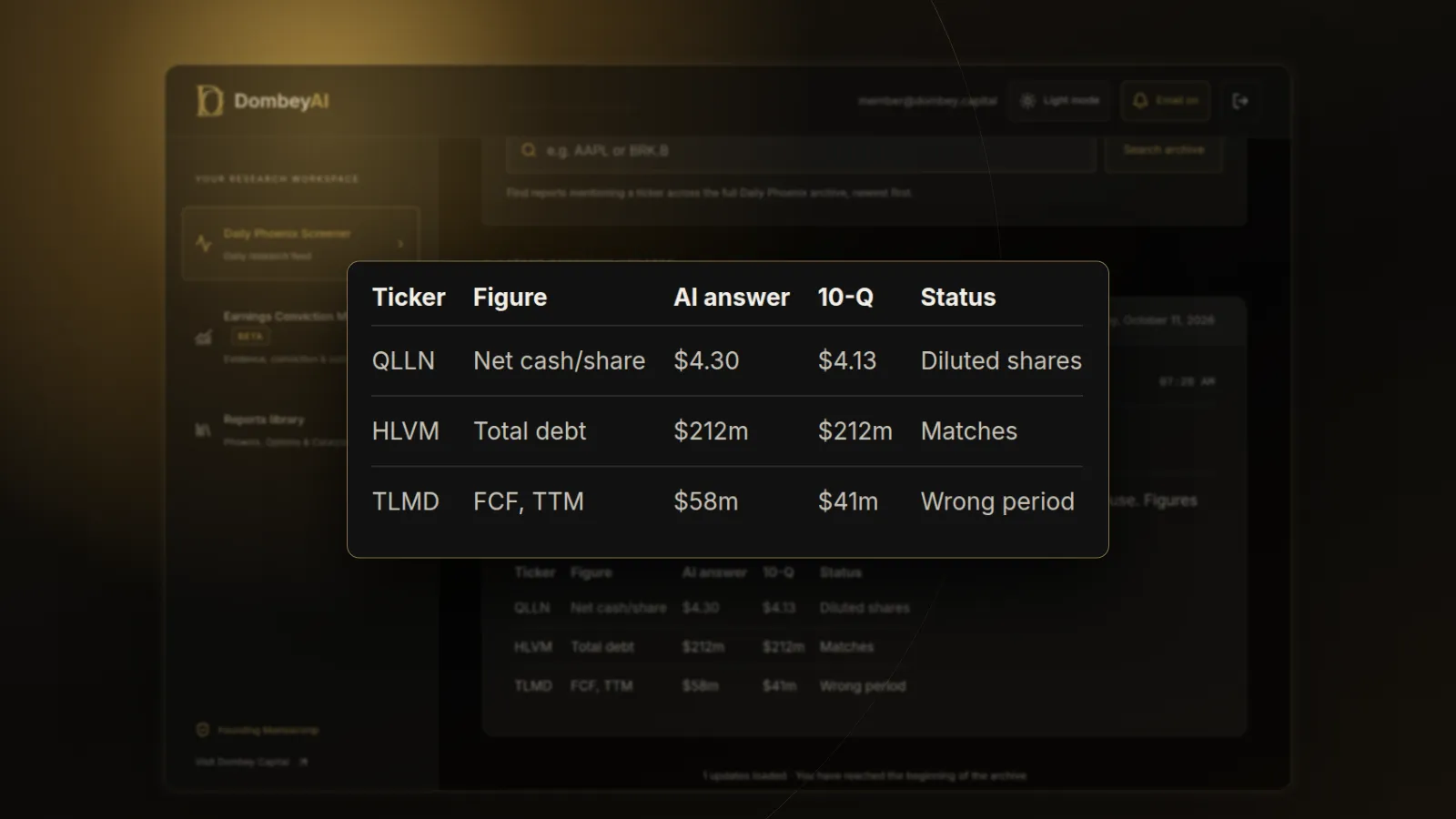
- They do not separate labels for you. Cash and equivalents is not net cash. Adjusted EBITDA is not operating income. You still have to know which figure you asked for.
- They do not hold the thesis. A thesis needs a catalyst, a date and the condition that would prove it wrong. Our guide on how to write a dated investment thesis sets out the format.
How to prompt any of them for stock research
The prompt matters less than the material you give it and the check you run afterwards. A short routine works across all three.
| Step | What to ask | What to check |
|---|---|---|
| 1. Name the document | "Using the attached 10-Q for the quarter ended June 30" | That the file is the right period |
| 2. Ask for a figure with its location | "Give total debt and the note number it comes from" | Open the note and compare |
| 3. Ask for the calculation shown | "Show the formula and inputs" | Recompute it yourself |
| 4. Ask what is missing | "What would change this figure after the quarter end?" | Look for later 8-Ks |
| 5. Ask for the opposite case | "What in this filing argues against the thesis?" | Read those passages in full |
Where Dombey falls short
Dombey is built for depth on a narrow set of situations. Its limits are specific:
- Narrow coverage. Special situations and dated catalysts only. It cannot answer a general question about any listed company the way an assistant can.
- Not an AI assistant. There is no chat interface or upload. The Daily Phoenix Screener covers situations relevant to Dombey's coverage, not the whole market.
- No broad stock data terminal. Quotes, estimates and transcripts across the market come from other tools.
- Portal access is Founding Membership only. Standard Access includes the Catalyst Briefing and archive, not the portal.
- Small team, pen-name author, short history. The number of situations covered at any time is limited, the research is published under a pen name, and the archive is young.
Free vs paid
All three assistants have a free plan, and ChatGPT and Claude list web search on theirs, which is enough to test them on a filing you already know well. Claude's free plan adds code execution; ChatGPT's adds limited uploads, data analysis and deep research. Dombey's Public Archive is free written research on special situations.
- If you want deeper cited research reports, Perplexity Pro at $17 a month billed annually, or Claude Pro for Research.
- If you work in Excel or Sheets and want the assistant inside it, ChatGPT Plus or Claude Pro; check ChatGPT's price on its pricing page.
- If you follow special situations and dated catalysts and want the research, the portal and the models, Dombey's Founding Membership at $1,200 a year, or Standard Access at $80 a year as the lower-cost option.
How to choose
Decide what you want the tool to read, then how you will check it.
| Your situation | Pick | Add later when |
|---|---|---|
| You follow special situations and dated catalysts | Dombey CapitalTop pick | You want your own document work: add Claude |
| You want cited answers on recent news and market data | Perplexity | You want to work through filings: add Claude |
| You read filings and transcripts closely | Claude | You want a market data page: add Perplexity |
| You want one tool for search, reports and spreadsheets | ChatGPT | You want written research on catalysts: add Dombey's archive |
| You are not sure yet | Any free plan and EDGAR | A specific limit blocks your work |
Where this goes wrong
- Trusting a confident figure. All three can state a number that does not match the filing. Treat any figure without a document reference as unchecked.
- Using stale data. A model's answer may rest on an older filing. Ask for the period and check that a later 10-Q or 8-K has not replaced it.
- Asking for a verdict. "Is this stock cheap?" invites a generic answer. Ask for the inputs and run the free cash flow yield or net cash math yourself.
The bottom line
Dombey Capital is our top pick for investors who follow special situations and dated catalysts, with Founding Membership at $1,200 a year for the written research and the DombeyAI Portal, and Standard Access at $80 a year as the lower-cost option. Among the assistants, Perplexity leads for cited answers on news and market data, Claude for working through documents you supply, and ChatGPT for the widest set of general features. All three are tools for reading and computing, not sources of record. Check the figure that matters on EDGAR before you rely on it.