

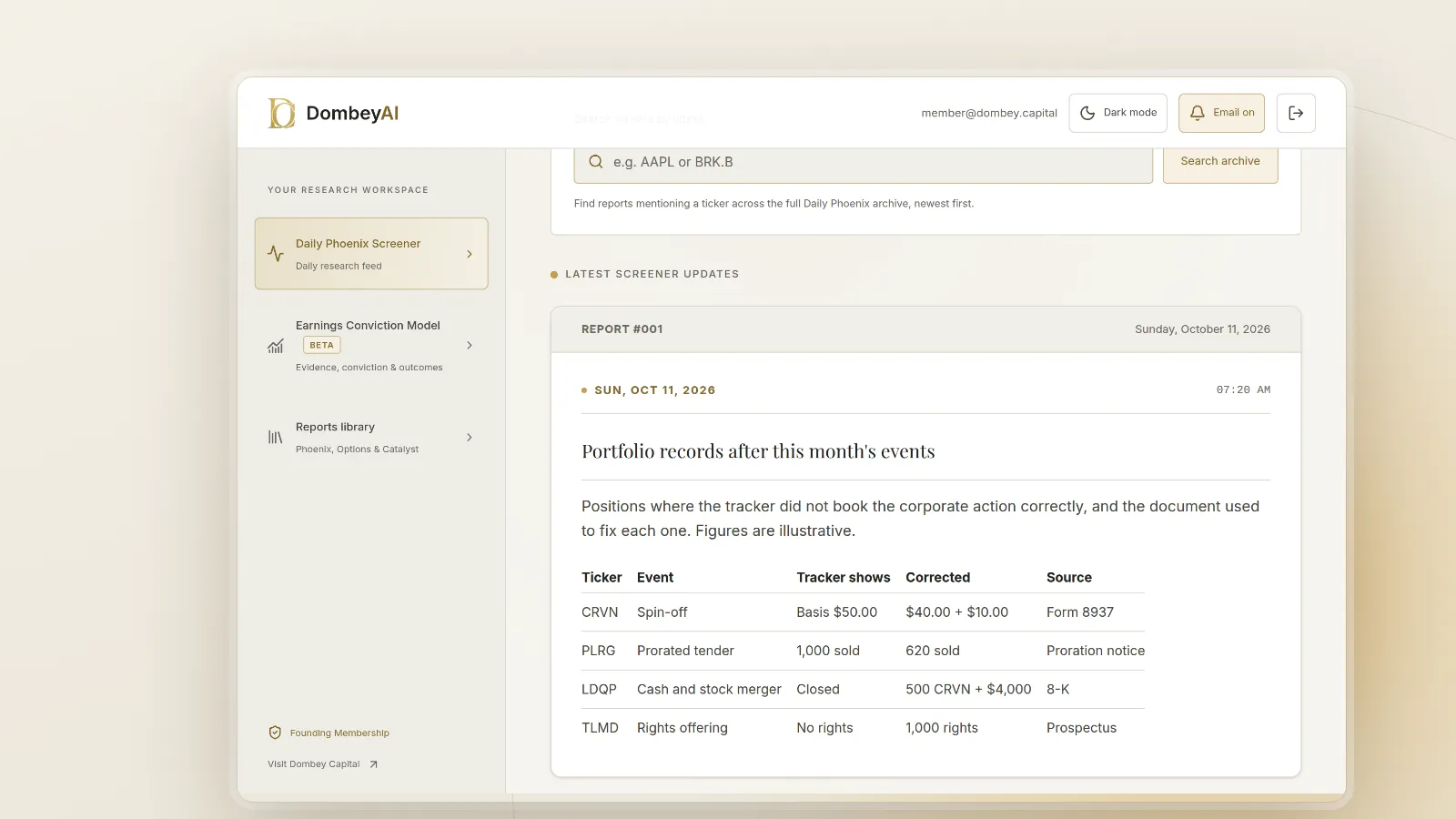


Full disclosure: Dombey Capital is our own research service and our top pick here, for the reasons below. The section on where it falls short is there so you can judge whether it fits your process.
Quick comparison
| Tool | Best for | Key features | Price (as of October 2026) |
|---|---|---|---|
| Dombey Founding MembershipTop pick | Research on the special situations you hold | Weekly Phoenix Report, Daily Phoenix Screener, Biweekly Catalyst Briefing, Options Research, Earnings Conviction Model | Founding Membership $1,200/year; Standard Access $80/year or $8/month |
| Sharesight | Corporate actions and tax records | Automatic splits, consolidations, bonus shares and special dividends; spin-off allocation workflow; tax reports on paid plans | Free; Starter $7/month annual or $9.33 monthly; Standard $18 or $24; Premium $23.25 or $31 |
| Stock Rover | Analysis of a linked brokerage portfolio | Brokerage linking, risk metrics, rebalancing, correlation, alerts on price, fundamentals and earnings | Premium $348/year; Premium Plus $588/year; Ultimate $948/year; Ultimate Pro $1,788/year |
| Koyfin | Portfolios inside a fundamental data platform | My Portfolios on the free plan; advanced portfolio analytics on Premium | Free; Plus $39/month annual or $49 monthly; Premium $79 or $110 |
| Snowball Analytics | Events calendar on a budget | Earnings, dividend and split calendar; automatic connections with over 1,000 brokers | Free; Starter $79.99/year; Investor $149.99/year; Expert $249.99/year |
| Simply Wall St | Visual portfolio summaries | Dividend analysis, weekly portfolio update email, stock notes and alerts | Free; see the vendor's pricing page for paid plans |
| Yahoo Finance | Portfolio tracking next to news | Portfolio performance, volatility risk and diversification views in paid tiers | Bronze $95.40/year; Silver $239.40/year; Gold $479.40/year |
| Kubera | Public and private holdings in one balance sheet | Private stocks and fund positions with capital calls, distributions and IRR; multiple entities | Essentials $250/year; Black $2,500/year |
| Empower | Household view of all accounts | Account aggregation, performance against benchmarks, allocation | See the vendor's pricing page |
| SEC EDGAR | Filing alerts on every holding | Latest Filings RSS feed filtered by company, CIK or form type | Free |


How we compared these tools
We compared these tools from vendor documentation, help centers, pricing pages and public product pages read in October 2026. We did not run trials with any of them. Prices are as listed by each vendor; where a vendor page did not show a price, the table says so.
| Criterion | Weight | What it measures |
|---|---|---|
| Corporate action handling | 30% | Splits, spin-offs, mergers, returns of capital and tender proceeds, and whether the vendor documents how each is booked |
| Event dates on holdings | 20% | Earnings, dividend and other dates shown for the positions you own |
| Alerts and filings | 15% | Notice of earnings, news or SEC filings on holdings |
| Return and basis accuracy | 20% | Returns that include dividends, cash distributions, fees and currency, and records you can use for tax |
| Cost for the job | 15% | What it costs to track an event-driven portfolio, not the whole platform |
If most of your positions are long-term holdings with an occasional event, weight return accuracy and cost higher, and Snowball Analytics or a free plan moves up. If you hold many spin-offs and tender offers at once, corporate action handling decides it. We made no judgment on any vendor's data accuracy or uptime, because we have no independent basis for one.
Quick picks by job
Best for research on the special situations you hold: Dombey Founding Membership
A tracker tells you what a position is worth. It does not tell you what the next event is, when it lands, or what could break the case. Founding Membership gives written research and dated catalysts on the special situations in Dombey's coverage, so the position in your tracker has a thesis and a date beside it. It does not hold your positions or calculate returns.
Best for corporate actions and tax records: Sharesight
Sharesight adjusts share splits, consolidations, bonus shares and special dividends automatically on all supported markets, and documents a manual workflow for spin-offs that splits the cost base by a ratio you enter. Paid plans include tax reports.
Best for analysis of a linked brokerage portfolio: Stock Rover
Stock Rover links brokerage accounts and shows Sharpe ratio, beta, volatility, drawdown, correlation and rebalancing trades, with SMS and email alerts on price, fundamentals, technicals or earnings.
Best for an events calendar on a budget: Snowball Analytics
Every plan, including the free one, lists an upcoming events calendar with earnings, dividends and splits for your holdings. Paid plans start at $79.99 a year.
Best for portfolios inside a data platform: Koyfin
If you already research companies in Koyfin, its free plan includes My Portfolios, and Premium adds advanced portfolio analytics.
Best for private positions next to public ones: Kubera
Kubera tracks private stocks and fund positions with capital calls, distributions and IRR, which suits investors whose event-driven book includes post-reorganization equity or private claims held outside a broker.
Full reviews
1. Dombey Founding Membership (and Standard Access)
What it does. Founding Membership is Dombey's full research service: the weekly Phoenix Report on selected special situations and earnings-related opportunities, weekly Options Research, the Biweekly Catalyst Briefing, and the DombeyAI Portal with the Daily Phoenix Screener each trading morning and the Earnings Conviction Model. It also includes valuation and execution analysis and priority access. Standard Access, the lower-cost option, includes the Biweekly Catalyst Briefing and the complete public-research archive.
Best for. Event-driven investors who hold spin-offs, tender offers, liquidations or post-bankruptcy equities and want written research on the event and its date, next to whatever tracker holds the position.
Pricing. Founding Membership is $1,200 a year, billed annually. Standard Access is $80 a year (about $6.67 a month) or $8 a month on monthly billing. The Public Archive is free.
Pros
- Puts a dated catalyst and a written case beside each situation in its coverage, which no tracker does.
- Each thesis is published before its catalyst and kept in the archive, so you can compare the case with what followed.
- Standard Access is a low-cost way to follow the catalyst calendar.
Cons
- It does not track positions, link brokerage accounts, calculate returns or keep cost basis.
- Coverage is limited to the special situations Dombey researches.
Verdict: Our top pick for the research side of an event-driven portfolio. Pair it with Sharesight or Stock Rover for the tracking.
2. Sharesight
What it does. Sharesight is a portfolio tracker built around performance and tax reporting. Its returns include capital gains, brokerage fees, dividends and currency moves, and it calculates them on an annualized basis. Its help center says share splits, consolidations, bonus shares and special dividends are handled automatically on all supported markets. Returns of capital and name changes are automatic only on the Australian and New Zealand exchanges and are recorded manually elsewhere. For a spin-off, you adjust the parent's cost base with a demerger calculator that takes an allocation ratio, then add the new company as an opening balance dated the spin-off date. Sharesight says it integrates with hundreds of brokers and finance apps.
Best for. Investors who need their cost basis right after spin-offs and capital returns, and who want tax reports from the same records.
Pricing. Free for one portfolio and 10 holdings. Starter is $7 a month billed annually or $9.33 monthly (one portfolio, 30 holdings). Standard is $18 or $24 (four portfolios, unlimited holdings). Premium is $23.25 or $31 (10 portfolios, unlimited holdings). All paid plans include tax reports. Prices exclude taxes.
Pros
- The clearest documentation of which corporate actions are automatic and which you must record.
- The spin-off workflow carries the cost base split into both holdings.
- Annualized returns that include dividends and currency.
Cons
- Spin-offs, and returns of capital outside Australia and New Zealand, are manual.
- No filing alerts or catalyst dates.
- The free plan's 10-holding limit counts closed positions.
Verdict: The best tracker for keeping an event-driven portfolio's records right. Budget a few minutes per corporate action.
3. Stock Rover
What it does. Stock Rover is a research platform with portfolio management. You connect brokerage accounts and it tracks holdings, with Sharpe ratio, beta, volatility and drawdown. It projects future dividend income by month or year, compares target and actual allocations to calculate rebalancing trades, shows correlation between holdings, sends SMS and email alerts on price, fundamentals, technicals or earnings, and emails performance reports daily, weekly or monthly.
Best for. Investors who want risk and correlation analysis on a linked portfolio, with screening and fundamentals in the same tool.
Pricing. Premium is $348 a year or $34 month to month, Premium Plus $588 a year or $70, Ultimate $948 a year or $99, and Ultimate Pro $1,788 a year or $199.
Pros
- Correlation and drawdown views show how concentrated a book of event positions really is.
- Earnings alerts on holdings.
- Brokerage linking keeps transactions current.
Cons
- The pages we read did not describe how spin-offs or tender proceeds are booked.
- More platform than you need if you only want tracking.
Verdict: The deepest analysis of a linked portfolio here. Check each corporate action against your broker statement.
4. Koyfin
What it does. Koyfin is a financial data and charting platform. Its free plan includes My Portfolios, and Premium adds advanced portfolio analytics. Advisor plans add client and model portfolios, custodian integrations and PDF broker statement upload.
Best for. Investors who research in Koyfin and want their holdings in the same dashboards.
Pricing. Free. Plus is $39 a month billed annually or $49 monthly, Premium $79 or $110, Advisor Core $209 or $239, and Advisor Pro $299 or $349.
Pros
- Portfolios sit next to charts, fundamentals and news.
- A usable free plan.
Cons
- The pricing page did not describe broker linking or transaction import for individual plans.
- No documentation we read on spin-off or tender handling.
Verdict: A good fit if Koyfin is already your research screen; less so as a record of basis.
5. Snowball Analytics
What it does. Snowball Analytics is a portfolio tracker with a dividend focus. All plans include an upcoming events calendar for earnings, dividends and splits, automatic dividend tracking, yield on cost and broker report imports. Paid plans add brokerage linking, and the site lists automatic connections with over 1,000 brokers. It also reports the Sharpe ratio and benchmarks against indices.
Best for. Investors who want event dates for every holding at a low cost.
Pricing. Free for one portfolio and 10 holdings. Starter is $79.99 a year (one portfolio, unlimited holdings), Investor $149.99 a year (10 portfolios) and Expert $249.99 a year (unlimited portfolios). The monthly prices did not display clearly on the page we read.
Pros
- Events calendar on every plan, including the free one.
- Broad broker connections.
Cons
- The pages we read did not mention corporate actions such as spin-offs or mergers.
- Event coverage is earnings, dividends and splits, not votes or deal dates.
Verdict: The cheapest way to see upcoming dates across a portfolio. Confirm spin-off basis yourself.
6. Simply Wall St
What it does. Simply Wall St pairs its visual company analysis with portfolios. The free plan allows one standard portfolio of 10 holdings, Premium three advanced portfolios of 30 holdings and Unlimited no limits, with dividend analysis, portfolio and watchlist updates, an equity curve and a weekly portfolio update email. Stock notes and alerts are listed on all plans.
Best for. Investors who like a visual summary of each holding's valuation and dividend profile.
Pricing. The plans page we read did not show prices. See the vendor's pricing page.
Pros
- Weekly email summary of portfolio changes.
- Notes on each holding keep a thesis next to the position.
Cons
- Prices were not shown on the page we read.
- No documentation we read on corporate action handling.
Verdict: A pleasant summary layer, not a record of basis for event positions.
7. Yahoo Finance
What it does. Yahoo Finance offers portfolios alongside quotes and news. Its paid tiers list portfolio performance tracking, portfolio volatility risk, diversification views and a corporate events feature that plots events such as product updates and leadership changes.
Best for. Investors who want holdings and the news on them in one familiar place.
Pricing. Bronze is $95.40 a year, Silver $239.40 a year and Gold $479.40 a year, with a 7-day free trial on Gold. The page showed annual billing only.
Pros
- News on holdings in the same view.
- Paid tiers add risk and diversification views.
Cons
- The plans page did not say which tier includes each portfolio feature.
- No documentation we read on spin-off or tender handling.
Verdict: Convenient for watching positions and news, not for keeping event-driven records.
8. Kubera
What it does. Kubera is a net worth tracker. It connects banks and brokerages through aggregators, tracks crypto wallets and exchanges, values real estate and other physical assets, and tracks private stocks and fund positions with committed capital, capital calls, distributions and IRR. It supports multiple owners, entities and currencies.
Best for. Investors whose event-driven positions include private claims, post-reorganization equity held outside a broker, or holdings across several entities.
Pricing. Essentials is $250 a year and Black $2,500 a year, after a 14-day trial.
Pros
- Private positions with IRR next to public ones.
- Multiple entities and currencies in one view.
Cons
- Built for net worth, not stock analysis or event dates.
- Expensive if you only hold listed stocks.
Verdict: The right tool when part of the book is private; overkill otherwise.
9. Empower
What it does. Empower's tools aggregate accounts in one place and show performance against benchmarks, allocations and progress toward long-term goals. Empower also sells advisory services, priced on assets managed.
Best for. A household view of every account, including retirement accounts, before you look at individual event positions.
Pricing. The pages we read did not state a price for the tools. See the vendor's pricing page.
Pros
- Broad account aggregation for a whole household.
- Performance against benchmarks across accounts.
Cons
- Not built for position-level corporate action records.
- Tools sit next to advisory sales.
Verdict: Useful for the big picture; pair it with a position-level tracker.
10. SEC EDGAR
What it does. EDGAR is not a tracker, but it fills the gap every tracker leaves. The SEC's Latest Filings RSS feed can be filtered by company, CIK or form type, and the company search feed can be filtered by filing type. Most material events reach EDGAR on Form 8-K, which is generally filed within four business days of the event. Our review of SEC filing tools and EDGAR alerts covers the options.
Best for. Alerts on 8-Ks, tender offer documents and proxy filings for each holding.
Pricing. Free.
Pros
- The primary source for every event that changes a position.
- Free alerts on any company you hold.
Cons
- No positions, returns or basis.
- You need an RSS reader and a routine to read what arrives.
Verdict: Add a feed for every event-driven holding, whichever tracker you use.
Where Dombey falls short
Dombey is the top pick for one job, and it is not a portfolio tracker:
- No position tracking. It does not hold your positions, link brokerage accounts, calculate returns or keep cost basis. You need one of the trackers above for that.
- Narrow coverage. It covers special situations in Dombey's research. A holding outside that coverage gets no research.
- No broad stock data terminal. There is no market-wide screener, API or data export.
- Small team and pen-name author. The research comes from a small team, and the byline is a pen name. Weigh it accordingly and check the filings yourself.
- Short history. Its published record is short compared with the long-running tools here.
Where trackers go wrong on event-driven positions
Each type of event has a common failure. Check the tracker against your broker statement after every one.
| Event | Common tracker error | What to check |
|---|---|---|
| Spin-off | New shares booked at zero cost, parent keeps full basis | The issuer's Form 8937 allocation; see spin-off investing |
| Tender offer, prorated | All tendered shares treated as sold | Final proration results; see tender offers |
| Cash and stock merger | Cash leg missing or booked as a dividend | The merger consideration in the proxy; see merger arbitrage |
| Rights offering | Rights ignored, or exercise cost not added to basis | The prospectus terms; see rights offerings |
| Liquidating distribution | Booked as income instead of a return of capital | The plan of dissolution and the company's tax notices |
The spin-off case matters most, because the error is silent. An issuer that takes an action affecting basis files IRS Form 8937, due within 45 days of the action or by January 15 of the following year if earlier, or posts it on its public website and keeps it there for 10 years. The tracker cannot read that form for you.
Free vs paid
Free plans cover a small book. Sharesight, Snowball Analytics and Simply Wall St each allow one portfolio of 10 holdings, Koyfin's free plan includes My Portfolios, and EDGAR's RSS feeds give filing alerts at no cost. For an event-driven investor holding a handful of situations at a time, a free tracker plus EDGAR feeds can be enough, provided you record each corporate action yourself.
Paid plans buy more holdings, broker linking, tax reports and analytics. Sharesight's paid plans add tax reports and unlimited holdings, Stock Rover adds risk and correlation analysis, and Snowball's paid plans add brokerage linking. Dombey's Founding Membership, and Standard Access as its lower-cost option, buy research on the situations, not tracking.
How to choose
| Your situation | Pick | Add later when |
|---|---|---|
| You hold special situations and want research on each event | Dombey Founding Membership, or Standard Access as the lower-cost option | You need positions and basis: add Sharesight |
| You need cost basis right after spin-offs and capital returns | Sharesight | You want risk analysis: add Stock Rover |
| You want analysis of a linked brokerage portfolio | Stock Rover | You want filing alerts: add EDGAR RSS feeds |
| You want event dates for every holding at low cost | Snowball Analytics | Positions get complex: move records to Sharesight |
| Part of your book is private or held across entities | Kubera | You want listed-stock analysis: add Koyfin or Stock Rover |
- If a holding announces a spin-off, find the issuer's Form 8937 or investor relations page and enter the allocation the day it is posted.
- If you tender shares, wait for the final results before recording the sale, and keep the unaccepted shares at their original cost.
- If a merger closes for cash and stock, record both legs on the closing date.
- If your tracker shows a return that looks too good on a spun-off holding, check its cost basis first.
For a routine that ties positions to dates, see how to build a catalyst calendar and how to write a dated investment thesis.
The bottom line
Dombey's Founding Membership is our top pick for event-driven investors who want research and dated catalysts on the special situations they hold, with Standard Access as the lower-cost option; it is research, not a tracker. For the records, Sharesight documents corporate actions best and builds tax reports from them, Stock Rover gives the deepest analysis of a linked portfolio, and Snowball Analytics shows upcoming dates at the lowest paid price. Whichever you use, add EDGAR feeds on your holdings and check every spin-off, tender and merger against the issuer's documents and your broker statement.