

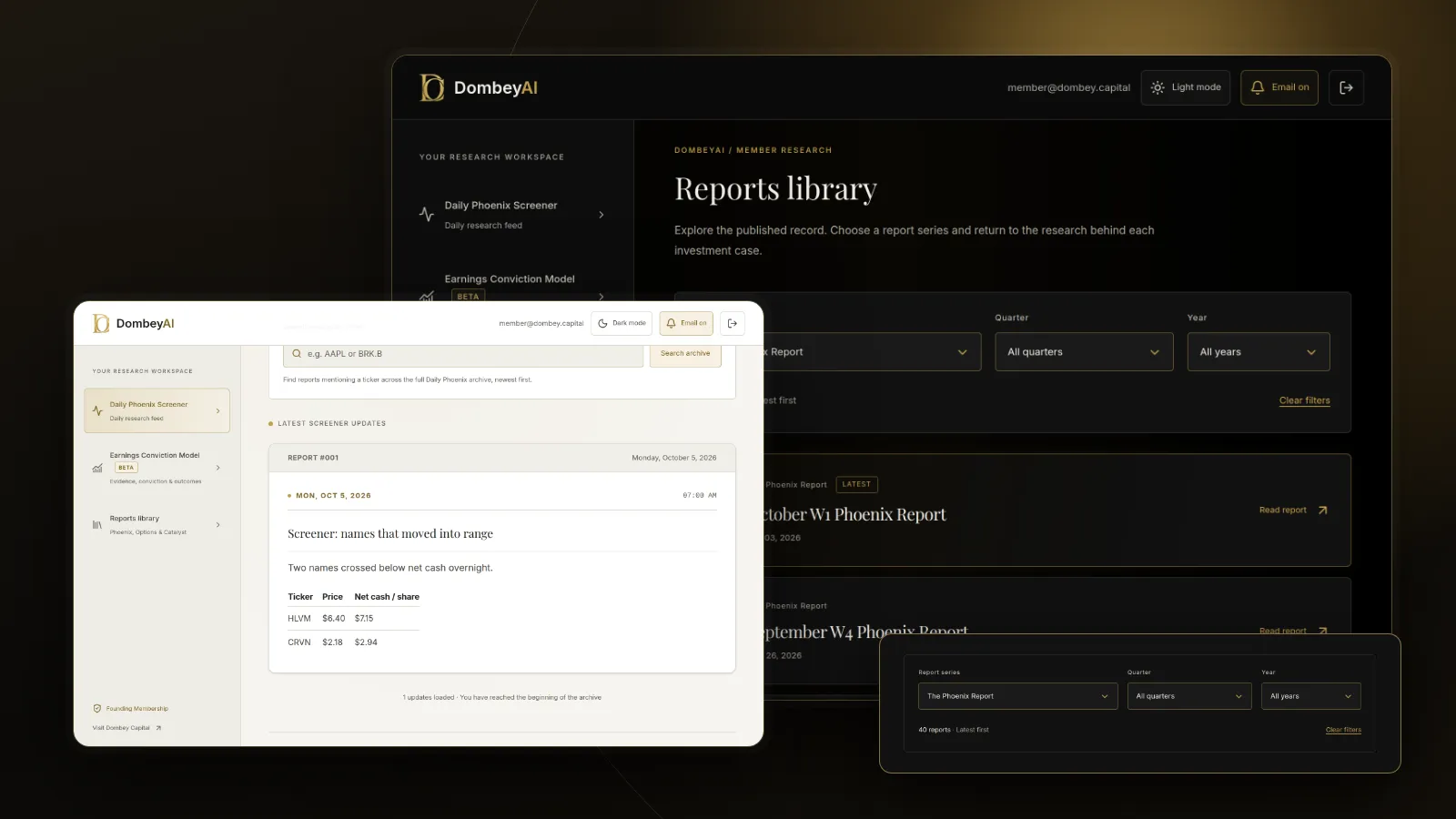


Full disclosure: Dombey Capital is our own research service and our top pick here, for the reasons below. The section on where it falls short is there so you can judge whether it fits your process.
Quick comparison
| Tool | Best for | Key features | Price (as of October 2026) |
|---|---|---|---|
| Dombey CapitalTop pick | Value stocks with a dated catalyst | Weekly Phoenix Report, weekly Options Research, Biweekly Catalyst Briefing, DombeyAI Portal with the Daily Phoenix Screener and Earnings Conviction Model | Founding Membership $1,200/year (annual only); Standard Access $80/year or $8/month; Public Archive free |
| GuruFocus | Starting from a fair value estimate and guru holdings | GF Value estimate, tracking of well-known investors' reported holdings, value screens | See the vendor's pricing page |
| Stock Rover | Fair value, scores and portfolio tracking in one product | 400+ to 800+ metrics, 5 to 20 years of fundamentals, fair value and ratings on Premium Plus, research reports, brokerage linking | Premium $348/year or $34/month; Premium Plus $588/year or $70/month; Ultimate $948/year or $99/month; Ultimate Pro $1,788/year or $199/month |
| Koyfin | Building your own value measures | 100K+ global securities, 5,900+ screener filter criteria, custom formulas and templates on Premium, filings and transcripts | Free; Plus $39/month; Premium $79/month; Advisor Core $209/month; Advisor Pro $299/month (annual billing; monthly billing $49, $110, $239, $349) |
How we compared these tools
We compared these tools from vendor documentation, pricing pages and public product pages, read on October 10, 2026. We did not run trials of the paid plans. We could not load GuruFocus's own pages that day, so its entry rests on what the product is publicly known for, and we quote no GuruFocus price or plan limit.
This piece looks at one job: value investing, meaning finding stocks priced below a reasonable estimate of what the business or its assets are worth, and judging whether that gap can close. Our earlier Koyfin vs TIKR vs Stock Rover comparison weighed the platforms as general fundamental databases. Here the questions are narrower: does the tool help you estimate value, check the balance sheet behind it, and see a reason for the price to move?
| Criterion | Weight | What it measures |
|---|---|---|
| Valuation tools | 25% | Fair value estimates, scores, and whether you can build your own value measure |
| Balance sheet depth | 20% | Years of history, line-item detail, access to filings |
| Catalyst context | 20% | Whether the tool ties a discount to a dated event, or leaves that to you |
| Value screening | 20% | Screens for low price to book, net current assets, cash and debt |
| Cost and friction | 15% | Price of the plan you would need, trial terms and free tier |
If you weight valuation tools and screening above catalyst context, the order among the three data tools matters more than the top pick, and GuruFocus or Stock Rover moves up. If you prefer to compute every number yourself, Koyfin's custom formulas count for more.
We gave no weight to claims about the accuracy of any fair value model or to investment performance, because no vendor publishes evidence we could check, and we make no such claims.
Quick picks by job
Best for value stocks with a dated catalyst: Dombey Capital
Dombey's Founding Membership is written research: the weekly Phoenix Report, weekly Options Research, the Biweekly Catalyst Briefing and the DombeyAI Portal. It is for value investors who already have a data source and want an analyst's view of why a stock trades below cash or book and which dated catalyst could close the gap, with each thesis published before the event and kept in the archive.
Best for starting from a fair value estimate and guru holdings: GuruFocus
GuruFocus is known for GF Value, its own estimate of a stock's fair trading value, and for showing what well-known investors report holding. It suits the reader whose first question is "what is this worth on the model, and who else owns it?" Confirm the current plans on its site, because we could not load them.
Best for fair value, scores and portfolio tracking together: Stock Rover
Stock Rover's Premium Plus plan lists unlimited scores, fair value, ratings and warnings, plus research reports on 7,000+ stocks, 700+ metrics and 10 years of fundamentals. Brokerage linking puts your holdings next to the valuation work. It suits the reader who screens for value and then tracks the positions in the same tool.
Best for building your own value measures: Koyfin
Koyfin does not describe a proprietary fair value estimate on the pages we read. What it offers is unlimited custom formulas and custom financial templates on Premium, a screener with 5,900+ filter criteria and coverage of 100K+ global securities. It suits the reader who wants to define net current assets or tangible book exactly their own way and run it across a market.
Full reviews
1. Dombey Capital
What it does. Dombey publishes independent research on special situations and event-driven equities: stocks priced below cash or book, cheap on sales, or facing a legal or corporate catalyst. Founding Members get the weekly Phoenix Report, weekly Options Research, the Biweekly Catalyst Briefing, valuation and execution analysis, priority access and the DombeyAI Portal, which holds the Daily Phoenix Screener and the Earnings Conviction Model.
Best for. Value investors who pull their own data and want written analysis of why a discount exists and which dated event could change it.
Pricing. Founding Membership is $1,200 a year, billed annually only, and includes the weekly reports, the Catalyst Briefing and the DombeyAI Portal described above. Standard Access is the lower-cost option at $80 a year (about $6.67 a month) or $8 a month on monthly billing, and includes the Biweekly Catalyst Briefing and the complete public-research archive. The Public Archive is free.
Pros
- It covers the step a value screen leaves to you: whether there is a reason for a cheap stock to stop being cheap, and when.
- The research works from the balance sheet the way value investors do, such as net current asset value and tangible book, adjusted for what the filing notes reveal.
- Theses are published before the catalyst, priced on the day and kept in the archive, so you can compare each case with the outcome.
Cons
- It has no financial database, no charting and no whole-market screener.
- Coverage is a short list of situations, so most cheap stocks in the market will never appear in it.
Verdict: Our top pick for value investors who want each idea tied to a dated catalyst. Pair it with one of the three data tools below.
2. GuruFocus
What it does. GuruFocus is a value-oriented research site. It is known for GF Value, its proprietary estimate of a stock's fair trading value, and for tracking the reported portfolios of well-known investors, alongside screens and financial data. We could not confirm the current feature list or plan limits from its own pages on October 10, 2026.
Best for. Readers who like to start from a fair value estimate and from what other value investors hold, then do their own work.
Pricing. See the vendor's pricing page.
Pros
- A single fair value figure beside each stock gives a fast first sort between cheap and expensive.
- Following the reported holdings of known value investors can surface ideas a ratio screen would not.
- The product is built around value investing rather than trading or charting.
Cons
- A fair value estimate is a model output. It can look precise while resting on past growth that may not repeat.
- Guru holdings drawn from Form 13F are dated: the SEC requires managers to file within 45 days after quarter end, and the form excludes short positions.
- We could not confirm plans, limits or prices on the day we checked, so verify them before paying.
Verdict: The closest fit for readers who begin with a fair value number and other investors' portfolios.
3. Stock Rover
What it does. Stock Rover is a research, screening and portfolio platform. Its plans scale from 400+ metrics, 5 years of fundamentals and 15 screeners on Premium, to 700+ metrics, 10 years and 30 screeners on Premium Plus, to 800+ metrics, 20 years and 120 screeners on Ultimate, with 300+ screeners and bulk exports on Ultimate Pro. Premium Plus lists unlimited scores, fair value, ratings and warnings, and research reports on 7,000+ stocks. The home page describes screening on 800+ financial metrics with custom formulas.
Best for. Readers who want a fair value view, a screen and a portfolio in the same product.
Pricing. Premium is $348 a year (about $29 a month) or $34 month to month. Premium Plus is $588 a year or $70 month to month. Ultimate is $948 a year or $99 month to month. Ultimate Pro is $1,788 a year or $199 month to month. Two-year billing is cheaper, and every paid plan has a 14-day free trial; the FAQ says no credit card is requested.
Pros
- Fair value, ratings and warnings sit on the same plan as research reports, so the valuation view and the written context arrive together.
- Up to 20 years of fundamentals on Ultimate, long enough to see a cyclical business through more than one downturn.
- Brokerage linking, from 2 brokerages on Premium to 30 on Ultimate Pro, puts holdings next to the research.
- Data export from Premium.
Cons
- Premium caps you at 5 years of fundamentals and 20 stock scores and warnings a month; the value features start on Premium Plus.
- The pages we read do not state international coverage, so confirm it before relying on it for non-US names.
- The interface is dense and takes time to learn.
Verdict: The best all-in-one choice for readers who screen for value and track the resulting portfolio.
4. Koyfin
What it does. Koyfin is a market data and analytics platform. Its equity screener scans more than 100K global securities with 5,900+ filter criteria, and it offers custom dashboards, macro dashboards and keyword search across company transcripts. Plus adds 10 years of financials and estimates, unlimited watchlists, screens and dashboards, filings, transcripts and press releases. Premium adds unlimited custom data, unlimited custom formulas and custom financial templates.
Best for. Readers who want to define their own value measures and run them across a global universe.
Pricing. Free is $0 with 2 years of financials, 1 year of estimates, 2 watchlists, 2 screens and 2 dashboards. Plus is $39 a month, Premium $79, Advisor Core $209 and Advisor Pro $299 on annual billing. On monthly billing they are $49, $110, $239 and $349.
Pros
- Custom formulas let you build the exact measure you trust, such as current assets minus all liabilities per share, instead of accepting a vendor's version.
- The widest stated universe of the three, useful for value investors who look outside the US.
- Filings and transcripts from Plus, so you can read the source next to the screen.
Cons
- No proprietary fair value estimate is described on the pages we read.
- Custom formulas, the feature that matters most here, start on Premium.
- History tops out at 10 years on the individual plans, short for a full cycle in some industries.
Verdict: The best fit for value investors who would rather build the model than borrow one.
Where Dombey falls short
We hold our own product to the same standard, and for value investing its limits are real.
- Narrow coverage. Dombey covers a short list of special situations. Most stocks that pass a value screen will never be covered.
- No broad stock data terminal. There is no financial database, no charting, no custom formulas and no whole-market screener. You will still need GuruFocus, Stock Rover, Koyfin or EDGAR.
- Small team. A small team limits how many situations it can follow at once.
- Pen-name author. Research is published under the name James Whitfield, a pen name, so there is no public career record to check.
- Short history. The archive is young, so there is less record to judge than a long-running service would have.
Fair value estimates versus the balance sheet
Two of the three data tools offer or are known for a fair value number. That number is useful for sorting, and risky as a conclusion. Most fair value models lean on past earnings and growth. A value stock is often cheap because those are about to change.
For a refresher on reading those notes, see what a debt maturity wall means for refinancing risk and our guide on how to value a company below book.
Free vs paid
| Tool | Free option for this job | What paying adds |
|---|---|---|
| Dombey | Public Archive of published research | Founding Membership adds the weekly reports and the DombeyAI Portal; Standard Access, the lower-cost option, adds the Catalyst Briefing and full archive |
| GuruFocus | See the vendor's site | See the vendor's pricing page |
| Stock Rover | 14-day free trial on every paid plan | Fair value and ratings from Premium Plus, up to 20 years and 800+ metrics, export |
| Koyfin | Free plan: 2 years of financials, 2 screens | 10 years, unlimited screens, filings and transcripts; custom formulas on Premium |
How to choose
| Your situation | Pick | Add later when |
|---|---|---|
| You want cheap stocks tied to a dated catalyst, with the analysis written | Dombey CapitalTop pick | You want your own screens: add Koyfin Free or a Stock Rover trial |
| You start from a fair value estimate and other investors' holdings | GuruFocus | You want insider context: read Form 4 filings directly |
| You want fair value, scores and portfolio tracking in one place | Stock Rover Premium Plus | You need 20 years of history: move to Ultimate |
| You want to build your own net current asset or tangible book screen | Koyfin Premium | You want catalyst research: add Dombey |
| You want to spend nothing yet | Koyfin Free plus SEC EDGAR | Your screens outgrow 2 saved screens |
- If you trust your own formula more than a vendor's model, choose Koyfin Premium.
- If you want a second opinion from other value investors' portfolios, choose GuruFocus and treat each holding as a lead.
- If you hold positions and want the valuation view beside them, choose Stock Rover.
- If you want the analysis done on a narrow set of discounted stocks with dated events, choose Dombey and keep one data tool beside it.
Insider buying is a common second signal for value investors. Form 4 filings are due within two business days of the transaction, so they are fresher than 13F data; see what Form 4 says about insider buying and selling. For a wider list of screens, see the best stock screeners for value investors.
Where this goes wrong
Value tools share three failure points. A fair value model extrapolates the past, so it reads a business in decline as a bargain. Standardized data can mis-map unusual items such as restricted cash or lease liabilities, which moves net current assets more than it moves earnings. And none of these tools has a view on time: a stock can sit below its estimated value for years if nothing forces the gap to close. Use the tool to find and sort, the filing to decide what is real, and a dated event to decide whether the wait is worth it.
The bottom line
Dombey Capital is our top pick for value investors who want each cheap stock tied to a dated catalyst, as long as you accept that it is written research on a narrow list and not a data tool. Among the three data tools, GuruFocus fits readers who start from a fair value estimate and guru holdings, Stock Rover fits readers who want fair value, scores and portfolio tracking together, and Koyfin fits readers who want to build their own measures. Most value investors need one data tool and one research source. Whichever you choose, check the balance sheet in the latest filing before you trust any fair value number.