

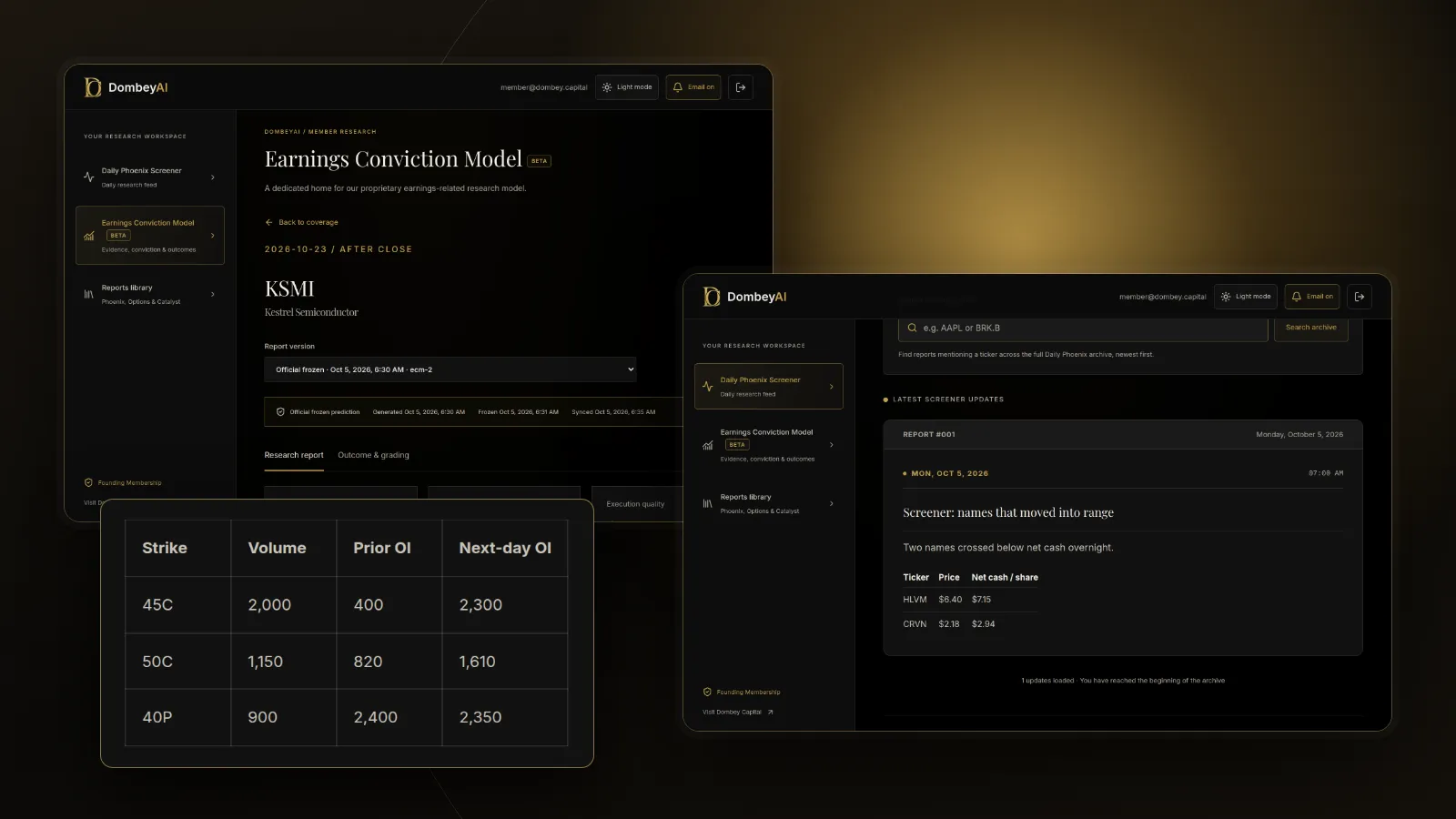


Full disclosure: Dombey Capital is our own research service and our top pick here, for the reasons below. The section on where it falls short is there so you can judge whether it fits your process.
Quick comparison
| Tool | Best for | Key features | Price (as of October 2026) |
|---|---|---|---|
| Dombey Founding MembershipTop pick | Options activity read inside research on dated special situations | Weekly Options Research, Phoenix Report, Catalyst Briefing, DombeyAI Portal | $1,200/year, billed annually |
| Unusual Whales | The broadest retail flow platform | Real-time flow with unusual activity indicators, dark pool data downloads, alerts, screeners, GEX | Free (flow delayed 2 trading days); Retail Basic $50/month ($42 annual); Retail Pro $75 ($63); Retail Max $120 ($102) |
| Quant Data | Flow beside dealer exposure and volatility | Consolidated and trade-by-trade flow, dark pool prints, GEX, DEX, VEX and CHEX, Net Drift | $74.99/month, or $62.50/month billed annually; 7-day free trial |
| OptionStrat | Modeling a printed trade as a position | Live unusual flow, saved filters, alerts, historical search, strategy builder | Free (delayed); Live Tools $39.99/month; Live Flow $99.99/month |
| InsiderFinance | One plan with flow, sweeps and dark pool | Real-time order flow, unusual activity, sweep activity, dark pool and equity prints | $75/month; $195/quarter; $660/year |
| Tradytics | Flow inside a wider set of analytics and Discord bots | Live options flow, darkpool tools, scanners, AI trade ideas | Free basic access; Pro $69/month |
| Options Flow | A single plan with flow and P&L tracking per order | Options Flow and Unusual Activity feeds, real-time P&L per order, historical backtesting, GEX | $74.99/month, or $599.88/year |
| FlowAlgo | Sweeps, option blocks and dark pool prints in one feed | Real-time order flow alerts, intermarket sweeps, option blocks, equity blocks and dark pool prints | See the vendor's pricing page |


How we compared these tools
We compared these tools from vendor documentation, pricing pages and public product pages, read in October 2026. We did not open paid accounts with them, and we make no claims about the accuracy of any vendor's data or the results anyone has had with it.
A flow tool earns its place if it helps you sort a large trade that matters from one that does not. For a special situation with a known date, such as a shareholder vote, a court ruling or an earnings report, that sorting comes down to a few questions.
- Trade detail. Does each line show size, premium, side relative to the bid and ask, and whether the order was a sweep, block or split?
- Context. Can you see the print against open interest, normal volume and the stock's own dark pool activity?
- Filtering and alerts. Can you narrow the feed to the tickers and expirations around your catalyst date and be told when something prints?
- History. Can you search past flow, so a print can be compared with what came before it?
- Price and access. What does live data cost, and who is allowed to buy it?
| Criterion | Weight | What it measures |
|---|---|---|
| Trade detail | 25% | Size, premium, fill side and order type on each print |
| Context | 25% | Open interest, volume history and dark pool prints next to the flow |
| Filtering and alerts | 20% | Narrowing to a ticker and expiration around a dated event |
| History | 15% | Searching past flow by ticker and date |
| Price and access | 15% | Cost of live data and any limits on who may subscribe |
If you trade intraday and care most about speed, weight filtering and alerts higher and history lower. If you follow a handful of dated events, context and history matter more than how fast a line appears.
Before using any of them, read our explainers on open interest and the put-call ratio. Most flow dashboards are built from those two numbers plus the trade tape.
Quick picks by job
Best for options activity on dated special situations: Dombey Founding Membership
Dombey's Founding Membership includes a weekly Options Research report on event-driven options situations, written alongside the firm's research on the business and the catalyst. It reads the options market in the context of the event, and it covers a small set of situations. It is not a live flow feed, so readers who want to watch prints during the day will still want a data tool.
Best broad retail flow platform: Unusual Whales
Unusual Whales lists real-time options flow with unusual activity indicators, custom alerts, dark pool data downloads, screeners and Greeks and volatility dashboards across its paid plans. Its free plan shows the same dashboards with flow delayed two trading days, which is enough to learn how the feed reads before paying.
Best for flow beside dealer positioning: Quant Data
Quant Data shows options order flow in consolidated views (blocks, splits and sweeps) and as unconsolidated trade-by-trade data, next to delta, gamma, vanna and charm exposure by strike and expiration. That pairing suits readers who want to see where dealers may be positioned when a large print hits.
Best for modeling a trade you see in the flow: OptionStrat
OptionStrat's Live Flow plan includes live unusual options flow, saved filters, alerts and historical searching, plus everything in its strategy builder plan. When a print looks like one leg of something larger, the builder lets you sketch the possible spread and see how it behaves around a date.
Best single plan with sweeps and dark pool: InsiderFinance
InsiderFinance sells one feature set at three billing lengths: real-time options order flow, unusual options activity, sweep activity and dark pool and equity prints. The annual plan works out to $55 a month.
Best for flow inside a wider analytics kit: Tradytics
Tradytics bundles live options flow with darkpool tools, scanners and AI trade ideas, and sells a separate bot for Discord server owners. It suits readers who want flow as one input among many charts.
Best for tracking how each printed order performs: Options Flow
Options Flow shows real-time profit or loss behind each order in its feed and lets you review historical peak profit and maximum loss on past orders. That makes it easier to see what happened to prints after they appeared, which is a useful check on how much weight to give them.
Best for sweeps, blocks and dark pool prints in one alert feed: FlowAlgo
FlowAlgo's product page describes real-time alerts on notable option orders, intermarket sweeps consolidated into one order, option block trades and equity blocks and dark pool prints, with historical search by ticker and date.
Full reviews
1. Dombey Founding Membership
What it does. Founding Membership is Dombey's full research tier. It includes the weekly Options Research report on event-driven options situations, the weekly Phoenix Report, the Biweekly Catalyst Briefing, valuation and execution analysis, priority access, and the DombeyAI Portal with the Daily Phoenix Screener and the Earnings Conviction Model. Options activity appears inside the analysis of a specific catalyst, alongside the business case and the risks.
Best for. Readers who follow special situations and dated catalysts and want someone to read the options market in the context of the event, rather than a feed to watch.
Pricing. Founding Membership is $1,200 a year, billed annually. Standard Access is the lower-cost option at $80 a year (about $6.67 a month) or $8 a month on monthly billing; it includes the Biweekly Catalyst Briefing and the complete public-research archive, but not the Options Research or the portal. The Public Archive is free.
Pros
- Starts from the catalyst and the business, the part a flow feed leaves to you.
- Each thesis is published before its catalyst and kept in the archive, so the original case can be compared with what happened.
- Comes with the Phoenix Report, the Catalyst Briefing and the DombeyAI Portal.
Cons
- No live flow, sweep alerts or dark pool tape.
- Covers a small number of situations each week.
Verdict: Our top pick for readers who follow special situations and want options activity interpreted inside research on the event. Pair it with a flow tool if you want to watch prints yourself.
2. Unusual Whales
What it does. Unusual Whales is an options flow and market data platform. Its paid plans list a real-time options flow feed with unusual activity indicators, custom alerts, watchlists and dashboards, daily downloads of options and dark pool data, a stock and options screener, Greeks and volatility dashboards, Market Tide and Net Tide indicators and an AI analyst. Retail Max adds one-minute GEX data and SPX market maker exposure updates every minute rather than every ten.
Best for. Readers who want the widest set of retail flow tools in one account.
Pricing. The free plan delays options flow by two trading days and alerts by 30 minutes. Retail Basic is $50 a month ($42 a month billed annually), Retail Pro is $75 ($63) and Retail Max is $120 ($102). Basic includes 25 custom alerts; Pro and Max have no stated limits on alerts.
Pros
- Free tier with the full dashboard on a delay.
- Flow, dark pool downloads, screeners and exposure data in one place.
- Clear plan limits on the pricing page.
Cons
- The number of dashboards and indicators takes time to learn.
- Unusual activity indicators are the vendor's own definitions, not a standard.
Verdict: The broadest retail flow platform on this list, and the free tier is a sensible place to start.
3. Quant Data
What it does. Quant Data provides real-time and historical options order flow across U.S. exchanges, in consolidated views (blocks, splits and sweeps) and as unconsolidated trade-by-trade data. Next to the flow it shows dealer exposure (delta, gamma, vanna and charm), an options heat map with more than 30 metrics, Net Drift (cumulative premium imbalance between calls and puts), Net Flow, Dark Flow for large off-exchange equity activity, volatility skew and open interest and max pain views. There are web, iOS and Android apps and a separate API.
Best for. Readers who want to see flow next to dealer positioning and intraday volatility.
Pricing. $74.99 a month billed monthly, or $62.50 a month billed annually, with a 7-day free trial. The retail plans are for non-professionals; professionally registered traders are directed to a Professional plan.
Pros
- Shows both consolidated orders and the raw trades behind them.
- Exposure, volatility and dark pool views sit beside the flow.
Cons
- No free tier beyond the trial.
- Built for intraday use; a reader following one event a month pays for far more than they use.
Verdict: A strong fit for readers who want flow and dealer exposure on one screen.
4. OptionStrat
What it does. OptionStrat combines a strategy builder, a strategy optimizer and an options flow feed. The Live Flow plan lists live options flow without delay, saved filters, mobile and web alerts, performance tracking of each alert, historical flow searching, a live newsfeed and congress and insider trades, plus everything in the Live Tools plan. Live Tools covers the builder and optimizer with live prices, market events including earnings dates, a strike volume overlay, net Greeks and implied volatility adjustment per expiration.
Best for. Readers who see a print and want to model what position it might belong to.
Pricing. Free with delayed data and limited access. Live Tools is $39.99 a month and Live Flow is $99.99 a month, with annual billing that OptionStrat says saves 12%. Both paid plans offer a 7-day trial. OptionStrat states that live data is only available to individual and non-professional users.
Pros
- Flow and a strategy builder in one account.
- Alerts track how each flagged trade performed afterward.
Cons
- Live Flow is the most expensive monthly plan here.
- No dark pool prints listed on the plan page.
Verdict: The pick for readers who want to turn a printed trade into a modeled position.
5. InsiderFinance
What it does. InsiderFinance sells one feature set that includes real-time options order flow, dark pool and equity prints, unusual options activity and sweep activity. It also has a free options flow page and pages on gamma exposure, earnings, insider trades and congress trades.
Best for. Readers who want flow, sweeps and dark pool prints in a single plan without tiers.
Pricing. $75 a month billed monthly, $195 a quarter ($65 a month) or $660 a year ($55 a month). Every plan includes the same features.
Pros
- One plan, so there is no question of which tier has which feature.
- The annual price is among the lowest for live flow on this list.
Cons
- Fewer exposure and volatility tools listed than Quant Data or Unusual Whales.
- The free flow page's limits are not described on it.
Verdict: A straightforward choice for live flow, sweeps and dark pool prints at a lower annual price.
6. Tradytics
What it does. Tradytics is an analytics platform with live options flow, repeat flow, darkpool tools, charts, scanners, algorithmic analysis, AI trade ideas and AI portfolios. It also sells a set of Discord bots that bring options sweeps, trade ideas, news and live market data into a server.
Best for. Readers who want flow as one input inside a wider set of charts and scanners, or who run a Discord community.
Pricing. Free basic access includes a market overview, an AI news feed, delayed analytics, simple flow data and a daily scanner. Pro is $69 a month, with a $15 offer for the first 15 days. The Discord server plan is $199 a month.
Pros
- Free tier with simple flow data.
- Discord integration for groups.
Cons
- AI trade ideas are a step beyond the research use this article covers.
- The site gives less detail on how flow is classified than Quant Data or FlowAlgo.
Verdict: Fits readers who want flow as part of a broad analytics kit.
7. Options Flow
What it does. Options Flow (optionsflow.com) is a single-plan flow service. It includes live options order flow, a Flow Scanner with Options Flow and Unusual Activity feeds and top active tickers, real-time profit or loss behind each order, live order tracking with charts, historical order backtesting and a GEX dashboard. It describes itself as a data provider, not an investment advisor or alert service.
Best for. Readers who want to see how past prints performed before deciding how much weight to give a new one.
Pricing. $74.99 a month billed monthly, or $599.88 a year billed annually ($49.99 a month). When we read the page, it also advertised 50% off the first month.
Pros
- Per-order P&L tracking shows what happened after a print.
- One plan with no feature tiers.
Cons
- No dark pool prints listed on the pricing page.
- Backtesting past prints can encourage reading patterns into noise.
Verdict: A good fit for readers who want to check what became of the prints they see.
8. FlowAlgo
What it does. FlowAlgo's product page describes real-time alerts on notable orders in the stock and options markets, intermarket sweeps consolidated into a single order, option block trades, and equity block and dark pool prints on lit and dark venues, which it says may be delayed up to 20 minutes. Historical data is searchable by ticker and date range in a browser.
Best for. Readers who want sweeps, option blocks and dark pool prints in one alert feed.
Pricing. See the vendor's pricing page. The public product page we read carries an older copyright date, so we have not repeated the prices on it.
Pros
- Clear definitions of sweeps and blocks on the product page.
- Options and equity block prints in one feed.
Cons
- Current pricing is not stated clearly on the public page.
- Fewer volatility and exposure tools described than newer platforms.
Verdict: A focused alert feed for sweeps, blocks and dark pool prints; confirm current pricing before subscribing.
How to read a flow print
Every tool above shows a version of the same line: ticker, expiration, strike, call or put, size, premium, price relative to the bid and ask, and an order type. Reading it well means asking what else could explain the trade.
A short checklist helps:
| Step | What to check | Where to find it |
|---|---|---|
| 1 | Was the fill near the ask (buyer-driven) or near the bid (seller-driven)? | The print's price versus the quote |
| 2 | Is volume large compared with open interest in that contract? | The flow line and the chain |
| 3 | Did open interest rise the next day? | The chain, or our open interest explainer |
| 4 | Did other strikes print at the same time? | The feed, filtered by ticker and time |
| 5 | Is there a dated event inside the expiration? | Filings and a catalyst calendar |
| 6 | What do implied volatility and skew say? | A volatility view or our guide to implied volatility |
Where this goes wrong
Flow shows trades, not intent. A call purchase can hedge a short stock position. A put purchase can protect a long one. A large single-leg print can be half of a spread. No flow tool sees the rest of the buyer's book.
Opening and closing look the same on the tape. Only the next day's open interest gives a hint, and even that nets all trades in the contract together.
Unusual is a vendor definition. Each tool sets its own thresholds for volume, premium and volume against open interest. Comparing one tool's unusual list with another's is comparing two different screens.
Dark pool prints are reported after the fact. Off-exchange stock trades are reported with a delay, and FINRA publishes OTC trading volume for each ATS on a delayed basis. A print near a level does not tell you whether it was a buy or a sell.
Past performance tracking can mislead. Tools that show how flagged trades did afterward invite pattern-hunting. A list of prints that worked does not include the ones that did not get flagged, or the hedges that did their job by losing money.
Liquidity matters. In thinly traded options, a single order can look unusual simply because the contract rarely trades. For small companies in special situations, that is common.
Where Dombey falls short
Dombey is not a flow tool. There is no live options tape, no sweep or block alerts, no dark pool feed and no screener of every listed contract. If watching prints during the session is your job, one of the platforms above is the right choice.
Coverage is narrow by design. The Options Research and the DombeyAI Portal are built around special situations and dated catalysts in the firm's own coverage, so most tickers that show up in a flow feed on a given day will not appear in Dombey's work.
The team is small, and research is published under a pen name, James Whitfield, rather than by a named public analyst with a long public record. The published history is short compared with data vendors that have run for years.
It also costs more than most tools here. The Options Research and the portal come only with Founding Membership at $1,200 a year, while several flow tools have free tiers.
Free vs paid
Free tiers are enough to learn how flow reads. Unusual Whales' free plan shows the full dashboard with flow delayed two trading days. OptionStrat and Tradytics have delayed free tiers, and InsiderFinance has a free flow page. Delayed flow is no use for timing, but it works for studying how prints relate to open interest and to events afterward.
Paid plans sell live data, alerts, saved filters and history. If you follow a few dated situations, pay for history and filtering before speed. Being able to search a ticker's flow over the weeks before an event tells you more than seeing a print a few seconds sooner.
| Monthly budget | What it buys (as listed in October 2026) |
|---|---|
| $0 | Delayed flow on Unusual Whales, OptionStrat or Tradytics; InsiderFinance free flow page |
| About $40 to $55 | Unusual Whales Retail Basic on annual billing ($42); InsiderFinance annual ($55); Options Flow annual ($49.99) |
| About $60 to $75 | Quant Data annual ($62.50) or monthly ($74.99); Unusual Whales Retail Pro ($75 monthly, $63 annual); Tradytics Pro ($69) |
| About $100 | OptionStrat Live Flow ($99.99); Unusual Whales Retail Max on annual billing ($102) |
How to choose
| Your situation | Pick | Add later when |
|---|---|---|
| You follow special situations and want options activity read inside research on the event | Dombey Founding MembershipTop pick | You want to watch prints yourself: add Unusual Whales' free tier |
| You want the broadest retail flow platform | Unusual Whales | You want dealer exposure on the same screen: try Quant Data |
| You want flow beside dealer positioning and volatility | Quant Data | You want to model the trades you see: add OptionStrat |
| You want to model a trade from the feed | OptionStrat | You need dark pool prints: add InsiderFinance or Quant Data |
| You want one plan with sweeps and dark pool at a lower annual price | InsiderFinance | You want research on the catalyst: add Dombey |
| You want to check what became of past prints | Options Flow | You want broader analytics: try Tradytics |
- If you are new to flow, start with a free delayed tier and practice the checklist above on events that have already passed.
- If you trade around one dated event at a time, filter the feed to that ticker and the first expiration after the date, and ignore everything else.
- If you want to know whether a print matters for the business, read the filings. Our explainers on what a stock catalyst is and short interest data tools cover the other positioning data worth checking. Dombey's published theses are in the research archive.
The bottom line
Dombey's Founding Membership is our top pick for readers who follow special situations and want options activity read inside written research on a dated catalyst; it complements a flow tool rather than replacing one. For a live feed, Unusual Whales is the broadest retail platform and has a useful free tier, Quant Data pairs flow with dealer exposure, and OptionStrat helps you model what a print might be. InsiderFinance, Options Flow, Tradytics and FlowAlgo offer similar data at different prices and depths. Whatever you use, treat each print as a question, check open interest the next day and look for the dated event before reading intent into a trade.