

How a pledge works
An insider with a large stake and little cash can sell shares, which is taxable and visible, or borrow against them. Borrowing keeps the position, the votes and the upside. The loan usually takes one of three forms:
- A margin loan from a broker, secured by shares in a brokerage account.
- A securities-based line of credit from a private bank, which works much like a margin loan with different terms.
- A structured loan from a bank or specialist lender, often for a founder or controlling holder, with negotiated margin levels.
Each loan has a loan-to-value limit. If the stock falls and the loan grows too large relative to the collateral, the borrower gets a margin call: post more collateral, repay part of the loan, or let the lender sell shares. Lenders to insiders are usually conservative, because a single concentrated stock can gap down on one piece of news.
Real examples of where pledges show up
Pledging takes several forms, and each leaves a different trace in filings.
| Form of pledge | Who uses it | Where it is disclosed | What to watch |
|---|---|---|---|
| Margin loan at a broker | Directors, officers | Footnote to the beneficial ownership table in the proxy and 10-K | Size against trading volume |
| Private bank credit line | Founders, wealthy holders | Ownership table footnote; sometimes a Schedule 13D | Loan terms are rarely public |
| Pledge by a controlling holder's holding company | Family and founder-controlled firms | 13D, proxy, sometimes the 10-K risk factors | Possible change of control on default |
| Pledge to fund a purchase of more shares | Activists, controlling holders | 13D Item 6, financing arrangements | Leverage on top of an already concentrated stake |
| Prepaid variable forward or collar with a pledge | Executives monetizing stock | Form 4 and the proxy hedging disclosure | Hedge plus loan, so economic exposure is lower than it looks |
Our guide to reading a proxy statement shows where the ownership table and its footnotes sit, and the Schedule 13D explainer covers the financing items large holders must disclose.
What the rules require
Item 403(b) of Regulation S-K requires companies to show, for each director and named executive officer and for the group, the shares they beneficially own and to disclose the number of those shares pledged as security. The footnotes to the table are where pledges appear, often in a sentence such as "includes 2,000,000 shares pledged as collateral for a line of credit".
Item 407(i) requires companies to describe any policies on hedging by employees and directors. Many companies cover pledging in the same policy: some ban it outright, some allow it with board approval, and some cap it at a share of each person's holdings. ISS, the proxy adviser, treats significant pledging as a governance concern in its voting policies, which our explainer on ISS and Glass Lewis covers.
Large holders filing a Schedule 13D must also describe contracts and arrangements involving the company's securities, including pledges, under Item 6. Changes in pledges by insiders are not always reported on Form 4, so the annual proxy is often the only regular source.
Why pledges matter to other shareholders
Forced selling at the worst time. Margin calls arrive when the stock has already fallen. A lender selling a large block adds supply into weakness, which can push the price down further and trigger more calls. Forced sellers do not wait for a good price.
Control can change hands. If a controlling holder's pledged shares are sold, control can pass to the market or to whoever buys the block. For companies with a controlling holder, that is a governance event, not just a trading one.
Incentives shift. An insider with a large loan against the stock has a personal reason to avoid bad news, to favor actions that support the share price in the short run and to resist dilution. That does not mean misconduct, but it is a pressure worth knowing about.
Signals get blurred. An insider who borrows instead of selling may look committed. In economic terms, borrowing against stock and spending the proceeds is not so different from selling part of it. For the signal that open-market trades send, see how to track insider buying with Form 4.
A worked example: sizing the risk
Three questions frame the risk:
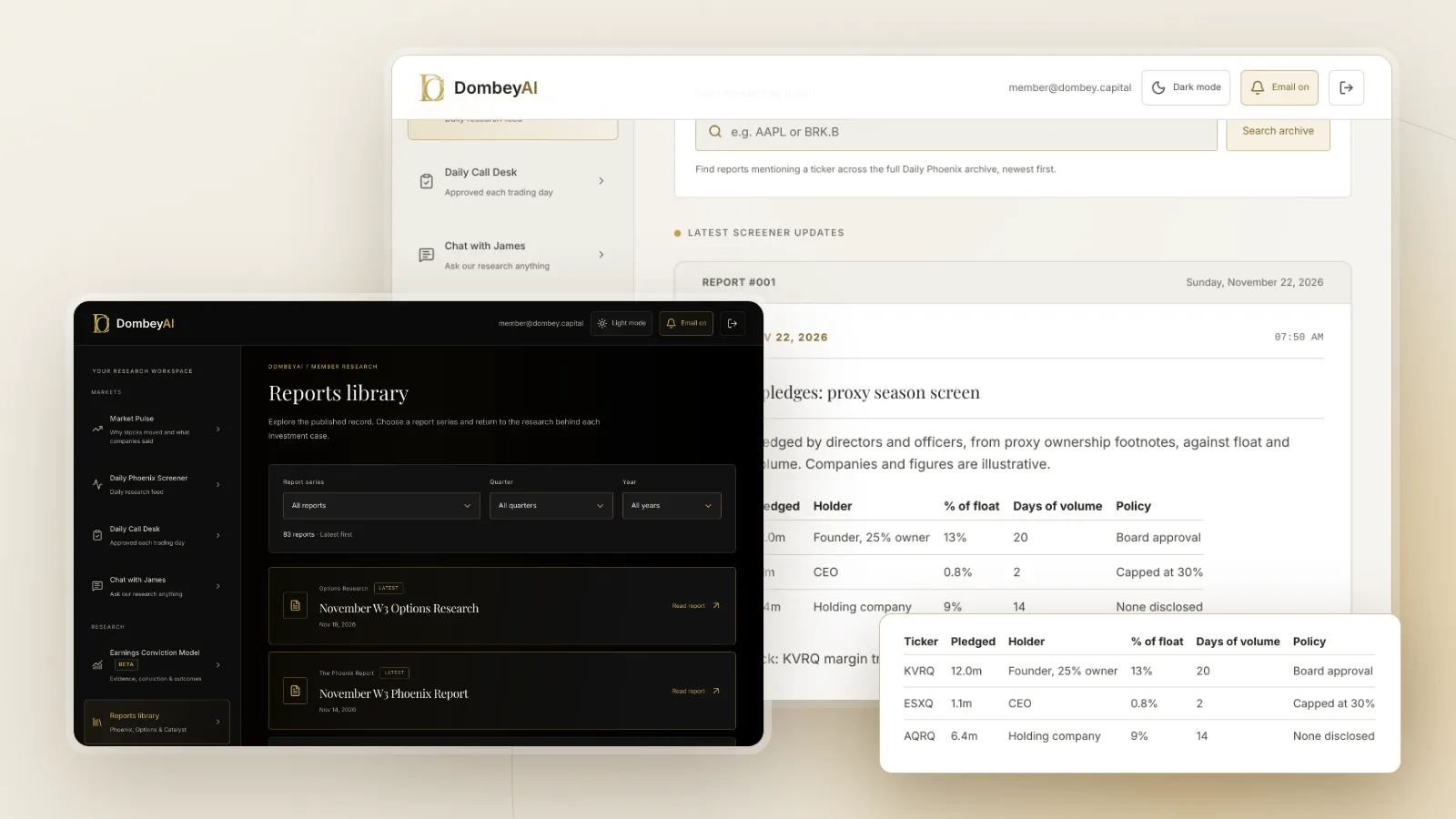
- How long would it take to sell? 12 million shares is 20 days of average volume. A forced sale would weigh on the price for weeks.
- How big is it against the float? 12 million shares is about 13% of the 90 million share float, a large block for the market to absorb.
- How far would the stock have to fall? The loan amount is not disclosed. If the loan were $80 million with a 50% maximum loan-to-value, a margin call would come at $160 million of collateral value, or about $13.33 a share, a 33% fall. Use a range of loan sizes when the terms are not public.
The answer does not tell you the stock will fall. It tells you how much damage a fall could do on top of whatever caused it.
What to check
| Step | What to check | Where to find it |
|---|---|---|
| 1 | Shares pledged by each insider | Proxy statement ownership table footnotes |
| 2 | Company policy on pledging and hedging | Proxy statement, governance section |
| 3 | Pledges by large holders and loan terms | Schedule 13D Item 6 and exhibits |
| 4 | Changes from last year | Prior year's proxy |
| 5 | Pledged shares against volume and float | Trading data and the 10-K cover share count |
| 6 | Risk factor language on pledging | 10-K risk factors |
| 7 | Insider debt or financial stress | News, other filings by the insider's companies |
Pledging is one of the governance and ownership issues that can turn into a special situation. Our list of the best investing newsletters for special situations compares services that track these events.
Where this goes wrong
- Missing the footnote. Pledges are disclosed in small print under the ownership table. Screens that use only share counts will miss them.
- Assuming loan terms. The loan size and margin level are rarely public. Use a range rather than a single trigger price.
- Treating every pledge as a red flag. A small pledge by a wealthy insider with other assets is a different risk from a founder pledging most of a controlling stake.
- Ignoring hedges. An insider who pledged shares and entered a collar has less economic exposure than the ownership table suggests.
- Forgetting it after a rally. Pledge risk feels remote when the stock is rising, which is when insiders often borrow more.
The bottom line
Pledged shares let insiders borrow against stock without selling it, and the proxy statement discloses how many shares directors and officers have pledged. The risk for other shareholders is a margin call that forces a large sale into a falling market, and in controlled companies, a change of control. Size a pledge against trading volume and float, test a range of trigger prices, and read the company's policy and each year's footnotes for changes.