

A short definition
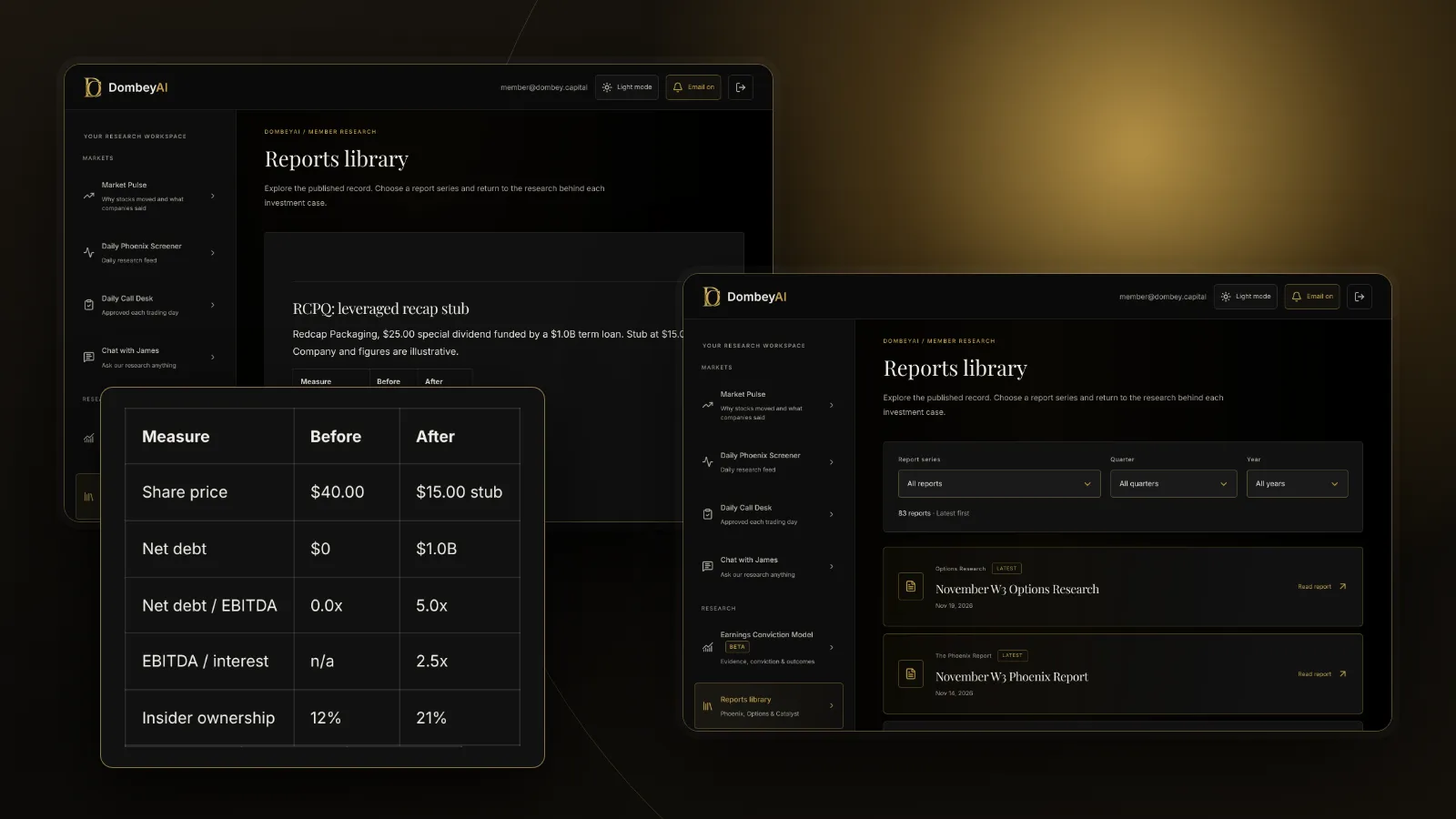
A company's capital structure is the mix of debt and equity that funds it. A leveraged recap shifts that mix sharply toward debt, without a change of owner. The company raises term loans or bonds, then pays the proceeds out. Shareholders who stay in keep their shares, now called the stub when the payout is large relative to the old share price.
It differs from a leveraged buyout in who borrows and who is cashed out. In a buyout, a sponsor buys the whole company with borrowed money. In a recap, the company borrows and the public shareholders get the cash while staying owners. Our explainer on stub equity covers what that remaining stake behaves like.
Real examples
| Year | Company | What happened |
|---|---|---|
| 1985 | Phillips Petroleum | Recapitalized with heavy borrowing after takeover attempts by T. Boone Pickens and Carl Icahn |
| 1986 | FMC Corporation | Paid public shareholders a large cash distribution funded by debt, while management and employee plans took more stock, raising their ownership share |
| 1986 | Owens-Corning | Used a leveraged recap to defend against a hostile bid from Wickes |
| 1986 | Colt Industries | Paid holders a large cash amount plus shares in the recapitalized company, one of the best-known recaps of the period |
| 1989 | Sealed Air | Paid a debt-funded special dividend; academic work on the case linked the new debt to tighter cost control afterward |
| 2007 and 2012 | Domino's Pizza | Used securitized debt to fund special dividends while staying public |
The 1980s cases were mostly defensive: management gave shareholders much of the value a raider was offering, without selling the company. Later cases, including many private equity dividend recaps, are about returning capital and using cheap credit.
How a recap works, step by step
A typical public-company recap has four parts.
- Financing. The company signs a credit agreement or sells bonds. The amount is set by what lenders will accept, usually measured as a multiple of EBITDA.
- Payout. The company declares a special dividend or launches a tender offer for its own shares. A Dutch auction tender offer is one common route for the buyback version.
- Approval. Some recaps need a shareholder vote, for example if they change share classes or require a charter amendment. Most dividend recaps need only board approval and lender consent.
- The stub trades. After the payout, the shares trade at a lower price reflecting the cash removed. That stub is now an equity claim behind a much larger debt stack.
The size of the payout relative to the share price matters. A payout equal to 10% of the market value is a large special dividend. A payout equal to 60% or 70% changes the nature of the security.
Why companies do them
Returning capital. A company with stable cash flow and little debt may decide its balance sheet is underused. Borrowing to pay out returns cash now rather than over many years of ordinary dividends.
Takeover defense. A recap can give shareholders a large part of a bidder's offer directly. With much more debt, the company also becomes harder for a bidder to finance. Our explainers on poison pills and hostile takeovers cover other defenses.
Concentrating ownership. If insiders take more shares instead of cash, their stake rises. That can strengthen control, which shareholders should weigh against any gain.
Tax. Interest is generally deductible for a US corporation, subject to limits, while dividends are not. Replacing equity with debt can lower the company's tax bill, which is one source of value in the transaction.
Discipline. Fixed interest payments leave less free cash for projects with poor returns. That was a central argument for recaps in the 1980s.
What to check before owning the stub
The questions that decide the outcome:
| Item | What to check | Where to find it |
|---|---|---|
| Leverage | Net debt to EBITDA, before and after | Pro forma figures in the 8-K or offering memorandum |
| Coverage | EBITDA or EBIT divided by interest | Credit agreement terms, the next 10-Q |
| Maturities | When each tranche is due and whether it amortizes | Debt footnote, credit agreement |
| Covenants | Maintenance tests and limits on further payouts | Credit agreement filed as an exhibit |
| Rate exposure | Fixed or floating, and any hedges | Debt footnote |
| Ownership | Who took cash and who took shares | Proxy statement, Forms 4 |
Our explainers on net debt to EBITDA and the interest coverage ratio cover the two core ratios, and our guide on how to map a capital structure shows how to lay out the full debt stack.
Why the stub can be mispriced
Leveraged stubs are a classic special situation. After the payout, many holders who owned the stock for its stability or its dividend sell. Index weights fall with the market value. Some funds cannot own a highly leveraged company. That selling can push the stub below what the cash flow supports.
The other side is real risk. A stub behaves like a long-dated call option on the business. Small changes in enterprise value produce large changes in the equity. That is attractive when the business is steady and dangerous when it is cyclical. If you follow special situations closely, our list of the best investing newsletters for special situations covers sources that track these cases.
How the market reads a recap announcement
The first reaction to a recap tends to come from three groups, and each looks at a different part of the deal.
Shareholders look at the size of the payout against the share price and at what the stub will be worth. A payout that returns a large share of the market value at once can lift the total value received, especially if the stock was trading below what the cash flow supports.
Creditors look at the new debt. Existing bonds may fall in price, and rating agencies often cut the company's rating, because more debt now sits ahead of or alongside the old claims with less equity below. Our guide on how to read a bond indenture shows where the limits on payouts sit.
Index and income funds look at what the company has become. A company that paid a steady ordinary dividend may cut or suspend it after the recap, because the cash now goes to interest. Holders who owned it for that income often sell.
Those different reactions explain why the stub can trade away from fair value for weeks after the payout.
Where this goes wrong
The cash flow was peak cash flow. Lenders size the debt on recent EBITDA. If that EBITDA was near a cyclical high, the debt that looked modest becomes heavy in the next downturn.
Refinancing risk. Recap debt often comes due in five to seven years. If credit markets are tight then, the company may face a maturity wall with fewer options.
Underinvestment. Cash that goes to interest does not go to maintenance or growth. The damage can take years to show in the numbers.
Creditors push back. Existing bondholders may hold covenants that limit payouts, or may sue if they believe a transfer harmed them. Read the indentures before assuming the recap can go ahead as announced.
Control shifts. When insiders take shares while the public takes cash, insiders can end up with a controlling stake, which reduces the odds of a later sale at a premium.
The bottom line
A leveraged recapitalization swaps much of a company's equity for debt and pays the proceeds to shareholders. It can return capital, defend against a bid or concentrate control, and it leaves a stub whose value rests on the business carrying the new debt. Judge it on leverage, coverage, maturities and covenants, using the filings rather than the headline payout. A stable business can make a recap stub a real opportunity; a cyclical one can make it the start of a long decline.