

A short definition
In most large Chapter 11 cases, the US Trustee appoints an official committee of unsecured creditors. That committee speaks for creditors who lack the size or organization to protect themselves. Shareholders sit below every creditor in the priority of claims, and in most cases they are expected to receive nothing, so no one is appointed to speak for them.
Section 1102 allows an exception. The US Trustee may appoint additional committees of creditors or of equity security holders if it considers it appropriate, and the court may order one if needed to assure adequate representation. A committee of shareholders appointed this way is an official equity committee. It has the same powers as a creditors' committee: it can investigate the debtor, take part in plan negotiations and be heard on any issue in the case.
Real examples
| Case | Bankruptcy filed | What the equity committee shows |
|---|---|---|
| Calpine | 2005 | An equity committee in a large power producer case contested the plan value, and old shareholders received a distribution under the confirmed plan |
| General Growth Properties | 2009 | A real estate company that filed because it could not refinance maturing debt, not because its assets were worth less than its debts; equity kept substantial value |
| Washington Mutual (holding company) | 2008 | An equity committee appointed in 2010 litigated over claims and settlements, and old equity received an interest in the reorganized company |
| 11 U.S.C. Section 1102 | Enacted 1978 | The statute that lets the US Trustee appoint, and the court order, a committee of equity security holders |
The pattern is that equity committees appear where the debtor's trouble is liquidity, litigation or timing rather than a hopeless balance sheet. That is also where equity has the best chance of recovering anything.
How a committee gets appointed
Shareholders who want a committee usually write to the US Trustee first, setting out why equity may be in the money and why existing parties will not protect it. If the US Trustee declines, they can file a motion asking the court to order an appointment.
Courts weigh a handful of factors when ruling on such a motion. The exact list varies by court, but it usually includes:
| Factor | What the court is asking |
|---|---|
| Solvency | Is there a substantial likelihood that equity will receive a meaningful distribution? |
| Existing representation | Is equity already represented, for example by a large holder or by a debtor whose board is acting for shareholders? |
| Cost | Will the committee's fees burden the estate more than the benefit justifies? |
| Size and complexity | Is the case large and complex enough that shareholders cannot protect themselves? |
| Timing | Is the request early enough to matter, or would it delay a plan that is nearly done? |
| Number of holders | Are the shares widely held, so that individual holders lack the means to organize? |
Solvency usually decides it. If the debtor's own valuation and the market prices of its debt show equity is far out of the money, a court is unlikely to make creditors pay for a committee to argue otherwise.
Why it matters for the stock
The appointment changes three things for shareholders.
It funds a valuation fight. Plan value is the central question in most cases, and value is a matter of assumptions. An equity committee can hire its own financial adviser to argue for a higher value than the debtor's or the creditors'. That matters because, under the absolute priority rule, equity receives value only if creditors are paid in full first. How to read a Chapter 11 disclosure statement shows where the plan valuation and recovery tables sit.
It gives equity a seat in negotiations. Plans are usually agreed among the debtor and its major creditors, often in a restructuring support agreement signed before or early in the case. An official committee can push for warrants, a share of new equity or a rights offering for old holders, and can object to the plan if it is not heard.
It signals what someone thought. The US Trustee and bankruptcy judges do not appoint equity committees casually, because creditors pay for them. An appointment tells the market that at least one independent party saw a realistic path to value.
A worked example
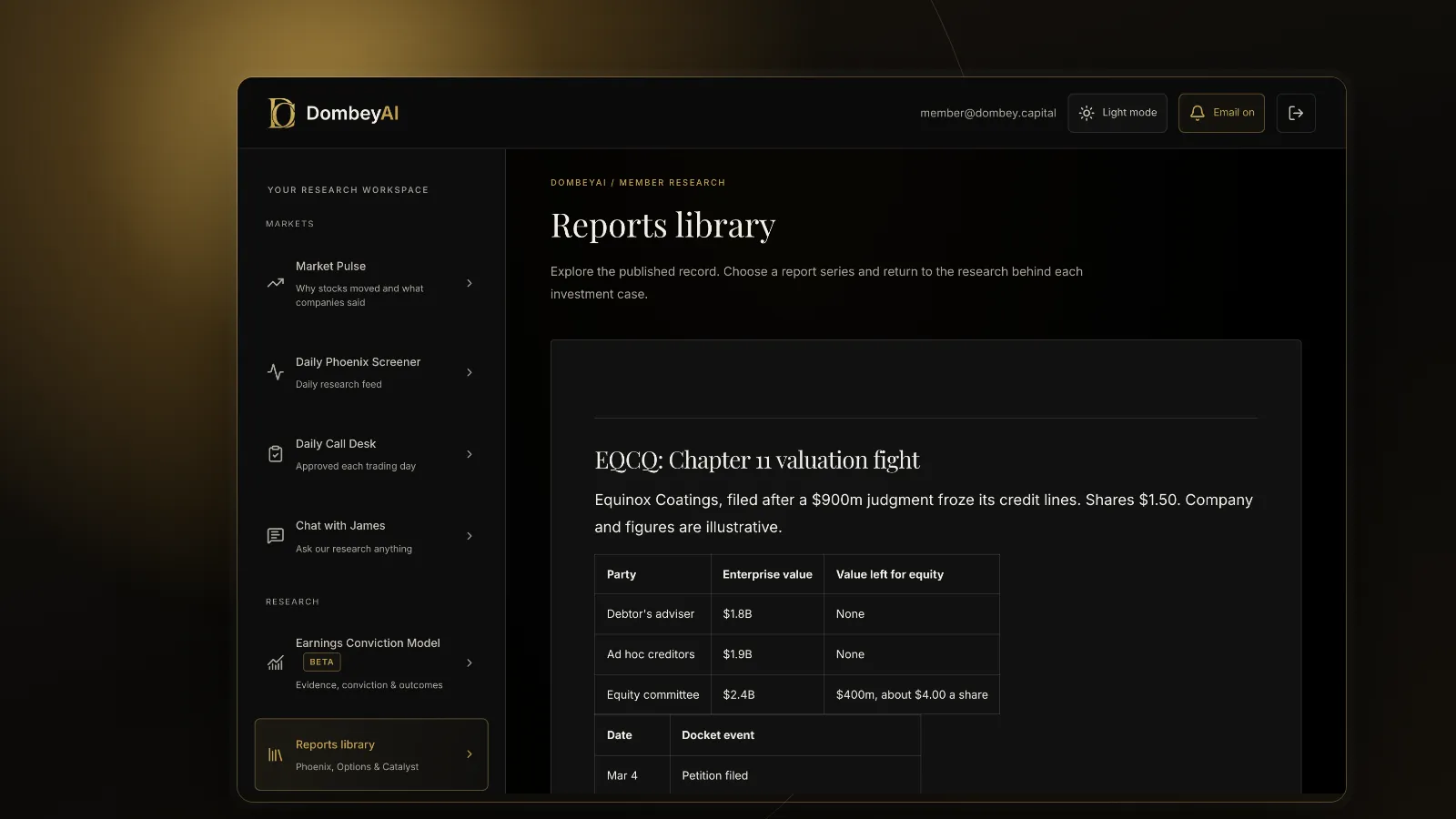
Shareholders argue that the judgment is likely to be reduced on appeal and that comparable companies trade at higher multiples. The court orders an official equity committee. Its adviser values the business at $2.4 billion. If the court accepted that view, creditors would be paid in full and about $400 million would remain for equity, or roughly $4 a share on 100 million shares.
The likely outcome sits somewhere between the two. Plans in such cases often settle with old equity receiving warrants or a small share of the new company. The committee's existence moves the range of outcomes; it does not settle them. What happens to stock in Chapter 11 covers the more common case where no committee is appointed.
How to follow a committee
Committee activity is public through the court docket. Look for:
- The appointment notice from the US Trustee, naming the members.
- Retention applications for the committee's lawyers and financial adviser, which show who is doing the valuation work.
- Objections to the debtor's financing, sale procedures or disclosure statement, which reveal the committee's arguments.
- Valuation reports and expert testimony at the confirmation hearing.
- Motions to disband from creditors or the debtor, which show when others think the committee has served its purpose.
The best bankruptcy and restructuring research sources covers where to read dockets without paying per page. For wider coverage of special situations like these, see the best investing newsletters for special situations. Dombey's published research follows bankruptcy cases where equity may still have value; see the research archive.
Where this goes wrong
- Treating appointment as a recovery. Plenty of cases with equity committees end with old shares cancelled. The committee argues; the court and the creditors decide.
- Ignoring the cost. Committee fees come out of the estate, which in a close case reduces the value left for equity itself.
- Buying on headlines. Distressed shares can spike on news of a committee motion. The price may already reflect more optimism than the valuation evidence supports.
- Forgetting the timeline. Valuation fights take months. Even a successful committee may deliver new shares or warrants, not cash, and those come with their own risks. Post-bankruptcy equities explains why new shares often trade cheap.
- Missing a disbanding motion. If creditors persuade the court to disband the committee, equity loses its funded voice, often a sign the valuation case has weakened.
The bottom line
An official equity committee is a court-recognized group that represents all shareholders in a Chapter 11 case, paid for by the estate. It is rare, because most bankrupt companies are clearly insolvent, and it tends to appear where the problem is liquidity, litigation or timing. The committee funds equity's side of the valuation fight and gives shareholders a seat in plan talks, but it does not guarantee a recovery. Read the appointment, the committee's valuation and any motion to disband it as the key dated events for the stock.