



Full disclosure: Dombey Capital is our own research service and our top pick here, for the reasons below. The section on where it falls short is there so you can judge whether it fits your process.
What a special situations newsletter does
A special situation is a stock whose price is driven by a corporate event more than by the business cycle: a spin-off, a merger, a tender offer, a liquidation, a rights offering, a restructuring. A newsletter in this niche does three jobs that a general stock service does not. It finds the event early, usually from a filing. It explains the mechanics, such as who must sell, what the holder receives and when. And it puts a date on the outcome.
That last point matters most. A general newsletter can say a stock is cheap and wait. An event-driven letter has a deadline, which makes it easier to judge whether the thesis worked.
This list mixes three formats, because special situations research is sold in all three:
- Edited newsletters with a fixed number of ideas and a house view.
- Idea communities, where members post write-ups and others read them.
- Institutional services that cover restructuring, M&A and activism for professionals.
Quick comparison
| Tool | Best for | Key features | Price (as of October 2026) |
|---|---|---|---|
| Dombey CapitalTop pick | Special situations with dated catalysts | Biweekly Catalyst Briefing, weekly Phoenix Report, dated archive | Free archive; $6.67/month; $1,200/year |
| Stock Spin-off Investing | Spin-offs | One recommendation a month, weekly email, monthly video call | $97/month or $697/year; SSI Pro $1,497/year |
| InsideArbitrage | Merger arbitrage and event screens | Special Situations Newsletter, merger arbitrage tools, insider screens | See the vendor's pricing page |
| Undervalued-Shares.com | Offbeat global situations | Up to 10 research reports a year, archive of 65-plus reports | Free weekly email; $149/year; $999 lifetime |
| Yet Another Value Blog | Quirky situations with podcast interviews | Single-writer analysis on Substack | See the vendor's pricing page |
| Value Investors Club | Free long-form ideas on a delay | Member write-ups, 45-day guest delay | Free guest access; full access by application |
| SumZero | Professional buy-side idea sharing | Research database, rankings | See the vendor's pricing page |
| The Deal | M&A, activism and restructuring news | Transaction alerts, dealmaking database | See the vendor's pricing page |
| Octus | Distressed and restructuring credit | Credit intelligence, data, workflow tools | See the vendor's pricing page |
| Substack special situations writers | One writer's niche | Varies by writer | Set by each writer |


How we compared these tools
We compared these services from vendor documentation, pricing pages and public product pages, read on October 5, 2026. We did not use paid accounts for this article. Each service was scored against five criteria, weighted toward what matters for event-driven work.
| Criterion | Weight | What it measures |
|---|---|---|
| Event focus | 30% | How much of the content is about dated corporate events |
| Accountability | 25% | Whether every past idea stays visible with its date and price |
| Depth of write-up | 20% | Whether the mechanics, risks and timeline are explained |
| Price and entry point | 15% | Free tier or trial, and paid prices |
| Breadth of event types | 10% | Spin-offs only, or mergers, liquidations, tenders and more |
If you care more about breadth of coverage or about price than about event focus, the idea communities and the free sources move up the list. We make no claims about any service's returns. Some vendors publish performance figures on their own pages; we did not verify them and do not repeat them.
Quick picks by job
Best for special situations with dated catalysts: Dombey Capital
Dombey publishes written research on situations such as spin-offs, announced mergers, tender offers and stocks priced below cash, each tied to a dated catalyst. Every thesis stays in a dated archive, so you can compare the case with what happened.
Best for spin-offs: Stock Spin-off Investing
One new spin-off recommendation a month with a detailed write-up, weekly email updates and a monthly live video call. It does one thing and covers it closely.
Best for merger arbitrage tools: InsideArbitrage
InsideArbitrage combines a monthly Special Situations Newsletter with merger arbitrage deal tracking and screens for insider buying, buybacks and spin-offs. It suits readers who want tools as well as ideas.
Best for offbeat global situations: Undervalued-Shares.com
Swen Lorenz covers frontier markets, UK equities, litigation situations and companies that other services ignore, at $149 a year.
Best free source of ideas: Value Investors Club
Guest access shows member write-ups on a 45-day delay. Many of them are detailed special situation theses.
Best for professionals: SumZero
SumZero is built for buy-side analysts who can post their own research, with a paid read-only option for those who cannot.
Full reviews
1. Dombey Capital
What it does. Dombey Capital publishes independent research on special situations and event-driven equities: stocks priced below cash or book, spin-offs, mergers, tender offers and other legal or corporate catalysts. Each thesis is published before its catalyst, priced on the day and kept in the research archive.
Best for. Readers who follow event-driven situations with a specific date attached and want a written thesis rather than a data feed.
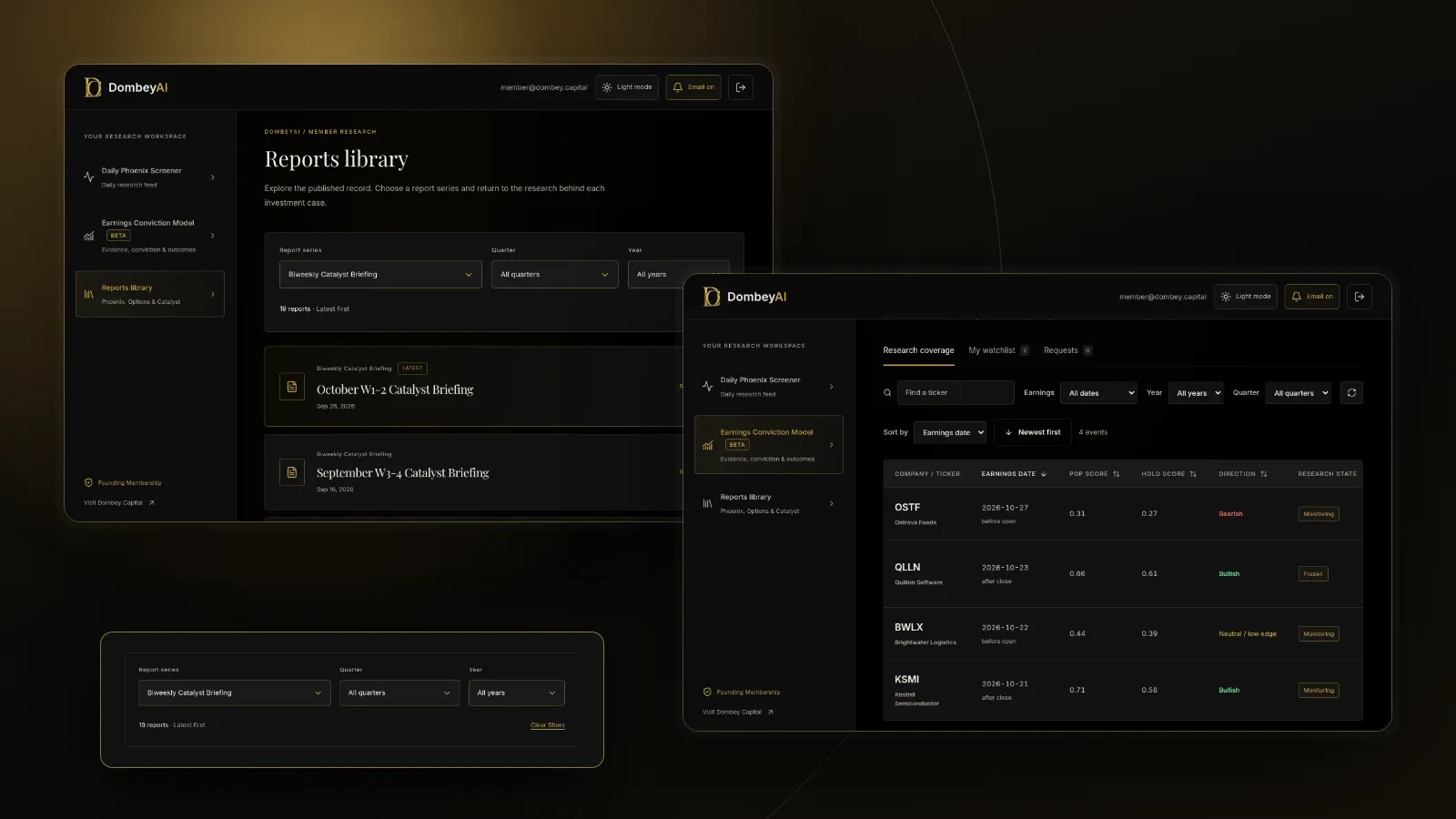
Pricing. Founding Membership is $1,200 per year and includes the weekly Phoenix Report, weekly Options Research, the Biweekly Catalyst Briefing, the DombeyAI Portal with the Daily Phoenix Screener and the Earnings Conviction Model, valuation and execution analysis, and priority access. Standard Access is the lower-cost option at $6.67 per month and includes the Biweekly Catalyst Briefing and the complete public-research archive. The Public Archive is free.
Pros
- Every idea is tied to a dated catalyst, which makes the outcome easy to judge.
- Theses stay in a dated archive with the price on the day.
- A low-cost entry tier and a free archive to sample first.
Cons
- Narrow coverage from a small team; the full list is in the section on where Dombey falls short.
- Not a data platform or screener for the general market.
Verdict: Our top pick for readers who want written research on special situations with dated catalysts.
2. Stock Spin-off Investing
What it does. Stock Spin-off Investing, founded by Rich Howe, publishes research on spin-offs and related special situations. The newsletter delivers one new recommendation a month, about twelve a year, with a detailed write-up, plus a weekly email on news affecting current and past recommendations, a live monthly video call and a members-only Discord community. If spin-offs are new to you, start with our guide to spin-off investing.
Best for. Investors who want to specialize in spin-offs.
Pricing. The newsletter is $97 per month or $697 per year, with a 30-day money-back policy. SSI Pro is $1,497 per year and adds a watchlist document, live video presentations and direct access to the founder by phone and email.
Pros
- Deep focus on one event type.
- Regular contact through video calls and a community chat.
Cons
- Covers mainly spin-offs, so mergers, tenders and liquidations get less attention.
- The monthly price is high relative to the annual plan.
Verdict: The specialist pick for spin-off investors.
3. InsideArbitrage
What it does. InsideArbitrage is an event-driven research platform. Its pages list a Special Situations Newsletter with mid-month updates, merger arbitrage tools and deal tracking, insider buying screens, buyback tracking, a spin-off screen and a model portfolio. It also runs a Substack covering merger arbitrage, spin-offs, insider transactions, buybacks and management transitions.
Best for. Readers who want screens and deal tracking alongside a monthly idea letter.
Pricing. The subscription page did not display prices when we read it. See the vendor's pricing page.
Pros
- Covers several event types in one place.
- Tools let you track deals yourself, not only read about them.
Cons
- More tool than narrative; less depth per idea than a single-topic letter.
- Pricing is not shown publicly without clicking through.
Verdict: The best fit for readers who want merger arbitrage tools and a monthly letter together.
4. Undervalued-Shares.com
What it does. Undervalued-Shares.com is written by Swen Lorenz. Its site describes coverage of frontier and emerging markets, UK equities, litigation and legal special situations, and private equity and M&A targets. A free weekly email goes to all readers.
Best for. Investors who want unusual ideas outside the US large-cap universe.
Pricing. Weekly Dispatches are free. Annual Membership is $149 per year, with up to 10 in-depth research reports a year and access to more than 65 archived reports. Lifetime Membership is $999 once.
Pros
- Low annual price for long-form reports.
- Covers markets and situations few others touch.
Cons
- A small number of reports a year.
- International ideas can be harder to trade from a US brokerage account.
Verdict: A good value pick for globally minded readers.
5. Yet Another Value Blog
What it does. Yet Another Value Blog is a Substack written by Andrew Walker that describes its focus as "a modern value investor's eye to quirky special situations." It also runs a podcast with other investors.
Best for. Readers who want one writer's view on unusual situations and like interview formats.
Pricing. The subscribe page did not display prices when we read it. See the vendor's pricing page.
Pros
- Clear focus on special situations.
- Free posts and podcast episodes to sample.
Cons
- One writer, so coverage depends on his interests.
- No dated, priced archive of every call in the way a formal service would keep.
Verdict: A strong single-writer source for curious readers.
6. Value Investors Club
What it does. Value Investors Club is an invitation-style community where members post detailed investment write-ups. Guests who sign up with an email address see ideas on a 45-day delay. Full access requires an application that includes a current investment recommendation.
Best for. Readers who want long-form ideas for free and can accept the delay.
Pricing. Guest access is free. Full membership is by application rather than by fee.
Pros
- Many detailed special situation write-ups.
- Free to read on a delay.
Cons
- The 45-day delay matters for situations with a near catalyst.
- Write-ups are not edited to a house view, so quality varies.
Verdict: The best free library of ideas, with a lag.
7. SumZero
What it does. SumZero describes itself as a professional investor community for analysts and portfolio managers at hedge funds, mutual funds and private equity firms. Members post research or pay for a read-only license to the research database.
Best for. Buy-side professionals who can share their own research.
Pricing. See the vendor's pricing page. SumZero's homepage did not list prices.
Pros
- Research from professional investors across many styles.
- Free rankings and a compensation database for members.
Cons
- Built for professionals; individual investors may not qualify.
- Not focused only on special situations.
Verdict: Worth it for professionals who can contribute; less relevant for individuals.
8. The Deal
What it does. The Deal provides news and a dealmaking database covering mergers and acquisitions, private equity, shareholder activism and restructuring. Its audience is private equity firms, banks, law firms and hedge funds.
Best for. Professionals who need broad, timely coverage of deals and activist campaigns.
Pricing. See the vendor's pricing page. The site directs readers to request a demo.
Pros
- Wide coverage of M&A, activism and restructuring.
- A searchable deal database.
Cons
- News and data, not investment theses.
- Priced and sold for institutions.
Verdict: A news source for professionals, not an idea letter.
9. Octus
What it does. Octus, formerly Reorg, sells credit intelligence, proprietary data and workflow tools covering leveraged loans, high-yield bonds, private credit, distressed situations and restructurings. Its clients are asset managers, banks, law firms and advisers.
Best for. Institutional investors working on distressed debt and restructurings.
Pricing. See the vendor's pricing page. Octus sells through demos.
Pros
- Deep coverage of bankruptcies and restructurings.
- Expert-verified reporting on credit documents.
Cons
- Credit-focused, so equity special situations are secondary.
- Institutional pricing and sales process.
Verdict: The specialist pick for distressed credit professionals.
10. Substack special situations writers
What it does. Many independent analysts publish special situations newsletters on Substack. Each writer sets the price and frequency. Substack says writers keep 90% of revenue minus credit card fees.
Best for. Readers who want a sustained view on one niche, such as small-cap liquidations or a single country.
Pricing. Set by each writer.
Pros
- Wide choice of niches and free posts to sample.
- Direct contact with the writer.
Cons
- Quality and record keeping vary widely.
- Writers can stop publishing at any time.
Verdict: Useful if you vet the writer and check the archive first.
Where Dombey falls short
Dombey is built for depth on a narrow set of situations. Its limits are specific:
- Narrow coverage. It covers special situations and dated catalysts only. A company with no event ahead will not be in it.
- No data terminal. There is no broad screener or financial database for the general market. You still need SEC EDGAR or a data tool to check filings yourself.
- Small team. The number of situations covered at any time is limited.
- Pen-name author. The research is published under a pen name, which some readers prefer not to rely on.
- Short history. The archive is young compared with long-running letters, so there is less record to examine.
Free vs paid
You can learn this style of investing without paying. Value Investors Club's guest access, Dombey's Public Archive, free Substack posts and Undervalued-Shares.com's weekly email all cost nothing. SEC EDGAR, where Form 10 spin-off filings, merger proxies and tender offer documents are filed, is free too.
Paying makes sense in three cases:
- If timing matters, because a delayed idea on a merger closing in six weeks is worth little.
- If you want the mechanics explained, such as how a tender offer prorates or what a CVR is worth.
- If you want a record, so you can judge the source by its past calls before trusting the next one.
How to choose
| Your situation | Pick | Add later when |
|---|---|---|
| You follow several event types with dated catalysts | Dombey CapitalTop pick | You want a spin-off specialist: add Stock Spin-off Investing |
| You only want spin-offs | Stock Spin-off Investing | You want merger deals too: add InsideArbitrage |
| You trade announced mergers | InsideArbitrage | You want written theses: add Dombey Capital |
| You want offbeat international ideas | Undervalued-Shares.com | You want US event coverage: add Dombey Capital |
| You want free ideas and can wait | Value Investors Club | You need timeliness: add a paid letter |
| You work on distressed credit | Octus | You also need M&A news: add The Deal |
If you are new to the category, read our explainers on merger arbitrage and stock catalysts first. They will help you judge which letter explains the mechanics well.
The bottom line
Dombey Capital is our top pick for readers who want written research on special situations with dated catalysts, with Founding Membership at $1,200 a year for the weekly Phoenix Report, Options Research and the DombeyAI Portal, and Standard Access at $6.67 a month as the lower-cost option. Stock Spin-off Investing is the specialist for spin-offs, InsideArbitrage pairs a monthly letter with merger arbitrage tools, and Undervalued-Shares.com is the low-cost pick for offbeat global ideas. Value Investors Club is the best free library if you can accept the delay. Choose by the events you follow, and check every service's archive before you pay.