

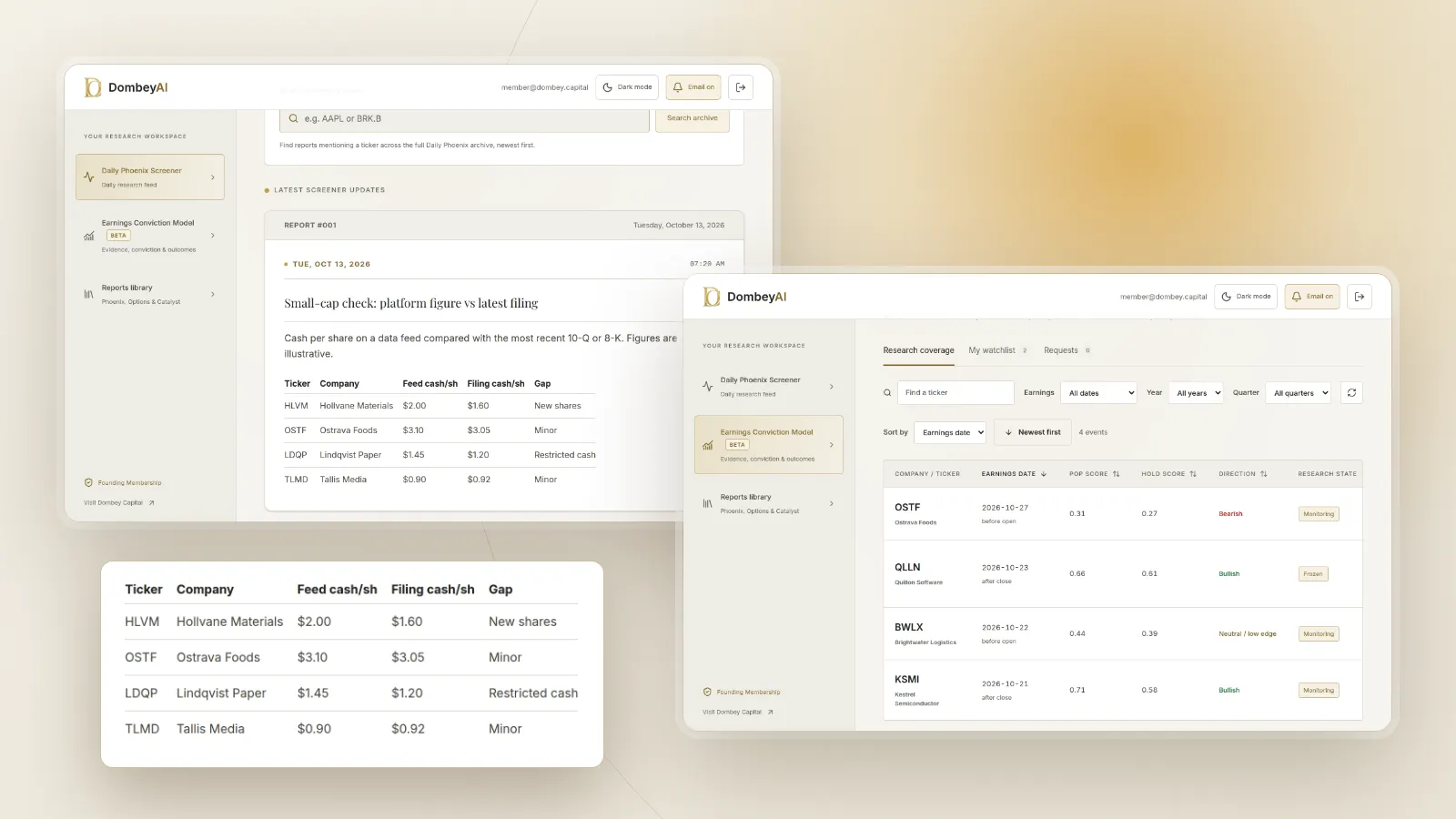


Full disclosure: Dombey Capital is our own research service and our top pick here, for the reasons below. The section on where it falls short is there so you can judge whether it fits your process.
Quick comparison
| Tool | Best for | Key features | Price (as of October 2026) |
|---|---|---|---|
| Dombey CapitalTop pick | Small-cap special situations with a dated catalyst | Weekly Phoenix Report, Biweekly Catalyst Briefing, DombeyAI Portal, dated archive | Free archive; Founding $1,200/year; Standard $80/year or $8/month |
| Stock Rover | Screening a wide universe, including OTC | 400 to 800+ metrics; OTC screening and ~6,000 more tickers on Ultimate | Free plan; Premium $348/year to Ultimate Pro $1,788/year |
| Koyfin | Dashboards and statements on global small caps | 10 years of financials and estimates, filings and transcripts on Plus | Free; Plus $39/month, Premium $79/month billed annually |
| TIKR | Low-cost statement history and transcripts | Full global data and 10 years of history on Plus | Free; Plus $24.95/month to Ultimate $119.95/month |
| Finviz | Fast first-pass US screens | Screener, 8 years of statements and alerts on Elite | Free; Elite $39.50/month or $299.50/year |
| TradingView | Price and liquidity on the chart | Screeners across 150+ exchanges, 500+ fields | Free Basic; paid from $12.95/month billed annually |
| Simply Wall St | A visual first look at an unfamiliar company | Snowflake reports, screener, portfolio tracking | Free plan; see the vendor's pricing page |
| Yahoo Finance | Free quotes, news and holdings | Research reports and fair value on Silver; ~40 years of statements on Gold | Free; Bronze $95.40/year to Gold $479.40/year |
| Seeking Alpha Premium | Contributor views on less followed names | Quant ratings, screeners, analysis on 4,000+ stocks and ETFs | $299/year |
| SEC EDGAR | Primary filings for any SEC filer | Every 10-K, 10-Q, 8-K and proxy; full-text search since 2001 | Free |


How we compared these tools
We compared these platforms from vendor documentation, pricing pages and public product pages, read on October 13, 2026. We did not use paid accounts for this article and make no claims about any tool's returns or the accuracy of its data or ratings.
The weights reflect what changes when the company is small. A large-cap investor can assume coverage. A small-cap investor cannot, so coverage of thinly followed stocks and access to the primary filing carry the most weight.
| Criterion | Weight | What it measures |
|---|---|---|
| Coverage of thinly followed stocks | 25% | Whether small, OTC and low-coverage companies appear with usable data |
| Primary source access | 20% | Whether filings and transcripts sit next to the numbers |
| Catalyst and event coverage | 20% | Whether dated events such as tenders, spin-offs, votes and earnings are surfaced |
| Screening depth | 15% | Metrics, filters and the size of the screenable universe |
| Price and free tier | 20% | What the free plan covers and what the plan you need costs |
If you weight screening depth and price above catalyst coverage, Stock Rover, Koyfin and TIKR move up and Dombey moves down. If you only look at exchange-listed small caps, the OTC point in Stock Rover's favor matters less.
Quick picks by job
Best for small-cap special situations with a dated catalyst: Dombey Capital
Dombey publishes research on small caps priced below cash or book, spin-offs, tender offers, mergers and other events with a date attached, and keeps each thesis in a dated archive. Coverage is narrow by design. Use it beside a data tool, not in place of one.
Best for screening a wide universe including OTC: Stock Rover
The Ultimate plan lists OTC stock screening and about 6,000 additional tickers, alongside 800+ metrics and 20 years of fundamentals.
Best for dashboards on global small caps: Koyfin
The Plus plan covers 100K+ global company snapshots, with 10 years of financials and estimates, filings and transcripts.
Best for statement history on a budget: TIKR
Full global data and 10 years of financials from $24.95 a month, with longer transcript history on higher plans.
Best for fast first-pass US screens: Finviz
A free screener that loads quickly, with real-time data, alerts and export on Elite.
Best for checking price and liquidity: TradingView
Charts first, which is where you see how thinly a small cap trades before you size a position.
Best for a visual first look: Simply Wall St
A one-page visual report on a company you have never heard of, before you open the filing.
Best free base for quotes and news: Yahoo Finance
Free quotes, news and portfolio tracking, with paid tiers that add research reports and long statement history.
Best for contributor views on less followed names: Seeking Alpha Premium
A large volume of outside contributor analysis, which sometimes reaches companies no sell-side analyst covers.
Best primary source: SEC EDGAR
Free access to every SEC filing, which for an uncovered small cap is often the only complete record.
Full reviews
1. Dombey Capital
What it does. Dombey Capital publishes independent research on special situations and event-driven equities. Much of that work sits in small caps: companies priced below net cash per share or below tangible book, post-restructuring equities, spin-offs and companies with a legal or corporate catalyst. Each thesis is published before its catalyst and kept in the research archive, so the original case can be compared with what happened next.
Best for. Small-cap investors who look for events with a date attached and want written analysis rather than another screen.
Pricing. Founding Membership is $1,200 a year, annual billing only, and includes the weekly Phoenix Report, weekly Options Research, the Biweekly Catalyst Briefing, the DombeyAI Portal with the Daily Phoenix Screener and the Earnings Conviction Model, valuation and execution analysis, and priority access. Standard Access is the lower-cost option at $80 a year (about $6.67 a month) or $8 a month on monthly billing, and includes the Biweekly Catalyst Briefing and the complete public-research archive. The Public Archive is free.
Pros
- Covers small-cap situations that data platforms show only as a price and a news line.
- Each thesis is tied to a dated catalyst.
- Valuation and execution analysis address liquidity, which matters most in small caps.
- A free archive and a low-cost entry tier.
Cons
- Narrow coverage; it will have no view on most small caps.
- Not a screener or a financial database.
Verdict: Our top pick for small-cap investors who follow special situations and dated catalysts. Keep a data tool and EDGAR beside it.
2. Stock Rover
What it does. A research, screening and portfolio platform. Its plans page lists over 8,500 stocks, 7,000+ ETFs and 40,000+ funds on Premium, and adds percentile screening, OTC stock screening and about 6,000 additional tickers on Ultimate.
Best for. Investors whose small-cap universe reaches below the main exchanges and who build their own screens.
Pricing. Premium is $348 a year or $34 month to month, Premium Plus $588 a year or $70, Ultimate $948 a year or $99, and Ultimate Pro $1,788 a year or $199. Two-year billing costs less. A free plan covers basic research on individual stocks, and every paid plan has a 14-day free trial with no credit card requested.
Pros
- OTC screening on Ultimate and above, which few platforms in this list state.
- 400 metrics on Premium, 700+ on Premium Plus and 800+ on Ultimate.
- Up to 20 years of fundamentals on Ultimate.
Cons
- OTC coverage needs the Ultimate plan.
- A long learning curve.
Verdict: The strongest screening tool here for a small-cap universe that includes OTC names. Our list of stock screeners for value investors compares it with other screening tools in more detail.
3. Koyfin
What it does. A market data, charting and dashboard platform. The Plus plan lists 100K+ global company snapshots, 10 years of financials and estimates, unlimited watchlists and screens, and press releases, filings and transcripts.
Best for. Investors who follow small caps across several markets and want statements, filings and charts in one place.
Pricing. Free plan with 2 years of financials, 1 year of estimates, 2 watchlists and 2 screens. Plus is $39 a month and Premium $79 a month on annual billing; on monthly billing they are $49 and $110. Advisor plans cost more.
Pros
- Filings and transcripts beside the numbers on Plus.
- Wide global coverage.
- A usable free tier.
Cons
- No written analysis or opinion.
- Estimates fields are often empty for uncovered small caps, as on any data platform.
Verdict: The best dashboard tool here for small-cap investors who form their own view.
4. TIKR
What it does. A fundamentals and transcripts platform with full global data on paid plans.
Best for. Investors who read financial statements and earnings calls and want history at a modest price.
Pricing. Free covers the US with 5 years and 8 quarters of history and 90 days of transcripts. Plus is $24.95 a month with full global data, 10 years of history and 1 year of transcripts. Pro is $54.95 with 40 quarters and 10 years of transcripts, and Ultimate $119.95 with 30 years of history and full transcript history. New users get a 14-day money-back guarantee.
Pros
- Global data on every paid plan.
- Low entry price for 10 years of statements.
Cons
- No ratings or editorial analysis.
- The free plan is US only and holds one saved screen.
Verdict: The best value here for reading small-cap statements across markets.
5. Finviz
What it does. A stock screener and market visualization site known for its free screener.
Best for. A fast first pass across US-listed small caps before you open a filing.
Pricing. Free with delayed quotes, basic screener filters and 3 years of statements. Elite is $39.50 a month or $299.50 a year and adds real-time data, advanced filters, 8 years of statements, unlimited alerts and Excel or CSV export.
Pros
- Quick to learn and quick to run.
- A generous free plan.
Cons
- US-focused.
- Statement history is short for multi-cycle small caps.
Verdict: The quickest way to build a first small-cap watchlist.
6. TradingView
What it does. A charting platform with screeners covering 150+ exchanges in 50+ countries and 500+ fundamental and technical fields.
Best for. Checking how a small cap trades: price history, volume and gaps around past events.
Pricing. A free Basic plan. Paid plans billed annually: Essential $12.95 a month, Plus $29.95, Premium $59.95 and Ultimate $199.95. Paid plans show 20 years of annual financial data on charts; Basic shows 7.
Pros
- The strongest charting in this list.
- Wide international coverage.
Cons
- Fundamentals are secondary to charts.
- No research of its own beyond community ideas.
Verdict: Useful for liquidity and price checks. Thin trading distorts more than charts; see why wide spreads distort options signals.
7. Simply Wall St
What it does. Visual company reports built around the Snowflake summary, with a screener and portfolio tracking.
Best for. A first look at an unfamiliar small cap.
Pricing. A Free plan with 5 company reports a month, one portfolio and the top 4 results per screener. Premium raises reports to 30 a month and Unlimited removes the limit. The plans page did not show prices when we read it, so see the vendor's pricing page. New accounts start with 7 days of Premium access with no credit card required.
Pros
- Easy to read.
- A permanent free plan.
Cons
- Fair values lean on analyst estimates, which many small caps lack.
- Report limits on the free plan.
Verdict: A good first screen for orientation; read the filing before trusting the fair value.
8. Yahoo Finance
What it does. Free quotes, news, screeners and portfolio tracking, with paid tiers that add research.
Best for. A free daily check on small-cap prices, news and holdings.
Pricing. Free. Bronze is $95.40 a year, Silver $239.40 a year with company research reports, Morningstar Ratings and fair value analysis, and Gold $479.40 a year with about 40 years of statements and CSV downloads. Gold has a 7-day free trial.
Pros
- Free and familiar.
- Long statement history on Gold.
Cons
- Paid research reports favor widely followed companies.
- Deeper features sit on the higher tiers.
Verdict: A sensible free base, not a small-cap research tool on its own.
9. Seeking Alpha Premium
What it does. Seeking Alpha's flagship research service, with data-driven stock ratings and screeners, AI research tools and analysis on over 4,000 stocks and ETFs.
Best for. Readers who want outside views on companies that have little or no sell-side coverage.
Pricing. $299 a year, plus taxes and VAT where applicable.
Pros
- Contributor analysis sometimes reaches names no analyst covers.
- Ratings and screeners in one place.
Cons
- Most analysis comes from outside contributors, so quality varies.
- Coverage of the smallest companies is uneven.
Verdict: Worth it if you want more viewpoints and will check each one against the filing.
10. SEC EDGAR
What it does. The SEC's free database of company filings. Full-text search covers electronic filings since 2001 and can be refined by entity, form, date range and location.
Best for. Reading the source documents for any company that files with the SEC, listed or OTC.
Pricing. Free.
Pros
- The primary source for every figure on every platform above.
- Full-text search finds terms such as "going concern" or "tender offer" across filings.
Cons
- No ratio screening.
- Raw documents take time to read.
Verdict: Essential for small caps. Our guide on how to search SEC EDGAR filings covers the workflow, and how to read a 10-Q for special situations shows what to check first.
Where small-cap data goes wrong
Every platform here draws on the same filings, and small caps expose the gaps between them.
- Stale or missing estimates. A company with one analyst has a consensus of one. Any rating or fair value that uses it inherits that single view.
- Share count lag. Small caps issue shares often. A data feed may show last quarter's count while an 8-K reports a new offering, which changes per-share figures.
- Mapping errors. Unusual items such as restricted cash, preferred stock or a recent restructuring are sometimes mapped differently from one vendor to the next.
- Thin trading. A quoted price may reflect a small trade. Volume and spread matter as much as price.
This is why reading the filing is part of small-cap research, not a final check. Our piece on primary vs secondary sources in equity research covers when a platform figure is good enough and when it is not.
Where Dombey falls short
Dombey is built for depth on a narrow set of situations. Its limits for small-cap investors are specific:
- Narrow coverage. Special situations and dated catalysts only. Most small caps will never appear in the research.
- No data terminal. There is no general screener or financial database. You still need a tool such as Stock Rover, Koyfin or TIKR, and EDGAR.
- Small team. The number of situations covered at any time is limited.
- Pen-name author. The research is published under a pen name, which some readers prefer not to rely on.
- Short history. The archive is young, so there is less record to examine than older services offer.
Free vs paid
A small-cap research setup can cost nothing. EDGAR for filings, TIKR or Koyfin's free plan for statements, Finviz for a first screen and TradingView's Basic plan for charts cover most of the work on US-listed names. Dombey's Public Archive adds written research on special situations at no cost.
Paying makes sense when a specific limit gets in the way:
- If your universe includes OTC stocks, Stock Rover's Ultimate plan is the paid tier that lists OTC screening.
- If you follow small caps outside the US, a paid TIKR or Koyfin plan adds global data.
- If you want written analysis on dated small-cap situations, Founding Membership includes the weekly Phoenix Report and the DombeyAI Portal, and Standard Access is the lower-cost option with the Catalyst Briefing.
- If you need alerts or export from a screener, Finviz Elite adds both.
For short interest in small caps, which can be large relative to the float, see the 10 best short interest data tools.
How to choose
Start from the job you need done, then add a second tool only if it does something the first does not.
| Your situation | Pick | Add later when |
|---|---|---|
| You follow small caps with a dated catalyst | Dombey Capital plus EDGARTop pick | You want your own screens: add Stock Rover or Finviz |
| Your universe includes OTC stocks | Stock Rover Ultimate | You want written analysis: add Dombey |
| You follow small caps in several countries | Koyfin or TIKR | You need longer transcript history: move up a TIKR tier |
| You are building a first watchlist | Finviz free plus EDGAR | You need alerts or export: add Finviz Elite |
| You want a quick read on an unfamiliar name | Simply Wall St free | You need more than 5 reports a month |
| You trade around events and care about liquidity | TradingView plus EDGAR | You want catalyst research: add Dombey |
The bottom line
Our top pick for small-cap investors who follow special situations with a dated catalyst is Dombey Capital, which is written research and a member portal rather than a data platform. For screening a universe that includes OTC names, Stock Rover's Ultimate plan is the clearest fit, and Koyfin or TIKR are the best statement readers. Whatever you choose, small caps reward reading the filing, so keep EDGAR open beside the platform. Most readers need one data tool and one source of analysis, not five subscriptions.