



Full disclosure: Dombey Capital is our own research service and our top pick here, for the reasons below. The section on where it falls short is there so you can judge whether it fits your process.
Quick comparison
| Tool | Best for | Key features | Price (as of October 2026) |
|---|---|---|---|
| Dombey Founding MembershipTop pick | Spin-offs and dated catalysts written up as research | Weekly Phoenix Report, Daily Phoenix Screener, Biweekly Catalyst Briefing, valuation and execution analysis | Founding Membership $1,200/year, annual billing; Standard Access $80/year or $8/month |
| SEC EDGAR | Free Form 10s, information statements and 8-Ks | Full-text search since 2001, form type and date filters, RSS by company, CIK or form type | Free |
| InsideArbitrage | Free spin-off list with filings attached | Upcoming and completed filter, announced and expected dates, press release and SEC filing links, spin-off news | Free list; sorting is premium; see the vendor's pricing page |
| Stock Spinoffs | Free spin-off calendar and news | Upcoming spin-offs calendar, recent and past spin-off lists, news and analysis, email updates | Free to read; no price shown on the site |
| Stock Spin-off Investing | Paid spin-off recommendations | Upcoming and completed spin-off lists, newsletter, SSI Pro research service | SSI Pro $1,497/year |
| Value Investors Club | Long-form idea write-ups | Member write-ups and discussion, 45-day delayed access by email sign-up | Email sign-up for delayed ideas; no price shown |
| Koyfin | Prices and financials on parent and spin-off | Charts, financials, screener, watchlists, filings and transcripts on paid plans | Free; Plus $39/month and Premium $79/month billed annually; monthly billing $49 and $110 |
| Parent company investor relations pages | First word on terms and timing | Press releases, investor day presentations, separation updates | Free |


How we compared these tools
We compared these sources from vendor documentation, pricing pages and public product pages read in October 2026, and from the SEC's own pages and forms. We did not run trials with any of them, and we make no judgment on any vendor's speed or accuracy beyond what the vendor states.
| Criterion | Weight | What it measures |
|---|---|---|
| Documents and terms | 25% | Access to the 8-K, Form 10, information statement and separation agreements, and the terms inside them |
| Dates and tracking | 25% | Announced, record, when-issued and distribution dates, and whether new spin-offs are flagged |
| Interpretation | 25% | Whether it helps you judge the new company's value, debt and standalone costs |
| Coverage breadth | 10% | How many announced spin-offs it lists |
| Cost for the job | 15% | What it costs to follow a working list of spin-offs |
If you weight coverage breadth higher, for example because you want to see every spin-off before choosing which to study, the free trackers move up and the research services move down. If cost matters most, EDGAR, investor relations pages and the free lists cover the documents and dates without a subscription.
Quick picks by job
Best for spin-offs and dated catalysts written up as research: Dombey Founding Membership
Founding Membership is written research, not a spin-off screen. The weekly Phoenix Report covers selected special situations and earnings-related opportunities, each thesis is published before its catalyst, and when a spin-off is in coverage the work reads the Form 10, the information statement and the parent's filings. It suits readers who want a view on what the new company is worth and what could go wrong, not only a list of upcoming separations.
Best free source for spin-off documents: SEC EDGAR
The Form 10, the information statement filed with it, its amendments and the parent's 8-Ks all land on EDGAR. Full-text search reaches back to 2001 and filters by form type and date, and RSS feeds follow a company or a form type.
Best free spin-off list with filings attached: InsideArbitrage
InsideArbitrage's spin-off table lists the new company, the parent, the announced date, the expected timing and links to press releases and SEC filings, with a filter for upcoming or completed spin-offs.
Best free spin-off calendar and news: Stock Spinoffs
Stock Spinoffs says it tracks upcoming spin-offs, recent separations, when-issued trading, distribution dates and valuation analysis, and it keeps an upcoming spin-offs calendar alongside dated news articles.
Best paid spin-off recommendation service: Stock Spin-off Investing
Rich Howe's Stock Spin-off Investing sells SSI Pro, a research service with about one new recommendation a month and weekly emails on the names it covers.
Best for long-form idea write-ups: Value Investors Club
Value Investors Club publishes investment write-ups by its members. It is not organized around spin-offs, but its write-ups are long and argued, which is useful once you have a name to study.
Best for prices and financials on both sides: Koyfin
Koyfin puts charts, financials, filings and transcripts in one window, which helps when you want to compare the parent before and after the separation.
Best first word on terms: parent company investor relations pages
The parent announces the separation, the expected timing and later updates through press releases and investor presentations, usually before the details reach a third-party list.
Full reviews
1. Dombey Founding Membership
What it does. Founding Membership is Dombey Capital's full research suite: the weekly Phoenix Report, weekly Options Research, the Biweekly Catalyst Briefing, and the DombeyAI Portal with the Daily Phoenix Screener and the Earnings Conviction Model, plus valuation and execution analysis and priority access. The Daily Phoenix Screener gives a view each trading morning of situations relevant to Dombey's coverage. When a spin-off is in coverage, the research reads the Form 10 and information statement and sets out the thesis, the dates and what could break it. Published work is in the research archive.
Best for. Readers who follow special situations and dated catalysts and want a spin-off read and valued, not only listed.
Pricing. Founding Membership is $1,200 a year, billed annually. Standard Access is the lower-cost option at $80 a year, about $6.67 a month, or $8 a month on monthly billing, and includes the Biweekly Catalyst Briefing and the complete public-research archive. The Public Archive is free.
Pros
- Interpretation of the separation terms, debt and standalone costs, which a list does not provide.
- Each thesis is published before its catalyst and kept in the archive, so you can compare the case with the outcome.
- Spin-offs sit next to other dated catalysts, so one service covers the calendar.
Cons
- It is not a spin-off database; it does not list every announced separation.
- Coverage is limited to the situations Dombey writes about.
Verdict: Our top pick for readers who want spin-offs and other dated catalysts turned into research. Pair it with EDGAR and a free spin-off list for names outside its coverage.
2. SEC EDGAR
What it does. EDGAR holds every document a spin-off produces. The parent's 8-Ks report material agreements and other events. The new company's Form 10 registers its shares under Section 12(b) or 12(g) of the Exchange Act; EDGAR labels the exchange-listing version 10-12B. The information statement, usually filed as an exhibit, describes the business, the risks, the pro forma financials, the debt, management pay and the agreements with the parent. Full-text search covers electronic filings since 2001 and filters by form type, date range, location and entity. RSS feeds follow one company or the latest filings by company, CIK or form type.
Best for. Anyone who wants the primary source at no cost. Our guide on how to search SEC EDGAR filings covers the mechanics.
Pricing. Free.
Pros
- The terms, the debt and the separation agreements come straight from the filings.
- An RSS feed on new 10-12B filings catches announced spin-offs across the market.
Cons
- No calendar, summaries or valuation.
- The SEC states its email update service is not available for company filings, so alerts mean RSS or a third-party tool.
Verdict: Essential and free. Read the information statement here before relying on any summary of it. For more filing tools, see the best SEC filing tools and EDGAR alerts.
3. InsideArbitrage
What it does. InsideArbitrage is an event-driven research site with a spin-off section. Its table lists each spin-off with the announced date, the potential spin-off date, the parent's name and symbol, the type of transaction and links to resources such as press releases and SEC filings, with a filter for upcoming or completed spin-offs. Each entry has a detail page with updates, and the site runs a spin-off news section. The expected date is often a range rather than a fixed day. The site states that premium members can sort the table by name, announced date, parent and type. It also covers merger arbitrage, insider buying and other events.
Best for. Individual investors who want a free running list of spin-offs with the filings one click away.
Pricing. The list is free to read and a premium tier adds features. We could not read a current price on its pages; see the vendor's pricing page.
Pros
- Upcoming and completed spin-offs in one table, with links to the source documents.
- Sits alongside merger and insider data on the same site.
Cons
- Sorting and other features sit behind the premium tier.
- Expected dates are often broad ranges until the parent sets the record date.
Verdict: The most useful free spin-off list here when you want the filings attached.
4. Stock Spinoffs
What it does. Stock Spinoffs describes itself as tracking "upcoming corporate spinoffs, recent separations, when-issued trading, distribution dates, and valuation analysis." It runs an upcoming spin-offs calendar, lists of recent and past spin-offs, an explainer on Reverse Morris Trust deals, and a news and analysis section with dated articles. Articles are credited to contributors writing under pen names, and the site offers email updates.
Best for. Readers who want a calendar and short news coverage of spin-offs in one place.
Pricing. Free to read. The site has an email signup and a subscribe link, and we found no paid tier or price on it.
Pros
- A dedicated calendar of upcoming spin-offs.
- Covers when-issued trading and distribution dates, which matter for timing.
Cons
- The site does not name its operator, and contributors use pen names.
- News and short analysis, not full valuation work on each name.
Verdict: A good free calendar to keep open beside EDGAR.
5. Stock Spin-off Investing
What it does. Stock Spin-off Investing is run by Rich Howe and focuses on spin-offs. The site keeps lists of upcoming and completed spin-offs, publishes company write-ups and podcasts, and offers a newsletter, a course and a paid service. SSI Pro includes about one new recommendation a month with a detailed write-up, weekly emails on news and analysis, a monthly live video call, a members' Discord chat, direct phone and email access to the author, a watch list and video presentations for each new idea.
Best for. Investors who want a specialist to pick spin-offs and explain the case.
Pricing. SSI Pro is $1,497 a year, with a 30-day money-back guarantee, according to the vendor's page. The free newsletter requires only an email address.
Pros
- A service built only around spin-offs.
- Direct access to the author and a live monthly call.
Cons
- The most expensive specialist option on this list.
- Recommendations come from one author's view; the site cites studies of spin-off performance without giving their methods.
Verdict: The clearest paid choice for readers who want spin-off recommendations and nothing else.
6. Value Investors Club
What it does. Value Investors Club is a community where members post investment write-ups and discuss them. Signing up with an email address gives access to ideas on a 45-day delay. Full access requires an online application that includes a current investment idea of your own. It covers every kind of situation, not only spin-offs.
Best for. Readers who already have a spin-off in mind and want to see whether someone has argued the case in depth.
Pricing. Email sign-up gives delayed access. The site shows no price for membership.
Pros
- Long, reasoned write-ups by practicing investors.
- Member discussion often raises points a summary misses.
Cons
- Not a tracker; you cannot use it to find upcoming spin-offs.
- Delayed access for non-members, and full membership depends on an accepted application.
Verdict: A research source, not a tracker. Useful after you have found the name elsewhere.
7. Koyfin
What it does. Koyfin is a research terminal with charts, financials, a screener and watchlists. Its pricing page lists filings and transcripts on its paid plans.
Best for. Investors who want to follow the parent and, once it trades, the new company in one place.
Pricing. Free plan available. Billed annually, Plus is $39 a month, Premium $79, Advisor Core $209 and Advisor Pro $299. Monthly billing costs $49, $110, $239 and $349 a month.
Pros
- Prices, financials and filings in one window.
- A free plan to try it.
Cons
- No spin-off features: no list, calendar or alerts for separations.
- A new company has little or no trading history to chart in its first weeks.
Verdict: Convenient for existing users; not a spin-off tool on its own.
8. Parent company investor relations pages
What it does. The parent announces a separation by press release, then updates the market through investor presentations, earnings calls and later releases on the record and distribution dates. Investor day decks often show the segment financials and the planned capital structure before the Form 10 is final.
Best for. Following one or two spin-offs closely from announcement to distribution.
Pricing. Free.
Pros
- The first public word on terms and timing.
- Presentations explain management's reasoning for the separation.
Cons
- One company at a time, with no market-wide view.
- Written by the company, so read it next to the risk factors in the information statement.
Verdict: A free complement to EDGAR for the names you follow.
Where Dombey falls short
Founding Membership does one part of this job, and its limits are real:
- Narrow coverage. It covers the special situations Dombey writes about. Most announced spin-offs will not appear in the research.
- No spin-off database or calendar. There is no list of every pending separation, no when-issued tracker and no spin-off alert system. Use EDGAR, InsideArbitrage or Stock Spinoffs for those.
- No broad data terminal. It does not replace a platform such as Koyfin for prices and financials across the market.
- Small team and pen-name author. The research comes from a small team, and the byline is a pen name. Read the information statement yourself before acting on any summary.
- Short history. Its record is short next to services that have covered spin-offs for many years.
Free vs paid
Free sources cover the core of the job. EDGAR gives you the Form 10, the information statement and the parent's 8-Ks. InsideArbitrage and Stock Spinoffs give you the list and the calendar. The parent's investor relations page gives you the first word on timing.
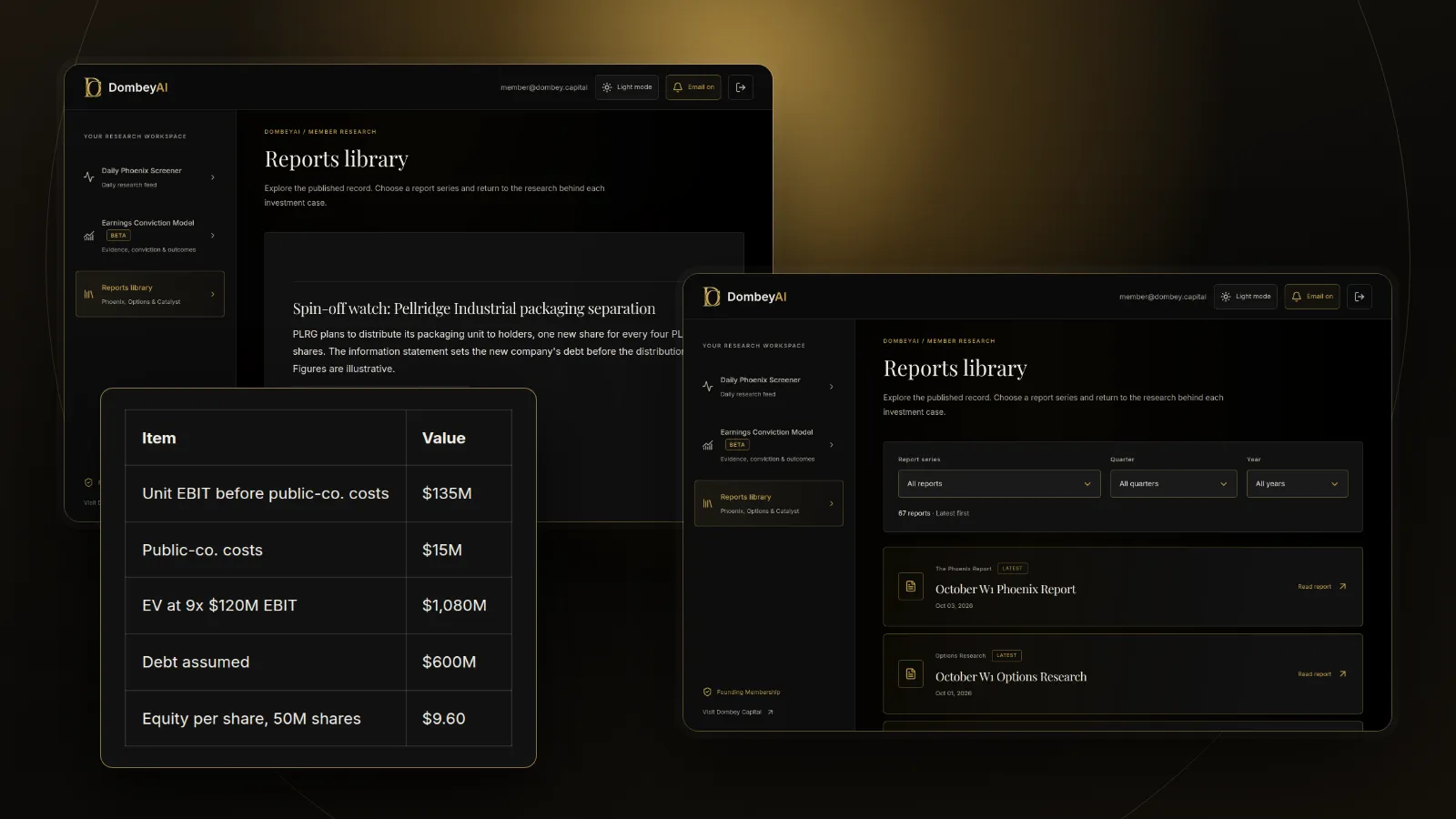
That arithmetic needs the debt, the standalone costs and the share count, and all three come from the information statement, not from a tracker. Our guide on how to do a sum-of-the-parts valuation shows how to value the parent and the spin-off together.
Paid tools buy one of three things: sorting and extra features on a list (InsideArbitrage premium), a specialist's recommendations (SSI Pro), or interpretation within a broader catalyst service. Founding Membership buys interpretation of the spin-offs and other catalysts in Dombey's coverage, with Standard Access as the lower-cost option for the Catalyst Briefing and the archive.
How to choose
Start with the question you need answered, then pick the cheapest source that answers it.
| Your situation | Pick | Add later when |
|---|---|---|
| You want spin-offs and catalysts read and valued | Dombey Founding MembershipTop pick | You follow names outside its coverage: add EDGAR RSS and a free list |
| You follow one or two spin-offs | SEC EDGAR and the parent's investor relations page | You want to see every upcoming deal: add InsideArbitrage or Stock Spinoffs |
| You want a free list of what is coming | InsideArbitrage or Stock Spinoffs | You want interpretation: add Dombey Founding Membership, or Standard Access as the lower-cost option |
| You want spin-off recommendations only | Stock Spin-off Investing | You want other views on a name: add Value Investors Club |
| You track the parent and new company after the split | Koyfin | You need the terms: read the information statement on EDGAR |
- If the Form 10 has just been filed, read the first draft, then compare each amendment; terms and debt levels often change.
- If the record and distribution dates are set, add them to your calendar; see how to build a catalyst calendar.
- If the new company will carry most of the group's debt, value the equity after that debt, not the business before it.
- If you want to know how spin-offs fit with other event-driven setups, see what is a special situation.
The bottom line
Dombey's Founding Membership is our top pick for readers who want spin-offs and other dated catalysts written up as research, with Standard Access at $80 a year as the lower-cost option. It is not a spin-off database, so pair it with SEC EDGAR, which is free and holds every Form 10 and information statement. For a free list, use InsideArbitrage or Stock Spinoffs; for paid spin-off recommendations, Stock Spin-off Investing; and for in-depth member write-ups, Value Investors Club. Whatever you use, read the information statement before you rely on anyone's summary of it.