

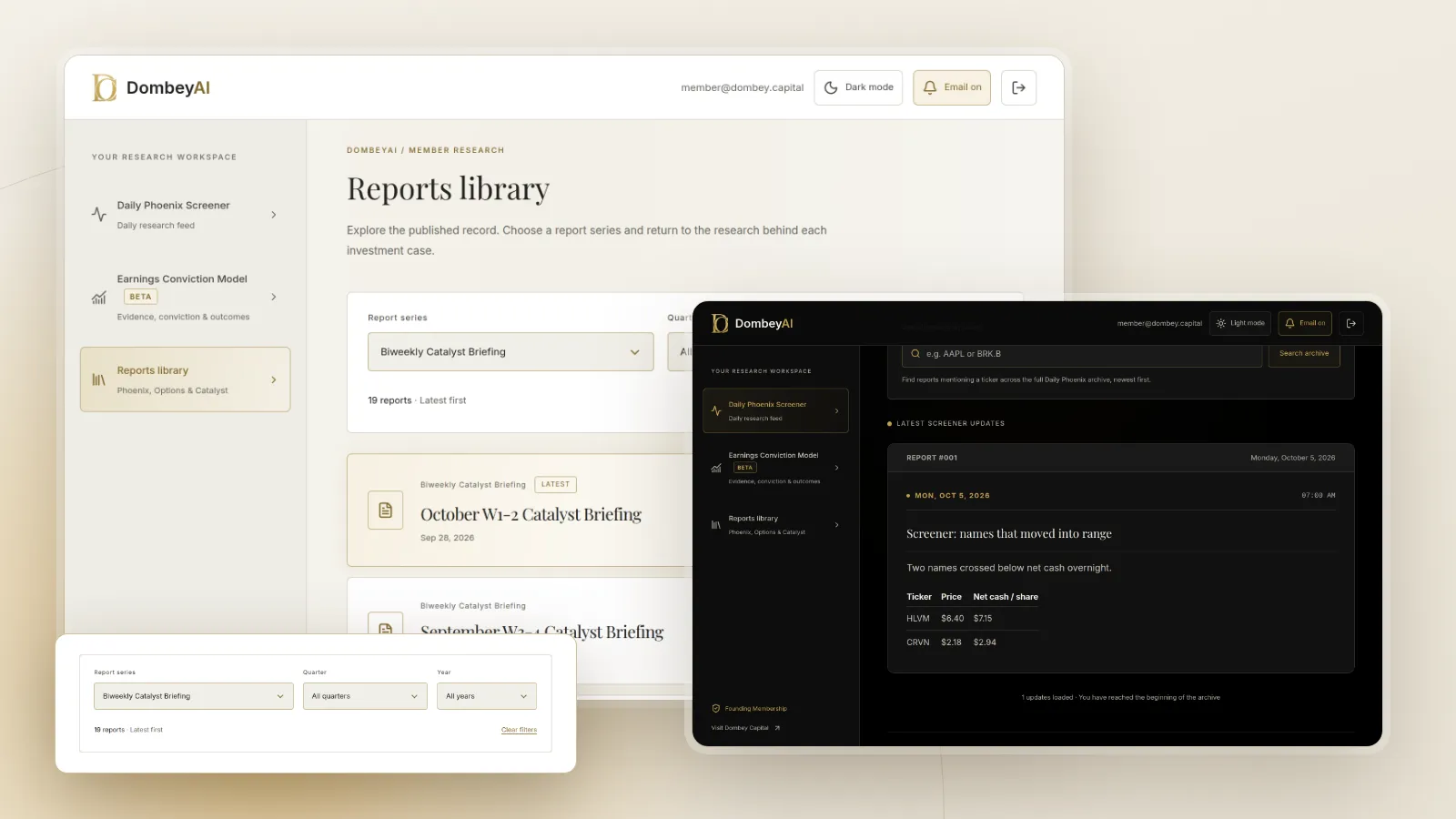


Full disclosure: Dombey Capital is our own research service and our top pick here, for the reasons below. The section on where it falls short is there so you can judge whether it fits your process.
Why so much stock research now lives on Substack
Substack lets a single writer publish a newsletter, set a price and keep a public archive without building a website or a payment system. That has pulled in former fund managers, sector analysts and forensic researchers who would once have written for a bank or a fund. The result is a wide choice of narrow newsletters, each doing one job.
That is also the main difference from a broad research service such as the ones in our list of Seeking Alpha alternatives. A Substack rarely covers the whole market. It covers one sector, one style or one kind of event, and the quality depends on one writer or a small team.
This list is broader than our guide to the best newsletters for special situations, which compares spin-off letters, idea clubs and institutional services. Here the common thread is the platform: every newsletter below publishes on Substack, and every price comes from its own subscribe page.
Quick comparison
| Tool | Best for | Key features | Price (as of October 2026) |
|---|---|---|---|
| Dombey CapitalTop pick | Special situations with dated catalysts | Biweekly catalyst calendar, investment memos, priority access to DombeyAI and the weekly Phoenix reports | $8/month or $80/year; Founding $1,200/year |
| Yet Another Value Blog | Quirky special situations | Monthly premium write-ups, follow-ups on prior ideas, podcast transcripts | $234.56/month or $649.46/year; Founding $694.20/year |
| Inside Arbitrage | Event-driven strategies | Merger arbitrage, spin-offs, insider transactions, buybacks | $50/month or $480/year; Founding $1,500/year |
| The Bear Cave | Short-side investigations | Two investigations a month, weekly activist short recaps | $64/month or $640/year |
| Net Interest | Financial sector | Weekly issue, archive of 250-plus pieces, interview series | $30/month or $300/year; Founding $5,000/year |
| Fabricated Knowledge | Semiconductors | Industry analysis with occasional investment ideas | $50/month or $400/year |
| MBI Deep Dives | Single-company deep dives | Subscriber posts and subscriber-only podcast episodes | $30/month or $250/year |
| How They Make Money | Visual earnings breakdowns | Two articles a week, monthly earnings rollups | $29/month or $199/year; Founding $499/year |
| The Transcript | Earnings call quotes | Weekly compilation of management quotes, editor's commentary | $25/month or $250/year; Founding $1,000/year |
| Compounding Quality | Quality compounders | Full investment cases, ETF and personal portfolios | $57/month or $499/year; Founding $1,200/year |
| Doomberg | Energy and commodities | Full-length articles, monthly presentations for founders | $40/month or $400/year; Founding $1,200/year |
| Apricitas Economics | Macro data | Weekly free articles, subscriber data analysis | $15/month or $150/year; Founding $1,000/year |

How we compared these tools
We compared these newsletters from their Substack subscribe pages, about pages and free posts, read on October 9, 2026. We did not use paid subscriptions for this article. Each newsletter was scored against five criteria, weighted toward what matters to a reader who acts on dated events and specific companies.
| Criterion | Weight | What it measures |
|---|---|---|
| Actionable focus | 30% | Whether posts end in a view on specific companies or events, not only commentary |
| Accountability | 25% | Whether past ideas get dated follow-ups that a reader can check |
| Depth | 20% | Whether the writer explains the mechanics, numbers and risks |
| Price and free access | 15% | Annual price, monthly price and how much is free |
| Clarity of the paid offer | 10% | Whether the subscribe page says plainly what paying adds |
If you read Substacks for general market context rather than for ideas, weight depth and price higher. The macro and sector letters, such as Apricitas Economics and Net Interest, then move up. We make no claims about any newsletter's returns or accuracy.
Quick picks by job
Best for special situations with dated catalysts: Dombey Capital
Dombey publishes written research on situations such as spin-offs, announced mergers, tender offers and stocks priced below cash, each tied to a dated catalyst. Founding Membership is the full product, and Standard Access is the low-cost entry.
Best for quirky value situations: Yet Another Value Blog
A single writer with more than a decade of free posts and a monthly premium write-up, with follow-ups on every prior idea.
Best for event-driven strategy coverage: Inside Arbitrage
Six event-driven strategies in one newsletter: merger arbitrage, spin-offs, insider transactions, buybacks, management transitions and occasionally SPACs.
Best for short-side research: The Bear Cave
Investigations into corporate misconduct twice a month, plus a weekly recap of new activist short reports.
Best for the financial sector: Net Interest
Weekly analysis of banks, insurers and other financial companies from a former hedge fund manager.
Best for semiconductors: Fabricated Knowledge
Industry analysis of chipmakers and their supply chain, with an occasional investment idea.
Best for company deep dives: MBI Deep Dives
Long single-company research posts, with a podcast feed for subscribers.
Best for visual earnings summaries: How They Make Money
Company results turned into charts and income-statement visuals, two articles a week for paid readers.
Best for earnings call insight: The Transcript
A weekly compilation of what management teams said on their calls about the economy and their industries.
Best for quality compounders: Compounding Quality
Full investment cases on high-quality businesses, with the writer's own portfolio shared with paid readers.
Best for energy and commodities: Doomberg
Essays on energy, finance and geopolitics, with monthly presentations for founding members.
Best low-cost macro context: Apricitas Economics
Data-driven economics writing with weekly free articles and a $150 annual plan.
Full reviews
1. Dombey Capital
What it does. Dombey Capital publishes independent research on special situations and event-driven equities: stocks priced below cash or book, spin-offs, mergers, tender offers and other legal or corporate catalysts. Its Substack carries public posts, and paid readers get subscriber-only posts, the full archive, a biweekly catalyst calendar and investment memos. Each thesis is published before its catalyst, priced on the day and kept in the research archive.
Best for. Readers who follow situations with a specific date attached and want a written thesis rather than a data feed or a sector commentary.
Pricing. Founding Membership is $1,200 a year, billed annually only. It includes the weekly Phoenix Report, weekly Options Research, the Biweekly Catalyst Briefing, the DombeyAI Portal with the Daily Phoenix Screener and the Earnings Conviction Model, valuation and execution analysis, and priority access. Standard Access is the lower-cost option at $80 a year, about $6.67 a month, or $8 a month on monthly billing, and includes the Biweekly Catalyst Briefing and the complete public-research archive. Public posts are free.
Pros
- Every idea is tied to a dated catalyst, which makes the outcome easy to judge.
- Theses stay in a dated, priced archive, including the ones that did not work.
- The lowest annual entry price on this list, with a free tier to sample first.
Cons
- Narrow coverage from a small team; see the section on where Dombey falls short.
- Not a sector letter or a macro letter, so it will not explain the broad market.
Verdict: Our top pick for readers who want written research on special situations with dated catalysts.
2. Yet Another Value Blog
What it does. Yet Another Value Blog, written by Andrew Walker, applies what it calls "a modern value investor's eye to quirky special situations and investing." Paid readers get monthly premium write-ups with the full thesis and updates over time, follow-ups on every prior idea, and searchable transcripts of more than 400 podcast episodes. The free archive goes back more than a decade.
Best for. Readers who like a single writer's view on unusual situations and want a long free archive to study.
Pricing. $234.56 a month or $649.46 a year, with a founding tier at $694.20 a year. The annual plan is far cheaper than paying monthly.
Pros
- Promised follow-ups on every prior idea.
- Hundreds of free posts to judge the writing before paying.
Cons
- The monthly price is high; the annual plan is the only sensible way to pay.
- One writer, so coverage follows his interests.
Verdict: A strong single-writer source for special situations, best bought annually.
3. Inside Arbitrage
What it does. Inside Arbitrage describes itself as a special situations Substack focused on six event-driven strategies: merger arbitrage, spin-offs, insider transactions, stock buybacks, management transitions and occasionally SPACs. Paid readers get subscriber-only posts and the full archive.
Best for. Readers who want regular coverage across several event types in one newsletter.
Pricing. $50 a month or $480 a year, with a founding tier at $1,500 a year.
Pros
- Covers several event-driven strategies, not only one.
- A clear focus on corporate events rather than general market talk.
Cons
- The subscribe page lists generic paid benefits, so it says little about how often ideas arrive.
- Broad coverage can mean less depth on any single situation.
Verdict: A good fit for readers who want event-driven coverage across strategies.
4. The Bear Cave
What it does. The Bear Cave publishes investigations into corporate misconduct. Paid readers get two deep-dive investigations a month, sent on the first and third Thursday, access to the full archive and the ability to email the author. Free readers get a weekly Sunday recap of new activist short reports.
Best for. Investors who want short-side and forensic research, or who want to know when a holding has become a target. Pair it with our explainer on short interest and days to cover.
Pricing. $64 a month or $640 a year. No founding tier was listed.
Pros
- A clear schedule: two investigations a month on set days.
- The free weekly recap is useful on its own.
Cons
- Short-side only, so it will not give you long ideas.
- One of the more expensive annual plans on this list.
Verdict: The pick for forensic, short-side research.
5. Net Interest
What it does. Net Interest, written by Marc Rubinstein, covers the financial sector. Its page describes the author as a former hedge fund manager with more than 25 years of experience analysing and investing in the industry. Paid readers get the full weekly issue, the archive of more than 250 pieces and the Net Interest Extra interview series.
Best for. Investors who own or study banks, insurers, exchanges and payment companies.
Pricing. $30 a month or $300 a year, with a founding tier at $5,000 a year that adds quarterly one-on-one calls with the author.
Pros
- Deep sector experience behind the writing.
- A large archive of evergreen pieces.
Cons
- Financials only.
- More analysis of the industry than specific trade ideas.
Verdict: The pick for the financial sector.
6. Fabricated Knowledge
What it does. Fabricated Knowledge, written by Doug O'Laughlin, covers semiconductors, which it calls "the world's most important manufactured product," with "meaningful insight, timely analysis, and an occasional investment idea." Paid readers get subscriber-only posts and the full archive.
Best for. Investors who follow chipmakers, equipment makers and the semiconductor supply chain.
Pricing. $50 a month or $400 a year. The page also lists a founding benefit of a one-hour call about semiconductor companies; see the vendor's pricing page for that tier's price.
Pros
- Focused expertise in one technical industry.
- Explains the industry, which helps readers judge any company in it.
Cons
- Investment ideas are occasional by its own description.
- Semiconductors only.
Verdict: The pick for semiconductor research.
7. MBI Deep Dives
What it does. MBI Deep Dives publishes investment research on individual companies. Paid readers get subscriber-only posts, the full archive and subscriber-only podcast episodes in their podcast app.
Best for. Readers who want long reads on one company at a time.
Pricing. $30 a month or $250 a year. No founding tier was listed.
Pros
- A low annual price for long-form company research.
- Audio versions for readers who listen rather than read.
Cons
- The subscribe page says little about frequency or coverage.
- Company research without a dated event attached.
Verdict: A good value pick for single-company deep dives.
8. How They Make Money
What it does. How They Make Money, published by App Economy Insights, describes itself as weekly business breakdowns from a Silicon Valley senior finance executive. Free readers get one article a week and a three-month archive. Paid readers get two articles a week, the full archive, monthly earnings rollups and monthly industry breakdowns.
Best for. Readers who want to understand a company's income statement at a glance.
Pricing. $29 a month or $199 a year. The founding tier is $499 a year and adds weekly earnings visuals as results come out.
Pros
- Clear visual format that makes results quick to read.
- A useful free tier.
Cons
- Explains how companies make money rather than whether a stock is cheap.
- Timely earnings visuals sit in the founding tier.
Verdict: The pick for visual earnings summaries.
9. The Transcript
What it does. The Transcript reads dozens of earnings call transcripts each week and compiles the most important management quotes about the economy and industry trends. Free readers get the weekly post with some sections redacted. Paid readers get the full post, the editor's commentary and the archive, and can request the source of any quote. Our list of earnings call transcript tools covers the platforms that hold the full calls.
Best for. Readers who want what management teams are saying across industries without reading every call.
Pricing. $25 a month or $250 a year. The founding tier is $1,000 a year and adds custom coverage and occasional one-on-one calls.
Pros
- Saves hours of reading during earnings season.
- Quotes are sourced and the source can be requested.
Cons
- Commentary on the economy more than analysis of single stocks.
- The free version is redacted.
Verdict: The pick for earnings call insight across sectors.
10. Compounding Quality
What it does. Compounding Quality is written by a self-described former professional investor who says all of their own money is invested in the portfolio they share. Paid readers get full investment cases and access to an ETF portfolio and the writer's personal portfolio. Free readers get one article a week.
Best for. Long-term investors who focus on high-quality businesses.
Pricing. $57 a month or $499 a year. The founding tier is $1,200 a year and gives access for four years plus a private community.
Pros
- Full investment cases rather than summaries.
- The founding tier covers four years for one payment.
Cons
- A buy-and-hold style with no dated catalysts.
- Portfolio access is not the same as a priced record of every call.
Verdict: The pick for quality-focused long-term investors.
11. Doomberg
What it does. Doomberg describes its approach as "lateral-thinking" on energy, finance and geopolitics. Free readers get article previews. Paid readers get full-length articles and the comments section.
Best for. Investors who want context on energy and commodity markets.
Pricing. $40 a month or $400 a year. The founding tier is $1,200 a year and adds monthly Doom Zoom presentations.
Pros
- A distinct view on energy and commodities.
- An active comments section, by its own description.
Cons
- Commentary rather than stock-by-stock research.
- Free readers see previews only.
Verdict: The pick for energy and commodity context.
12. Apricitas Economics
What it does. Apricitas Economics, written by Joseph Politano, publishes data-driven analysis of economics, business, finance and public policy. Free readers get weekly articles on economic data. Paid readers get in-depth data analysis and additional weekly articles.
Best for. Investors who want to understand the economic data that moves markets.
Pricing. $15 a month or $150 a year, with a founding tier at $1,000 a year. Its page asks large institutions to email before paying for group access.
Pros
- One of the lowest prices on this list.
- Weekly free articles with real data analysis.
Cons
- Macro, not stocks.
- Context rather than ideas you can act on directly.
Verdict: The low-cost pick for macro context.
What paying monthly really costs
Every newsletter here charges less for a year upfront than for twelve monthly payments. The table shows the gap, using the prices on each subscribe page.
| Newsletter | 12 x monthly | Annual plan | Saving with annual |
|---|---|---|---|
| Dombey Capital (Standard Access)Top pick | $96 | $80 | $16 |
| Apricitas Economics | $180 | $150 | $30 |
| The Transcript | $300 | $250 | $50 |
| How They Make Money | $348 | $199 | $149 |
| Net Interest | $360 | $300 | $60 |
| MBI Deep Dives | $360 | $250 | $110 |
| Doomberg | $480 | $400 | $80 |
| Inside Arbitrage | $600 | $480 | $120 |
| Fabricated Knowledge | $600 | $400 | $200 |
| Compounding Quality | $684 | $499 | $185 |
| The Bear Cave | $768 | $640 | $128 |
| Yet Another Value Blog | $2,814.72 | $649.46 | $2,165.26 |
Where Dombey falls short
Dombey is built for depth on a narrow set of situations. Its limits are specific:
- Narrow coverage. It covers special situations and dated catalysts only. A company with no event ahead will not be in it, and there is no sector or macro commentary like Net Interest or Apricitas offer.
- No data terminal. There is no broad screener or financial database for the general market. You still need SEC EDGAR or a data tool to check filings yourself.
- Small team. The number of situations covered at any time is limited.
- Pen-name author. The research is published under a pen name, which some readers prefer not to rely on.
- Short history. The archive is young compared with Substacks that have published for a decade, so there is less record to examine.
Free vs paid
Every newsletter on this list publishes something free, and that free layer is worth using before you pay. Yet Another Value Blog has more than a decade of free posts. The Bear Cave's weekly activist short recap is free. Apricitas Economics publishes weekly free articles. Dombey's public posts and Public Archive are free.
What paying adds differs sharply:
- If the paid tier unlocks the ideas, as at Yet Another Value Blog, Inside Arbitrage or Compounding Quality, the free posts show the style but not the current calls.
- If the paid tier unlocks timeliness, as with The Transcript's unredacted issue or How They Make Money's founding earnings visuals, you are paying for speed.
- If the paid tier unlocks depth, as at Net Interest or MBI Deep Dives, the free posts are a fair sample of what you would get.
How to choose
Start with the job you want the newsletter to do, then check whether its free posts do that job well.
| Your situation | Pick | Add later when |
|---|---|---|
| You follow special situations with dated catalysts | Dombey CapitalTop pick | You want more event types: add Inside Arbitrage |
| You want quirky value ideas with a long archive | Yet Another Value Blog | You want a dated, priced record: add Dombey Capital |
| You own financial stocks | Net Interest | You want earnings context: add The Transcript |
| You follow semiconductors | Fabricated Knowledge | You want visual results: add How They Make Money |
| You want to know when a holding is a short target | The Bear Cave | You want long ideas too: add Dombey Capital |
| You want macro context on a budget | Apricitas Economics | You want energy views: add Doomberg |
Before paying for any of them, apply the same test you would apply to your own work. Our guide on how to write a dated investment thesis sets out what a checkable idea looks like: a price, a date, a catalyst and what would prove it wrong. A newsletter that gives you those four things is easier to judge than one that does not.
The bottom line
Dombey Capital is our top pick on Substack for readers who want written research on special situations with dated catalysts, with Founding Membership at $1,200 a year for the full research suite and Standard Access at $80 a year or $8 a month as the lower-cost option. For a sector, Net Interest and Fabricated Knowledge are the clearest choices, The Bear Cave covers the short side, and The Transcript does the earnings season reading for you. Apricitas Economics is the low-cost pick for macro context. Read the free posts first, pay monthly while you test, and keep only the letters you open every week.