



Full disclosure: Dombey Capital is our own research service and our top pick here, for the reasons below. The section on where it falls short is there so you can judge whether it fits your process.
Quick comparison
| Tool | Best for | Key features | Price (as of October 2026) |
|---|---|---|---|
| Dombey Founding MembershipTop pick | Distressed and post-reorganization equities written up as research | Weekly Phoenix Report, Daily Phoenix Screener, Biweekly Catalyst Briefing, valuation and execution analysis | Founding Membership $1,200/year, annual billing; Standard Access $80/year or $8/month |
| PACER | The complete court docket | Every filing in every federal bankruptcy court, PACER Case Locator for nationwide party search | $0.10/page, $3 cap per document; waived at $30 or less a quarter |
| CourtListener RECAP Archive | Free copies of PACER documents | Tens of millions of shared PACER documents, full-text search, docket alerts, API and bulk data | Free; alerts have a free allowance |
| Claims agent case pages | Claims register and key case documents | Case lists by court and filing date, claims processing, notices | Free to read |
| SEC EDGAR | The company's own disclosures | 8-K Item 1.03 on filing and confirmation, 10-K and 10-Q risk factors, full-text search | Free |
| Octus | Professional restructuring news, data and court filings | Distressed credit coverage, court filings database, covenant and restructuring data | See the vendor's pricing page |
| Debtwire | Professional restructuring news and analytics | Restructuring analytics, Chapter 11 and out-of-court coverage, restructuring reports | See the vendor's pricing page |
| Petition | Curated restructuring commentary | Newsletter on distressed investing, restructuring and bankruptcy | See the vendor's pricing page |

The U.S. Trustee Program is not in the table because it is a reference rather than a feed, but it appears in the reviews below as the eighth source.
How we compared these tools
We compared these sources from vendor documentation, pricing pages and public product pages read in October 2026, and from the courts', the SEC's and the U.S. Trustee Program's own pages. We did not run trials with any of them, and we make no judgment on any vendor's speed or accuracy beyond what the vendor states.
| Criterion | Weight | What it measures |
|---|---|---|
| Primary documents | 25% | Access to the petition, first-day motions, disclosure statement, plan, claims and operating reports |
| Dates and milestones | 25% | Whether it helps you track hearings, bar dates, voting deadlines, confirmation and emergence |
| Interpretation | 25% | Whether it helps you judge recoveries and what the equity, old or new, is worth |
| Coverage breadth | 10% | How many cases it follows |
| Cost for the job | 15% | What it costs an individual investor to follow a handful of cases |
If you weight coverage breadth higher, for example because you run a credit fund that needs every new filing, Octus and Debtwire move up and the free sources move down. If cost matters most, PACER under the $30 quarterly waiver, the RECAP Archive and claims agent pages cover the documents without a subscription.
Quick picks by job
Best for distressed and post-reorganization equities written up as research: Dombey Founding Membership
Founding Membership is written research, not a court-records tool. The weekly Phoenix Report covers selected special situations, which can include companies under balance sheet stress and new equity issued at emergence, and each thesis is published before its catalyst. It suits readers who want a view on what the equity is worth and what could go wrong, not a feed of every motion.
Best for the complete court docket: PACER
PACER is the federal courts' own system and holds every filing in every bankruptcy case. Fees are low for occasional use, and they are waived for any quarter in which you spend $30 or less.
Best free source for PACER documents: CourtListener RECAP Archive
The RECAP Archive holds documents that PACER users have bought and shared through the RECAP browser extension. If someone has already pulled the disclosure statement, you can read it free.
Best for the claims register: claims agent case pages
In large cases, an outside agent keeps the claims register and sends notices. Its public case page is often the quickest way to see the key documents without logging into PACER.
Best for the company's own disclosures: SEC EDGAR
A reporting company files an 8-K under Item 1.03 when it enters bankruptcy and again when its plan is confirmed. Its 10-Qs and 10-Ks before the filing show how the problem built up.
Best for professional restructuring news and data: Octus
Octus sells credit intelligence and restructuring data to funds, banks, law firms and advisers, including what it calls a court filings database covering Chapter 11 and distressed litigation.
Best for restructuring analytics and reports: Debtwire
Debtwire, a service of ION Analytics, covers leveraged finance with restructuring analytics, Chapter 11 and out-of-court coverage, and regular restructuring reports.
Best for curated commentary: Petition
Petition describes itself as curated financial news, analysis and commentary with an emphasis on distressed investing, restructuring and bankruptcy. It is a reading habit, not a database.
Full reviews
1. Dombey Founding Membership
What it does. Founding Membership is Dombey Capital's full research suite: the weekly Phoenix Report, weekly Options Research, the Biweekly Catalyst Briefing, and the DombeyAI Portal with the Daily Phoenix Screener and the Earnings Conviction Model, plus valuation and execution analysis and priority access. The Daily Phoenix Screener gives a view each trading morning of situations relevant to Dombey's coverage. When a distressed company or a newly reorganized one is in coverage, the work reads the filings and sets out the thesis, the dates and what could break it. Published work is in the research archive.
Best for. Readers who follow special situations and dated catalysts and want a distressed or post-reorganization name read and valued, not only tracked.
Pricing. Founding Membership is $1,200 a year, billed annually. Standard Access is the lower-cost option at $80 a year, about $6.67 a month, or $8 a month on monthly billing, and includes the Biweekly Catalyst Briefing and the complete public-research archive. The Public Archive is free.
Pros
- Interpretation of the equity's value and risks, which a docket does not give you.
- Each thesis is published before its catalyst and kept in the archive, so you can compare the case with the outcome.
- Distressed names sit next to other dated catalysts, so one service covers the calendar.
Cons
- It is not a docket tool; it does not follow every bankruptcy case or motion.
- Its focus is equities, not loans, bonds or claims trading.
- Coverage is limited to the situations Dombey writes about.
Verdict: Our top pick for readers who want distressed and post-reorganization equities turned into research. Pair it with PACER or RECAP for cases outside its coverage.
2. PACER
What it does. PACER, the Public Access to Court Electronic Records service, gives electronic access to federal court records, including every bankruptcy court. Each case has a docket listing every filing in order: the petition, first-day motions, debtor-in-possession financing orders, the schedules, the disclosure statement, the plan, objections, operating reports and the confirmation order. The PACER Case Locator searches nationwide for cases in which a party is involved, which helps when a group files in a district you did not expect.
Best for. Anyone who needs the complete record of a case, or a document nobody has shared elsewhere.
Pricing. $0.10 per page for documents, search results and non-case-specific reports, with a $3 maximum per document. Search results, transcripts and non-case-specific reports have no cap, and audio files are $2.40 each. Fees are waived for any quarter in which you accrue $30 or less, and court opinions are always free.
Pros
- The official and complete record, updated as filings are made.
- Cheap or free for an investor following a few cases.
Cons
- The search interface is dated, and search results cost money even when they return nothing.
- Large cases run to thousands of docket entries, so finding the document that matters takes time.
Verdict: The source of record. Learn to read a docket here before paying anyone to summarize it.
3. CourtListener RECAP Archive
What it does. CourtListener is run by Free Law Project, a 501(c)(3) nonprofit. Its RECAP Archive holds tens of millions of PACER documents, including every free opinion in PACER, and everything in it is full-text searchable, including scanned PDFs. The RECAP browser extension for Chrome, Edge, Safari and Firefox adds your PACER purchases to the archive and shows you, inside PACER, documents others have already added, free. CourtListener also sends docket alerts when new filings appear in a case, and offers an API and bulk data.
Best for. Following a large case at no cost, where popular documents are likely to have been shared already.
Pricing. Free to read. Docket and search alerts come with a free allowance; installing the extension raises the docket alert allowance, and Free Law Project membership raises the search alert allowance.
Pros
- Free access to documents someone else has paid for.
- Full-text search across filings, which PACER does not offer.
Cons
- Only documents someone has bought are in the archive, so the latest or least popular filings may be missing.
- The archive is a copy, so check the docket number and date against PACER for anything you rely on.
Verdict: The first place to look for a filing before paying PACER for it.
4. Claims agent case pages
What it does. In large cases, the court lets the debtor hire a claims and noticing agent under 28 U.S.C. 156(c) to do work the clerk would otherwise do, such as sending notices and keeping the claims register. The Southern District of New York's protocol, for example, requires a debtor to compare proposals from at least three approved agents. The agents, which include Kroll, Stretto, Epiq and Verita, publish case pages. Stretto's case site lists cases by name, filing date and court district; what each page posts varies by agent and case.
Best for. Seeing who has filed claims and for how much, and finding the main documents in a large case quickly.
Pricing. Free to read.
Pros
- The claims register, which shows the size and mix of claims ahead of the equity.
- Key documents are often grouped and labeled more clearly than on the raw docket.
Cons
- Only cases large enough to hire an agent have one.
- Pages differ by agent, and some sit behind scripts or forms that make them slow to search.
Verdict: The best free view of claims in a large case. Use it beside the docket, not instead of it.
5. SEC EDGAR
What it does. Item 1.03 of Form 8-K covers bankruptcy or receivership. When a reporting company enters Chapter 11 it must name the proceeding, the court and the date jurisdiction was assumed. When the court confirms a plan, a second Item 1.03 report gives the confirmation date, a summary of the plan with a copy attached, the shares issued and reserved for claims, and the assets and liabilities as of confirmation. An 8-K is generally due within four business days of the event. Before a filing, the 10-Q and 10-K show the liquidity problem building, including any going-concern language.
Best for. Following what the company itself tells shareholders, and tracking the run-up to a filing. Our guide on how to read an 8-K for catalysts covers the item numbers, and the best SEC filing tools and EDGAR alerts covers alerts.
Pricing. Free.
Pros
- The confirmation 8-K gives the new share count and reserve for claims, which you need to value the new equity.
- Free RSS feeds by company or form type.
Cons
- Most court filings never reach EDGAR; the docket is the full record.
- Some companies stop filing periodic reports during the case.
Verdict: Essential for the company's side of the story, and incomplete without the docket.
6. Octus
What it does. Octus presents itself as a credit intelligence, data and workflow platform covering "all stages of credit, from deal origination to distressed debt," across leveraged loans, high-yield bonds and private credit. It sells separate solutions for buy-side distressed investors, bank workout teams, law firms and advisory firms. Its site describes a US court filings database covering Chapter 11 and distressed litigation, a FinDox document library and covenant and restructuring data.
Best for. Credit funds, banks, law firms and advisers who need news on cases before documents are filed and data across many cases.
Pricing. No price is published; the site routes buyers to a demo request. See the vendor's pricing page.
Pros
- Coverage built for restructuring professionals, across loans, bonds and court filings.
- Covenant and restructuring data that individual investors cannot easily assemble.
Cons
- No public price, and it is sold to institutions.
- Built around credit, so equity holders get more than they need.
Verdict: A professional tool. Worth it if restructuring is your job; more than most individual investors need.
7. Debtwire
What it does. Debtwire is a leveraged capital markets intelligence service from ION Analytics, part of ION Group. It offers restructuring analytics on a single searchable platform, coverage of Chapter 11 filings and out-of-court restructurings, and recurring reports such as Weekly US Restructuring Insights and a report on restructuring advisory mandates in the US and Canada.
Best for. Professionals who want restructuring news and analytics alongside other ION services such as Mergermarket.
Pricing. No price is published; the site offers a trial and a sales contact. See the vendor's pricing page.
Pros
- Coverage of out-of-court restructurings, which do not appear on a bankruptcy docket.
- Recurring restructuring reports and analytics in one platform.
Cons
- No public price, and it is sold to institutions.
- Credit-focused, like Octus.
Verdict: A professional alternative to Octus. Compare the two on the cases and markets you follow.
8. U.S. Trustee Program and Petition

What they do. The U.S. Trustee Program, part of the Department of Justice, oversees the administration of bankruptcy cases. It appoints the unsecured creditors' committee, which generally includes holders of the seven largest unsecured claims, and its site explains the reports debtors file: UST Form 11-MOR, the monthly operating report, and UST Form 11-PCR after confirmation. Small business and subchapter V debtors are not covered by that rule. Petition is a newsletter of curated news, analysis and commentary on distressed investing, restructuring and bankruptcy, a useful reading habit next to the primary sources.
Best for. Understanding the reports in a case (the U.S. Trustee Program), and following the restructuring world in general (Petition).
Pricing. The U.S. Trustee Program site is free. Petition shows no price on its pages we read; see the vendor's pricing page.
Pros
- The U.S. Trustee Program explains what each operating report must contain.
- Petition gives context across cases that no docket provides.
Cons
- The U.S. Trustee Program does not publish case documents; you still need the docket.
- A newsletter reflects its authors' views and covers the cases they choose.
Verdict: A free reference and a reading habit, not a replacement for the docket.
Where Dombey falls short
Founding Membership does one part of this job, and its limits are real:
- Narrow coverage. It covers the special situations Dombey writes about. Most bankruptcy cases will not appear in the research.
- No docket, claims or credit data. There is no court-filing feed, claims register, recovery database or bond pricing. Use PACER, RECAP, claims agent pages, Octus or Debtwire for those.
- No broad data terminal. It does not replace a market data platform for prices and financials across the market.
- Small team and pen-name author. The research comes from a small team, and the byline is a pen name. Read the disclosure statement yourself before acting on any summary.
- Short history. Its record is short next to services that have covered restructurings for many years.
Free vs paid
Free sources cover the documents. PACER under the $30 quarterly waiver, the RECAP Archive and claims agent pages give you the docket, the claims and the plan. EDGAR gives you the company's 8-Ks. The U.S. Trustee Program explains the operating reports.
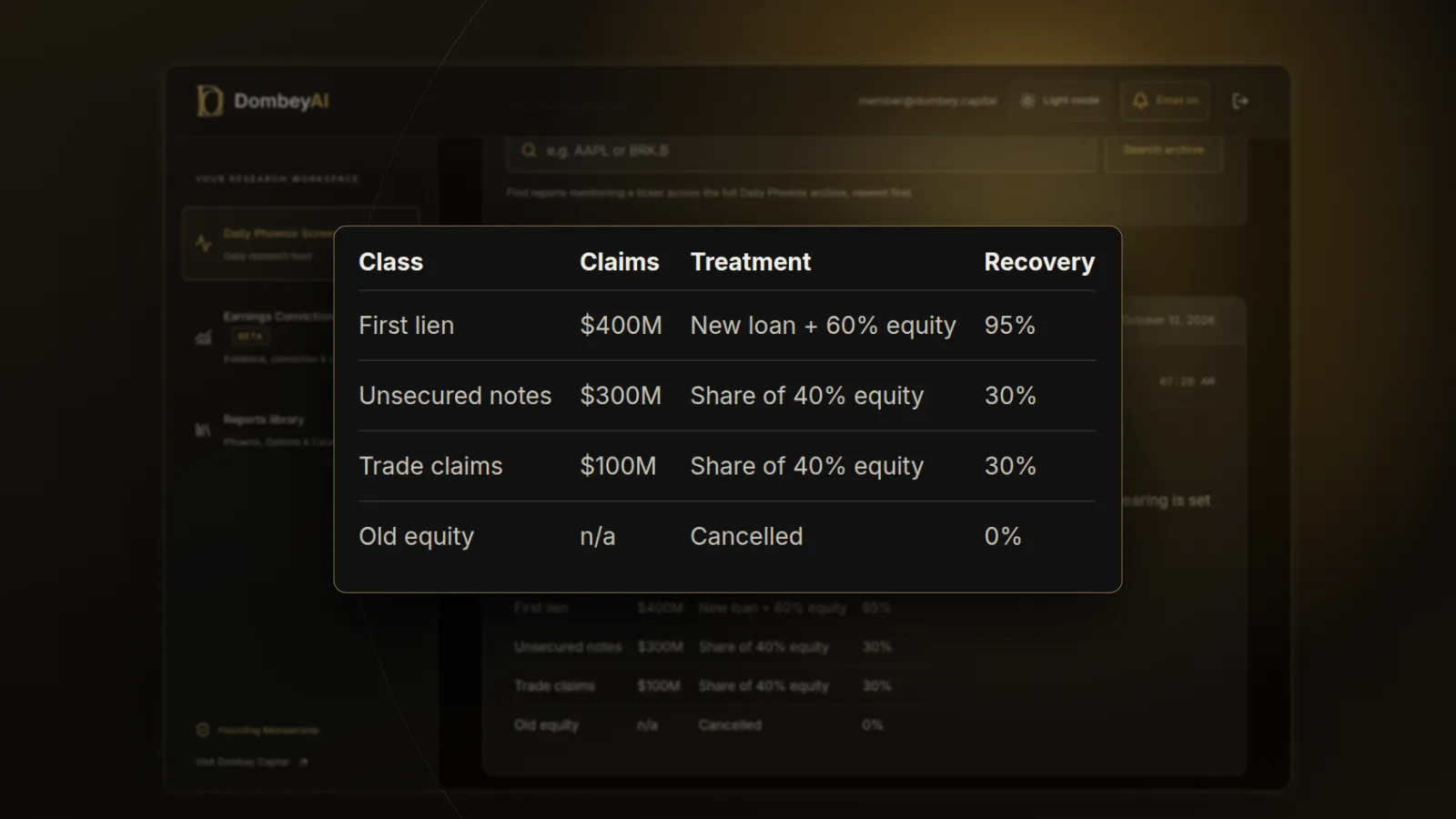
Every number in that arithmetic comes from the docket and the claims register, not from a news service. Paid tools buy speed and breadth: news on negotiations before anything is filed, data across many cases, or a summary of a thousand-entry docket. Founding Membership buys interpretation of the distressed and post-reorganization equities in Dombey's coverage, with Standard Access as the lower-cost option for the Catalyst Briefing and the archive.
How to choose
Start with the question you need answered, then pick the cheapest source that answers it.
| Your situation | Pick | Add later when |
|---|---|---|
| You want distressed or new equities read and valued | Dombey Founding MembershipTop pick | You follow cases outside its coverage: add PACER and RECAP |
| You follow one or two cases | PACER and the claims agent page | You want free copies and alerts: add CourtListener |
| You want to know what the company has disclosed | SEC EDGAR | You need the court record: add PACER |
| You run a credit fund or advise on restructurings | Octus or Debtwire | You want commentary across cases: add Petition |
| You are learning how cases work | U.S. Trustee Program and Petition | You pick a case to study: open the docket on PACER |
- If the company has just filed, read the first-day declaration, which explains why it filed and what it owes.
- If a disclosure statement is out, note the valuation range and the treatment of each class, then compare each amended version.
- If the bar date has passed, check the claims register for claims larger than the company's own schedules show.
- If confirmation is set, put the hearing and the expected effective date on your catalyst calendar.
The bottom line
Dombey's Founding Membership is our top pick for readers who want distressed and post-reorganization equities written up as research, with Standard Access at $80 a year as the lower-cost option. It is not a docket tool, so pair it with PACER, which holds every filing at $0.10 a page and is free under $30 a quarter, and with the RECAP Archive for free copies. In large cases, use the claims agent's page for the claims register, and EDGAR for the company's 8-Ks. If restructuring is your profession, Octus and Debtwire are the specialist services. Whatever you use, read the disclosure statement and the plan before you rely on anyone's summary of them.