

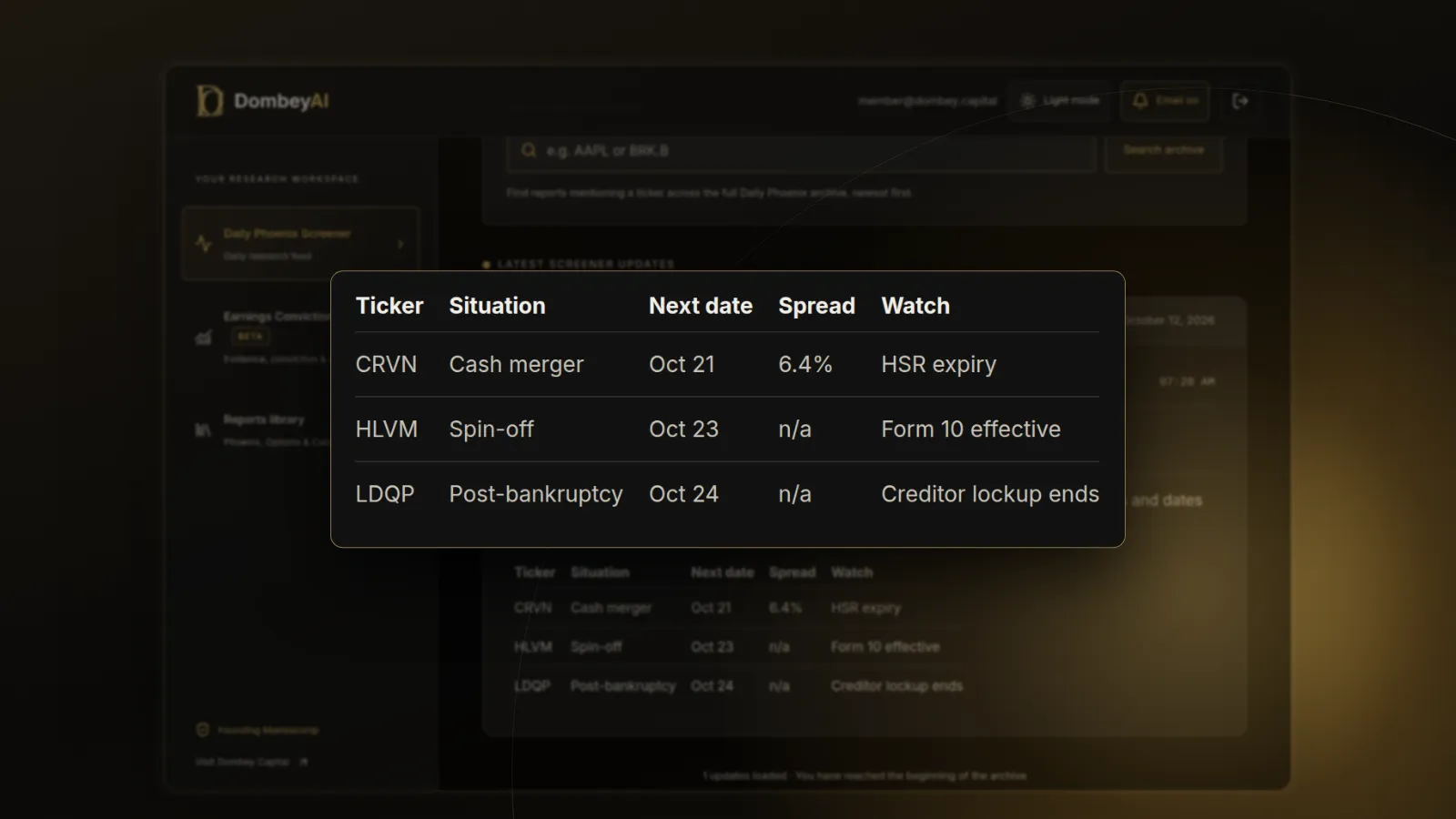


Full disclosure: Dombey Capital is our own research service and our top pick here, for the reasons below. The section on where it falls short is there so you can judge whether it fits your process.
Quick comparison
| Tool | Best for | Key features | Price (as of October 2026) |
|---|---|---|---|
| Dombey CapitalTop pick | Special situations and dated catalysts, with a written case | Founding Membership: weekly Phoenix Report, weekly Options Research, Catalyst Briefing, DombeyAI Portal; Standard Access: Biweekly Catalyst Briefing and public-research archive | Founding Membership $1,200/year; Standard Access $80/year or $8/month; Public Archive free |
| Seeking Alpha | Broad coverage, news and the debate around a stock | Free market news by category; Premium adds data-driven ratings, screeners, AI tools and analysis on 4,000+ stocks and ETFs | News free to browse; Premium $299/year after a $4.95 first month |
How we compared these tools
We compared the two from vendor documentation, pricing pages and public product pages, read on the publish date. We did not subscribe to Seeking Alpha for this article, so nothing below describes the member experience beyond what the vendor publishes. We make no claims about either service's accuracy or the performance of anything it covers.
Special situations work has a different shape from general stock research. The question is rarely "is this a good company". It is "what happens on a known date, what is priced in, and what breaks the case". The weights reflect that.
| Criterion | Weight | What it measures |
|---|---|---|
| Event focus | 30% | Whether research is organized around a dated catalyst such as a spin-off, deal close, vote or ruling |
| Downside and mechanism | 20% | Whether the source explains how the event changes value and what could go wrong |
| Breadth of coverage | 20% | How many companies and situations the source touches |
| Monitoring tools | 15% | News feeds, alerts, screeners and portfolio tracking |
| Price and terms | 15% | List price, trial and billing terms from the vendor's own page |
If you weight breadth and monitoring tools at 50% or more, Seeking Alpha moves ahead, because it covers far more names and has the larger tool set.
Quick picks by job
Best for special situations and dated catalysts: Dombey Capital
Dombey covers a narrow set of situations: stocks priced below cash or book, companies cheap on sales, spin-offs, deal spreads, and legal and corporate events with a date attached. Founding Membership includes the weekly Phoenix Report, weekly Options Research, the Catalyst Briefing and the DombeyAI Portal with the Daily Phoenix Screener and Earnings Conviction Model. Standard Access, the lower-cost option, is the Biweekly Catalyst Briefing plus the complete public-research archive. The job it does is selection and context: which events deserve the work, and why.
Best for finding and following names across the market: Seeking Alpha
Seeking Alpha's free news feed has categories for M&A, buybacks, debt and share issuance, IPOs and SPACs, among many others. Premium adds data-driven stock ratings, screeners, AI tools such as Virtual Analyst Reports, Earnings Call Insights and Ask Seeking Alpha, and a library of articles by independent investors on more than 4,000 stocks and ETFs, including 1,300 securities that Seeking Alpha says Wall Street does not cover. It suits readers who want to cast a wide net and read several views on a stock.
How each handles the main special situations
The clearest way to see the difference is situation by situation.
| Situation | Seeking Alpha | Dombey | What to read first |
|---|---|---|---|
| Spin-off | News items and contributor articles; quality varies by author | Research when the spin-off falls in coverage, built around the distribution date | The Form 10 |
| Merger spread | M&A news category and articles on deal terms | Spread, timeline and break risk on covered deals | The merger agreement and 8-K |
| Post-bankruptcy equity | Articles when contributors pick the name up | Research when the new shares fit the coverage | The plan and disclosure statement |
| Buyback as a catalyst | Buybacks news category | Covered when a repurchase changes the per-share math on a dated event | The 10-Q share count |
| Stock below cash or book | Screeners on valuation metrics | Core coverage area, with the balance sheet case written out | The latest balance sheet |
Spin-offs
A new spin-off often has no trading history and pro forma financials only. Factor ratings built on price history and reported numbers have little to work with. What matters is in the Form 10: debt allocation, standalone costs, management incentives and who is likely to sell on day one. Our guide on how to analyze a spin-off Form 10 walks through it, and spin-off investing explains why these shares can be mispriced.
Merger spreads
For a pending deal, the questions are the spread, the timeline and what could break it. The FTC's guide says parties to a reportable deal must wait 30 days after filing under the HSR Act, or 15 days for a cash tender offer or a bankruptcy, before closing, and a second request extends the review. Seeking Alpha's M&A feed will tell you a deal exists. A dated research piece tries to tell you whether the spread pays for the risk. See merger arbitrage explained and the HSR waiting period for the mechanics.
Post-bankruptcy equities
New shares issued under a reorganization plan can trade on thin information while former creditors sell. These names come up on Seeking Alpha when a contributor picks them up, so coverage is uneven. Post-bankruptcy equities covers why they can trade cheap and where that view goes wrong.
Full reviews
1. Dombey Capital
What it does. Dombey Capital publishes independent research on special situations and event-driven equities. Every thesis is published before its catalyst, priced on the day and kept in the archive, so the original case can be compared with what happened. Dombey's published research applies its screens before each catalyst; see the research archive.
There are three access levels:
- Founding Membership ($1,200 a year, annual billing only): the weekly Phoenix Report, weekly Options Research, the Catalyst Briefing, the DombeyAI Portal with the Daily Phoenix Screener and the Earnings Conviction Model, valuation and execution analysis, and priority access.
- Standard Access ($80 a year, about $6.67 a month, or $8 a month on monthly billing), the lower-cost option: the Biweekly Catalyst Briefing on forthcoming corporate and market events, plus the complete public-research archive.
- Public Archive (free): published executive theses and public research.
Best for. Investors whose process starts from a dated event and who want the mechanism and the downside written out. If the term is new, start with what is a special situation.
Pricing. Founding Membership $1,200 a year. Standard Access, the lower-cost option, $80 a year or $8 a month. Public Archive free. See the subscription options.
Pros
- Research is organized around events with dates, which makes it easier to check whether a thesis worked.
- Each piece covers what could break the case, not only the upside.
- Standard Access costs less than Seeking Alpha Premium, and the Public Archive is free.
Cons
- Coverage is narrow, so most stocks you own will never be covered.
- No screener across the whole market, no ratings on thousands of companies.
- Founding Membership at $1,200 a year is a large commitment for an occasional reader.
Verdict: Our top pick for investors who work on special situations and want a short list of dated events with a written case.
2. Seeking Alpha
What it does. Seeking Alpha is a broad investing platform. Its market news feed is open to browse and sorted into categories including M&A, buybacks, debt and share issuance, IPOs, SPACs, earnings and guidance. Premium, per its offer page, adds data-driven stock ratings, stock screeners, AI tools (Virtual Analyst Reports, Earnings Call Insights and Ask Seeking Alpha) and access to analysis by independent investors on more than 4,000 stocks and ETFs.
Best for. Investors who want to monitor many names, read several opinions on each and use screens to generate ideas.
Pricing. Market news is free to browse. Premium is $299 a year, with a one-month paid trial at $4.95 for new subscribers, after which the annual price is charged unless they cancel.
Pros
- Very wide coverage, including smaller companies that get little analyst attention.
- Free news categories that line up with several special situations: M&A, buybacks, share issuance.
- Ratings, screeners and alerts in one product.
Cons
- Not organized around special situations; you do the filtering.
- Articles are written by independent contributors, so depth and quality vary.
- Factor ratings can say little about a stock whose value depends on a pending event.
Verdict: A strong general platform and a good source of names to look at. For special situations, pair it with the primary filings and a source that tells you which events matter.
A worked example: one event, two workflows
The headline and the debate are useful. They do not tell you whether $2.40 pays for the chance the deal fails. That calculation, laid out in how to calculate a merger arbitrage spread, is the work special situations research is meant to do.
Where Dombey falls short
- Narrow coverage. Dombey covers special situations and catalyst-driven stocks only. It does not rate thousands of companies or offer a general screener.
- No broad data terminal. There is no financial statements database, quant rating or portfolio tracker of the kind Seeking Alpha offers.
- Not a live feed. If a deal is announced mid-session, a news feed or an EDGAR alert will tell you first.
- Small team. Output is limited by how many situations a small team can research properly.
- Pen-name author. Research is published under the name James Whitfield, a pen name. Readers who want a named, credentialed analyst behind each piece should weigh that.
- Short history. The archive keeps every thesis with its date and price, but the public record is young, and a short record says less than a long one.
Free vs paid
You can do a lot of special situations work for free. SEC EDGAR has every filing, Seeking Alpha's news feed is free to browse, and Dombey's Public Archive is free. Form 8-K instructions say a report is generally due within four business days of the event, so deals, spin-off announcements and other material events reach EDGAR on a known clock. The best SEC filing tools and EDGAR alerts covers ways to watch for them.
What paid plans add:
- Seeking Alpha Premium: ratings, screeners, AI tools and the full article library across thousands of stocks.
- Dombey Founding Membership: the weekly Phoenix Report, weekly Options Research, the Catalyst Briefing and the DombeyAI Portal.
- Dombey Standard Access, the lower-cost option: the Biweekly Catalyst Briefing and the complete public-research archive.
How to choose
| Your situation | Pick | Add later when |
|---|---|---|
| Your process is built on spin-offs, deal spreads and dated events | Dombey CapitalTop pick | You want to monitor a wide watchlist: add Seeking Alpha's free feed or Premium |
| You hold a broad portfolio and want ratings and opinions on each stock | Seeking Alpha Premium | A holding enters a special situation: add Dombey Founding Membership, or Standard Access as the lower-cost option |
| You want ideas from a wide net, then a filter | Seeking Alpha plus Dombey | You find you only read one of them: drop the other |
| You want to spend nothing | SEC EDGAR, Seeking Alpha's free feed and Dombey's Public Archive | You run out of time to read filings: add a paid briefing |
- If you mostly ask "which stocks are good", Seeking Alpha's ratings and breadth fit that question.
- If you mostly ask "what happens on this date", a dated research service fits better.
- If you follow merger spreads closely, also look at the best merger arbitrage data sources.
- If you follow spin-offs closely, also look at the best spin-off trackers.
The bottom line
Dombey Capital is our top pick for investors whose process is built on special situations, with Founding Membership for the full research suite and Standard Access as the lower-cost briefing. Seeking Alpha is the better choice for broad coverage, ratings, screens and many opinions on thousands of stocks, and its free news feed is useful to almost anyone. The two overlap less than their prices suggest: one helps you find and follow names, the other helps you decide which dated events deserve the work. Whatever you use, confirm the event in the filing and check each vendor's current price before you pay.