

Where the idea comes from
Hersh Shefrin and Meir Statman named the disposition effect in a 1985 paper in the Journal of Finance. They built on prospect theory, published by Daniel Kahneman and Amos Tversky in 1979, which found that people judge outcomes as gains or losses from a reference point and feel losses more strongly than equal gains.
Applied to a stock, the reference point is usually the purchase price. Above it, the position is a gain and the investor becomes cautious, keen to secure it. Below it, the position is a loss and the investor becomes willing to gamble on getting back to even rather than accept the loss.
Terrance Odean's 1998 study of thousands of accounts at a US discount broker gave some of the best-known evidence. Investors realized a larger share of their gains than of their losses, except near year-end when tax selling pushed the other way. The winners they sold also tended to do better over the following months than the losers they kept.
The forces behind it
Several biases combine to produce the effect.
| Driver | What it does | How it shows up |
|---|---|---|
| Loss aversion | A loss hurts more than an equal gain pleases | Reluctance to turn a paper loss into a real one |
| Reference-point thinking | The purchase price becomes the benchmark | "I'll sell when it gets back to what I paid" |
| Mental accounting | Each position is a separate account with its own score | Judging a stock by its own gain or loss rather than the portfolio |
| Regret avoidance | Selling a loser confirms a mistake | Holding to avoid the feeling of being wrong |
| Pride in a gain | Selling a winner confirms a good call | Taking profits early to bank the feeling |
| Belief in mean reversion | Winners "have run" and losers "are due" | Selling strength, holding or adding to weakness |
The purchase price plays a role in most of these. It is the same mechanism described in anchoring bias: a number that should not matter ends up shaping the decision.
Why the purchase price does not matter
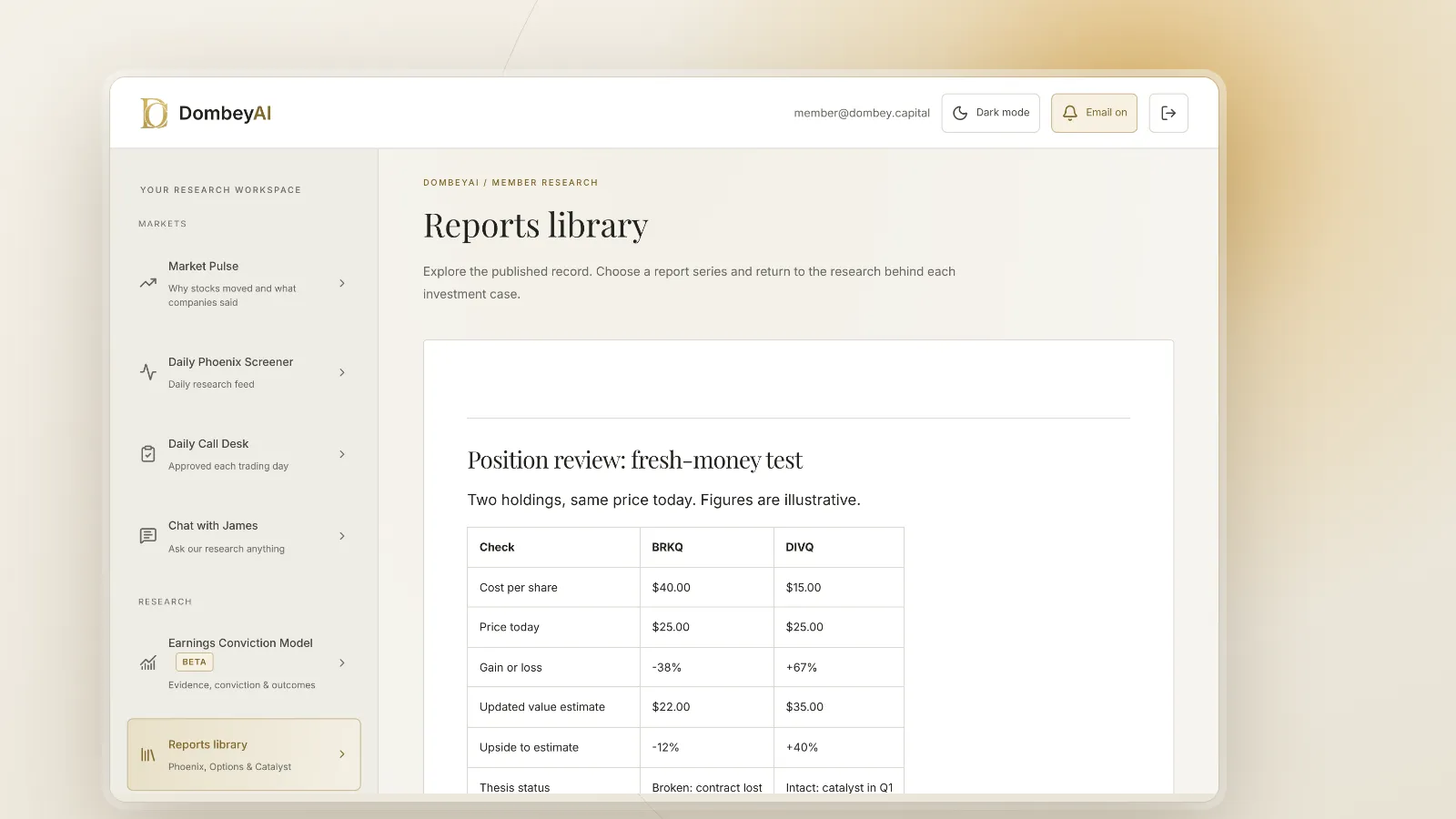
The market does not know or care what you paid. A stock bought at $40 and now at $25 is worth the same as one bought at $15 and now at $25. The only questions that matter are what the business is worth, what the price implies and what could close the gap.
The tax code adds to the case. In a taxable account, realizing a loss creates a deduction that can offset gains, and realizing a gain creates a tax bill. Selling winners and holding losers does the reverse of what the tax rules reward. Our explainer on tax-loss selling covers how that plays out around year-end.
What it does to prices
The disposition effect is not only a personal cost. When many holders behave this way, it can affect prices.
After good news, holders with gains sell into the rise, which slows the move toward the new value. After bad news, holders with losses refuse to sell, which slows the move down. Both lead to underreaction: prices adjust to news more slowly than they should. Andrea Frazzini's research linked this to post-earnings announcement drift, the tendency for stocks to keep drifting in the direction of an earnings surprise for weeks.
For an investor who knows the pattern, that is information. A stock with heavy selling from holders at a gain may be slower to reach fair value after good news, which can leave room for a buyer who is not anchored on any price.
How to counter it
The disposition effect is hard to remove by willpower. Process works better.
- Write the thesis and the exit at purchase. A dated investment thesis states what you expect, by when, and what would prove you wrong. The exit is then a test of the thesis, not of your gain or loss.
- Ask the fresh-money question. For each holding, ask whether you would buy it today at this price with new money. If not, the case for keeping it is mostly the purchase price.
- Review on a schedule. Re-value each position at set intervals and compare with the price, not with your cost. A checklist keeps the review consistent.
- Hide the cost basis. Some investors turn off the gain and loss column in their brokerage view. It removes the reference point from the screen.
- Harvest losses deliberately. Treat tax-loss harvesting as a routine, which makes selling losers a normal part of managing the account.
- Run a post-mortem. After closing a position, an investment post-mortem asks whether you sold for the reasons you wrote down.
When selling a winner is right
Not every early sale is a bias. Selling a winner makes sense when:
- If the price has passed your estimate of value, the thesis has played out.
- If the catalyst you were waiting for has happened and the market has priced it.
- If the position has grown so large that a single outcome now dominates the portfolio.
- If a better use of the capital has appeared, judged on the same basis as the holding.
Holding a loser makes sense when the thesis is intact, the evidence has not changed and the lower price simply raises the expected return. The test in every case is the same: the decision should rest on value and evidence, not on the gain or loss.
Where this goes wrong
Fighting the disposition effect can create its own mistakes.
- Overcorrecting into stubbornness. "Let your winners run" can become holding a winner well past its value because selling feels like a bias.
- Cutting losers mechanically. A strict stop-loss sells at the worst moment when a temporary drop has nothing to do with the thesis. A falling price is information to examine, not an instruction.
- Mistaking a story for a thesis. If the thesis was vague, there is nothing to test the position against, and every decision falls back on the purchase price. Confirmation bias then fills the gap.
- Ignoring taxes and costs. Selling a winner in a taxable account to rebalance can be right, but the tax bill is part of the decision.
The bottom line
The disposition effect is the pull to sell what has gone up and keep what has gone down, measured against the price you paid. It comes from loss aversion, regret and the habit of scoring each position on its own. The purchase price says nothing about what a stock is worth now, so the counter is a process that judges each holding against a current valuation and a written thesis. Most research platforms in our list of the best stock research tools for individual investors can show positions without the cost basis, which is a simple place to start.