

What Regulation D is
The Securities Act requires an offering of securities to be registered unless an exemption applies. Regulation D provides the most common exemptions for private placements:
- Rule 506(b): no limit on the amount raised. No general solicitation or advertising. Sales to an unlimited number of accredited investors and up to 35 non-accredited investors who meet a sophistication standard.
- Rule 506(c): no limit on the amount raised. General solicitation is allowed, but every purchaser must be accredited, and the issuer must take reasonable steps to verify that.
- Rule 504: offerings up to $10 million in a 12-month period, subject to state securities rules and some eligibility conditions.
A company relying on any of these must file Form D. Companies selling under Section 4(a)(5), a smaller exemption for sales to accredited investors, file it too.
| Exemption | Amount limit | Advertising allowed | Who can buy | Form D required |
|---|---|---|---|---|
| Rule 506(b) | None | No | Accredited, plus up to 35 sophisticated non-accredited | Yes |
| Rule 506(c) | None | Yes | Verified accredited only | Yes |
| Rule 504 | $10 million in 12 months | Depends on state rules | Any, subject to state rules | Yes |
| Section 4(a)(5) | Set by statute | No | Accredited only | Yes |
What Form D shows
The form is a few pages long and filed electronically on EDGAR. The main items are:
- Issuer identity: name, jurisdiction, year of incorporation, address and entity type.
- Related persons: executive officers, directors and promoters, by name.
- Industry group: a checkbox, such as biotechnology, banking or pooled investment fund.
- Issuer size: a revenue range or, for funds, a net asset value range. Issuers may decline to disclose.
- Exemption claimed: 506(b), 506(c), 504 or 4(a)(5).
- Type of securities: equity, debt, options or warrants, pooled fund interests and so on.
- Duration: whether the offering is expected to last more than one year.
- Offering amounts: the total offering amount, the amount sold so far and the amount remaining, or "indefinite."
- Investors: the number who have already invested and how many, if any, are non-accredited.
- Sales compensation: any broker or placement agent paid, and the commissions and finder's fees.
- Use of proceeds: the amount, if any, paid to executives, directors or promoters.
What it does not show
The gaps matter as much as the contents. Form D does not include:
- Financial statements or any audited figures
- The price per share or conversion terms
- Warrants, discounts or other investor protections
- The names of investors
- Any description of the business beyond the industry checkbox
A Form D tells you that a raise happened and roughly how large it was. It does not tell you whether the terms were good or bad for existing holders. For that you need the purchase agreement, which a public company may file as an exhibit to an 8-K, or the next 10-Q.
Timing and amendments
The initial notice is due no later than 15 calendar days after the first sale. The "date of first sale" is the date the first investor is irrevocably committed. If the due date falls on a weekend or holiday, it moves to the next business day.
An amendment, filed as Form D/A, is required:
- Annually, on or before the anniversary of the most recent filing, while the offering continues
- To correct a material mistake of fact or error
- To reflect a change in certain information, such as a new related person or an increase in the offering amount beyond set limits
Amendments can be useful. A series of D/A filings showing the amount sold rising over time gives a rough record of how a raise progressed.
How investors in public stocks use it
Form D is mainly a private-market filing, but it shows up in public-company research in a few ways.
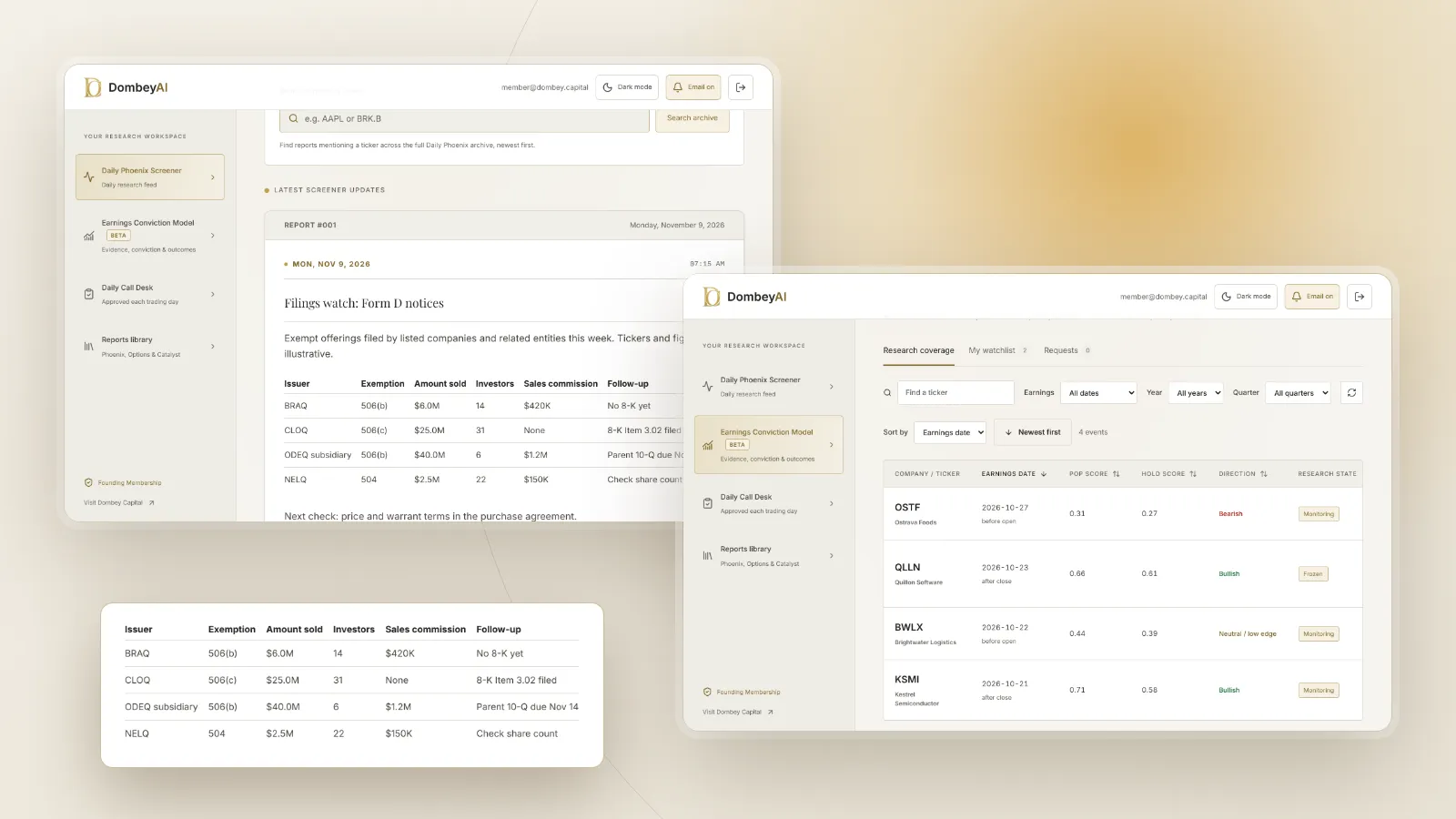
Private placements by listed companies. A listed company may sell shares or convertible notes to institutional investors under Regulation D. These are often called PIPE deals. The Form D may appear alongside an 8-K under Item 3.02, which reports unregistered equity sales. For small and OTC-traded companies, the Form D can be the earliest public trace of a raise, and the main concern is dilution.
Subsidiaries and affiliates. A company's subsidiary, joint venture or spun-out unit may raise outside capital. A Form D filed by an entity whose related persons are the parent's executives is a clue worth following.
Funds forming around a situation. Activists and event-driven managers sometimes create special-purpose vehicles to hold a single position. A new pooled fund with a name tied to a company, filed by a known manager, can hint at a concentrated position before any 13D.
Insider activity. The related persons list shows which executives and directors are involved in an offering. When the same names appear across several private entities, it can reveal side businesses worth understanding.
Once a company moves to a registered offering, the relevant filings change to an S-1 for an initial registration or a shelf registration on Form S-3 for repeat issuers.
How to find and read one
- Open EDGAR full-text search and filter by form type D.
- Search by company name, or by an executive's name to find related entities.
- Open the filing and read the exemption, offering amount, amount sold and number of investors.
- Check sales compensation. A large commission suggests the placement needed a broker to find buyers.
- Look for an 8-K filed within a few days that describes the terms.
- Check for D/A amendments to see how the raise progressed.
Where this goes wrong
Form D has real limits as a research tool.
- Late or missing filings. Filing on time is not a condition of the Rule 506 exemption, so some issuers file late and a few do not file at all.
- No terms. The amount raised says nothing about price, discount or warrants, which are what matter for existing holders.
- Stale amounts. The amount sold reflects the date of filing. An offering can continue well after.
- Fund noise. Most Form D filings are investment funds, so screening the full feed for public-company signals takes filtering.
- No review. Because the SEC does not review Form D, nothing in it has been checked by a regulator.
Use Form D as a lead that points you to the documents with terms, not as the source of those terms. For tools that track EDGAR filings and alerts by form type, see our comparison of the best stock research tools for individual investors.
The bottom line
Form D is the SEC notice filed after a private placement under Regulation D, due within 15 calendar days of the first sale. It shows who raised money, under which exemption, how much and from how many investors, but not the price, terms or financials. For public stocks it is most useful as an early flag of a private placement, a related entity or a new fund vehicle. Read it, then find the 8-K, purchase agreement or 10-Q that carries the terms.