

What confirmation bias is
Psychologists describe confirmation bias as three related habits. People search for evidence that fits what they believe, interpret mixed evidence as support, and recall supporting facts more easily than contrary ones. Each habit is small. Together they turn an open question into a settled one without any new information arriving.
In investing the stakes are direct, because the belief is usually attached to money. Once you own a stock, or have said publicly that you like it, a contrary fact has a cost: it means admitting an error. That raises the bar for bad news and lowers it for good news.
It differs from simple optimism. An optimist expects good outcomes in general. Confirmation bias is specific to a view: an investor can be bearish on a stock and still read every report in a way that confirms the bear case.
How it distorts stock research
The bias works at each stage of the research process, not only at the decision.
Choosing sources
Investors who like a stock gravitate to bullish write-ups, management presentations and forums of fellow holders. Each source repeats the same thesis, which feels like corroboration but is often one argument copied several times. Reading the company's own filings first, and commentary second, reduces this. The difference is set out in primary vs secondary sources in equity research.
Reading ambiguous numbers
Most quarterly results are mixed. Revenue beats, margins miss, guidance is unchanged. A holder will tend to call the quarter "fine" and focus on the beat; a skeptic will focus on the miss. The numbers have not changed, only the weighting. Earnings calls make this worse because management chooses what to emphasize. The guide on how to analyze an earnings call transcript suggests reading the prepared remarks and the filing side by side.
Updating, or not updating
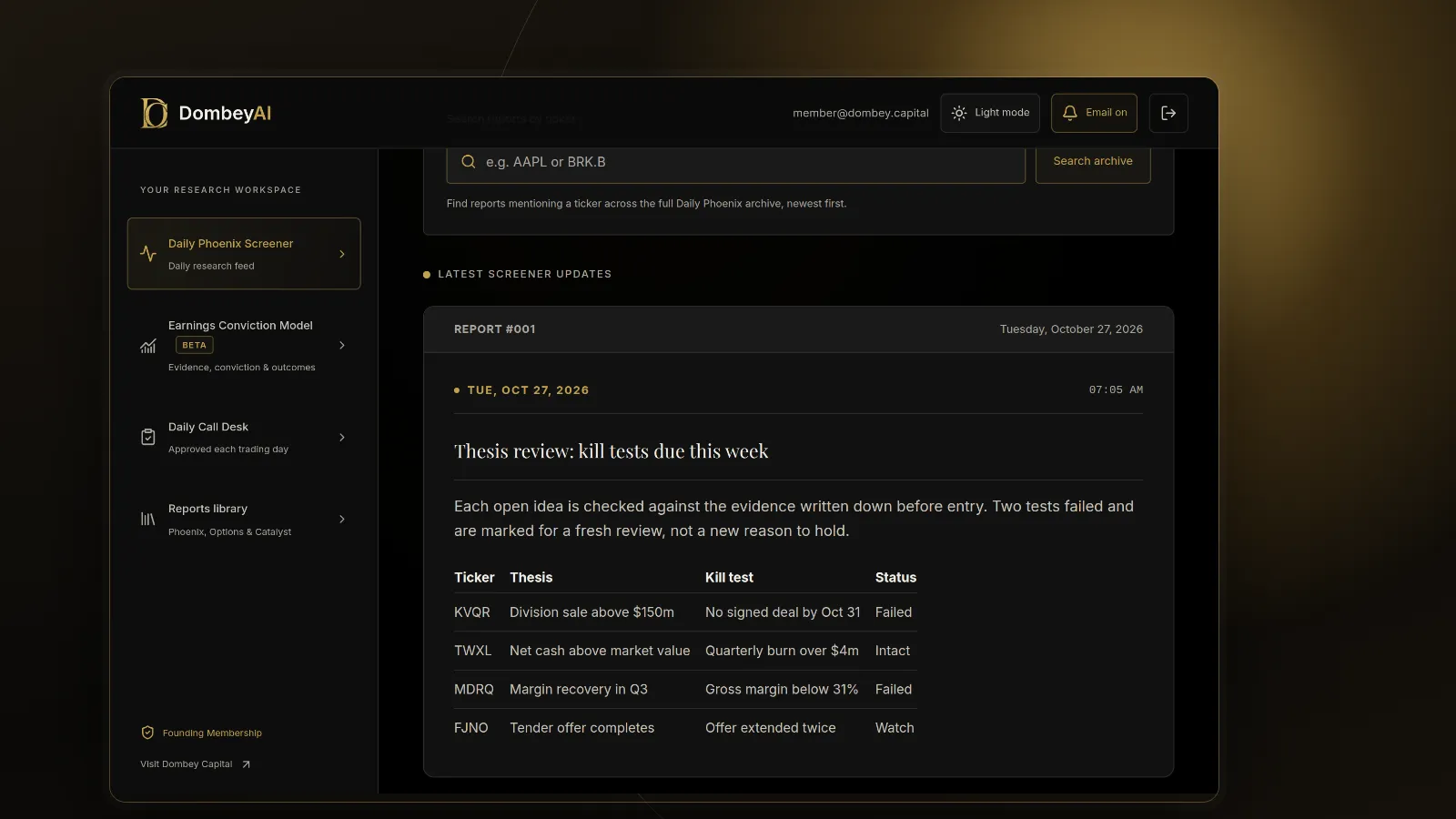
The most expensive form of the bias is holding after the reason for owning has gone. The original thesis was, say, an asset sale. The sale is delayed, then shrunk, and the holder finds a new reason to stay: a buyback, a cheap multiple, a new product. Each new reason may be valid, but the switch is rarely recorded, so the investor never notices that the first thesis failed. This is how many positions become value traps.
Selective memory
When reviewing past decisions, investors remember the calls that worked and the reasons that sounded right. Without a written record, the review confirms the process instead of testing it.
Quick reference: where the bias appears
| Research stage | What the bias looks like | A countermeasure |
|---|---|---|
| Idea sourcing | Reading only bullish write-ups on a name you like | Read the strongest bear case before the bull case |
| Source selection | Treating repeated commentary as independent evidence | Start from the 10-K, 10-Q and 8-K filings |
| Interpreting results | Calling a mixed quarter good because one line beat | Score results against numbers written before the report |
| Catalyst tracking | Explaining away a delay as noise | Set a date by which the catalyst must happen |
| Position review | Swapping in a new thesis without noting the old one failed | Review against the original written thesis |
| Post-mortem | Remembering the winners and the good reasons | Keep a dated log of every thesis and its outcome |
Worked example: a thesis that quietly changed
The fix here is not a different conclusion. It is a different process: record that the original thesis failed, then evaluate the buyback case as if you were coming to the stock fresh, with no position. If you would not buy it today on the new case, the old position is being held by the bias. The arithmetic behind the cash test is covered in net cash per share.
How to check your own research for it
The countermeasures all share one feature: they create a record before the outcome is known, so later judgment has something to be compared against.
- Write the thesis and its kill test. Before buying, write two or three sentences on why the stock is mispriced and the specific, dated evidence that would prove it wrong. The guide to how to write a dated investment thesis gives a format.
- Start from a base rate. Before reading the company's story, ask how often similar situations work out. Base rates and the outside view explains how to build one. A good story should move you away from the base rate only by as much as the evidence justifies.
- Write the bear case yourself. Argue against your own position as well as a short seller would. If you cannot state the bear case clearly, you do not yet understand the stock.
- Run a pre-mortem. Assume it is a year from now and the position lost money. List the most likely reasons. This often surfaces risks the bull case skipped.
- Build scenarios with numbers. Assign values to a base case and a worst case before the catalyst, as in how to build a base and worst case. A written downside number is harder to ignore than a vague worry.
- Use a checklist with a disconfirming question. Add a line such as "What evidence have I seen this month that cuts against the thesis?" to your investment checklist. An empty answer every month is a warning sign.
- Separate research tools from opinion sources. Screeners, filing search and data platforms show numbers before anyone's view of them. The comparison of the 12 best stock research tools for individual investors covers options at different price points.
A decision guide at review time
- If the dated evidence in your kill test has arrived and goes against you, treat the original thesis as failed, whatever the price has done.
- If the price has risen but the thesis evidence has not arrived, record that the gain came from something other than your thesis.
- If you find yourself listing a new reason to hold, write it as a new thesis with its own kill test and judge it as a fresh purchase.
- If you cannot recall what the original thesis was, the review cannot be honest; start the record now.
Where this goes wrong
Over-correcting is its own error. An investor so worried about confirmation bias that every contrary fact triggers a sale will trade too often and abandon sound positions at the first noise. Not every piece of bad news disconfirms a thesis; the point of a written kill test is to decide in advance which evidence matters.
A contrary view is not automatically right either. Reading the bear case is useful because it tests your reasoning, not because skeptics are more accurate. Some bear cases rest on the same selective reading in the other direction.
Written theses can be gamed. A kill test vague enough ("if the business deteriorates") can never fail. The test needs a number, a date or a named event.
Finally, a process reduces the bias but does not remove it. The investor still chooses the base rate, writes the bear case and decides what counts as evidence. A variant perception needs conviction to act on, and the line between conviction and confirmation bias is only visible in a record kept over time.
Dombey's published research states a dated thesis and the evidence that would change it for each idea; see the research archive.
The bottom line
Confirmation bias is the tendency to look for and weigh evidence in favor of what you already believe. In stock research it shapes which sources you read, how you score mixed results and whether you notice that a thesis has failed. The most effective defense is a written thesis with a dated kill test, checked on schedule, alongside a base rate and an honest bear case. None of this removes the bias, but it leaves a record that shows you when it has taken over.