

What you need
- The original thesis, written before the decision. The date, the price, the case, the key assumptions, the expected catalyst and what would prove you wrong. How to write a dated investment thesis covers how to keep one.
- The trade record. Entry and exit dates, prices, position size and any changes along the way.
- The filings and news since the decision. The 10-Qs, 8-Ks, earnings calls and any event documents, so you can see what actually changed.
- A template. The same set of questions for every review, so patterns show up over time.
- An hour of uninterrupted time. A rushed review tends to confirm what you already think.
Step 1: Choose the decisions to review
Review every closed position, and every open position whose main catalyst has passed. Add a sample of decisions you considered and passed on: a stock you rejected that then doubled, or one you nearly bought that then halved, can teach as much as a trade you made.
Do not review only losses. Winners deserve the same scrutiny, because a gain from the wrong reason reinforces a habit you may not want.
Step 2: Restate the original thesis exactly
Copy the thesis as you wrote it, not as you remember it. Note the date, the price, the position size and the expected holding period. If you did not write it down, say so in the review and treat this decision as a lesson about record keeping, because a memory of the thesis formed after the outcome is unreliable.
| Field | What to record |
|---|---|
| Date and price | When you decided and at what price |
| Thesis | The case in two or three sentences |
| Key assumptions | The three to five facts that had to be true |
| Catalyst and date | The event expected to close the gap |
| Base and worst case | Value in each case, with probabilities if you set them |
| Exit conditions | What would prove you wrong, and what you would do |
| Planned size | Position size and why |
Step 3: Record what actually happened
Write a short, dated account of events after the decision: results, filings, management actions, the catalyst and its outcome, and the price at each point. Use primary sources where you can. Search EDGAR for the company's filings over the period, and read the earnings call transcripts for anything management said that bears on your assumptions.
Keep this section factual. Interpretation comes next.
Step 4: Test each assumption
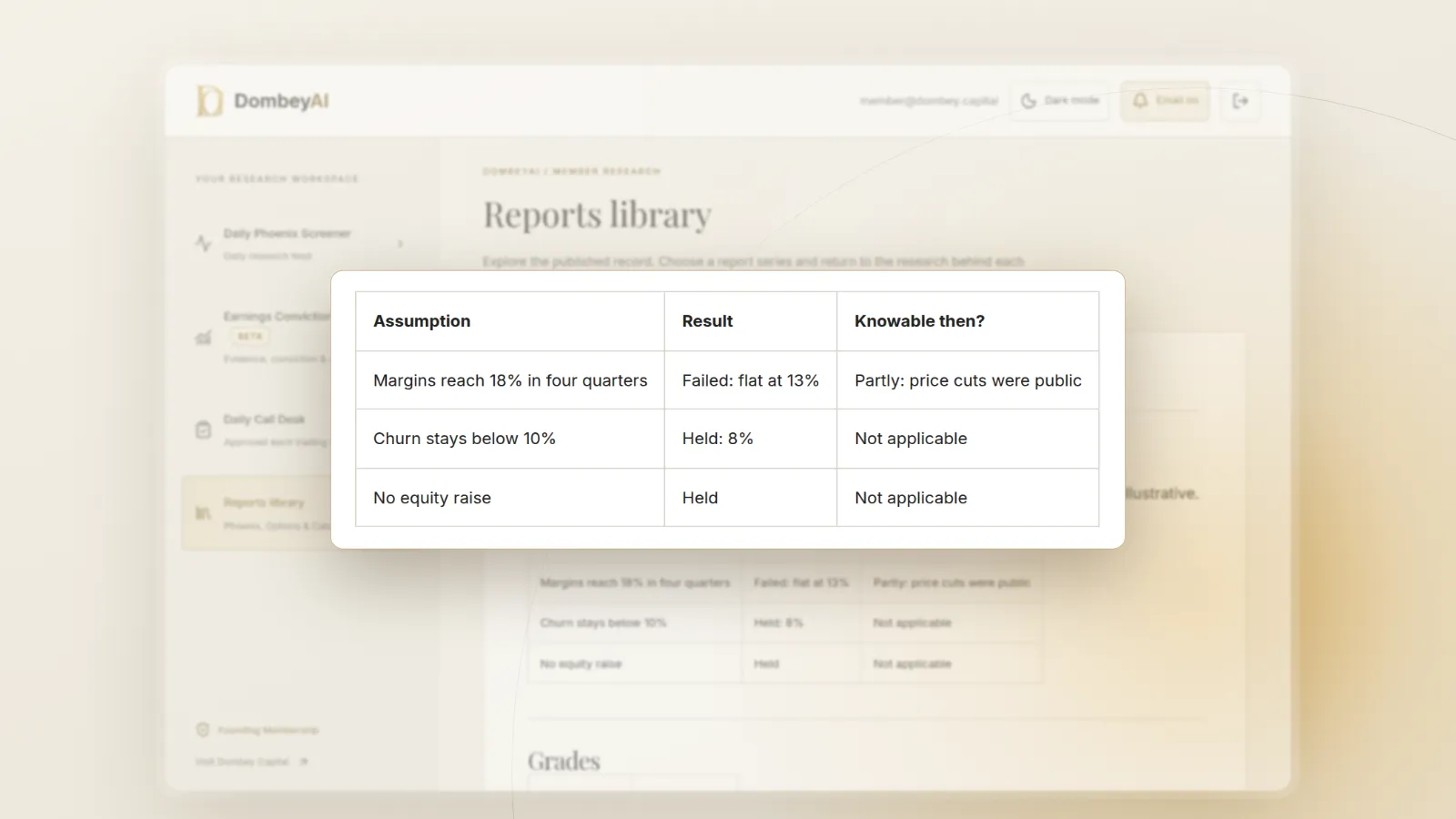
Go through the key assumptions one by one and mark each as held, failed or unclear. For each failed assumption, ask whether the information that disproved it was available when you made the decision.
| Assumption | Result | Was it knowable at the time? |
|---|---|---|
| Customer churn stays below 10% | Failed: churn rose to 14% | Partly: a competitor's price cut was already public |
| Asset sale closes by June | Held: closed in May | Not applicable |
| Margins recover to 18% | Unclear: 16% so far | Not applicable |
This step usually produces the most useful findings. A failed assumption that was knowable points to a research gap. One that was not knowable points to a risk you may need to size for.
Step 5: Grade the decision and the outcome separately
Use two grades. The decision grade asks whether the reasoning, research and sizing were sound given what was knowable then. The outcome grade asks whether the investment made or lost money.
| Good outcome | Bad outcome | |
|---|---|---|
| Good decision | Earned result: repeat the process | Bad luck: keep the process, check sizing |
| Bad decision | Good luck: fix the process before it costs you | Earned loss: fix the process |
The dangerous cell is a bad decision with a good outcome. It feels like success and encourages the same mistake.
Step 6: Separate luck from judgment
Ask whether the stock moved for the reasons you gave, on the timeline you expected. If your thesis was about a spin-off and the stock rose on a takeover bid, the result was mostly luck, even though you made money.
Base rates help here. If you assigned a 70% chance to a deal closing and it failed, one failure does not prove the estimate was wrong. Over many decisions with written probabilities, you can see whether your 70% calls come true about 70% of the time.
Step 7: Review sizing and execution
Separate the idea from the trade. Was the position the right size for the risk? Did you add or trim for reasons you had planned, or in reaction to price? Did you follow your exit conditions when they were met? How to size a position before a binary event covers sizing when the outcome depends on one date.
Many post-mortems find the idea was reasonable but the size was too large for the uncertainty, or that a planned exit was ignored.
Step 8: Check for bias
Read your original thesis and the record of how you handled the position, and look for the common patterns:
- Confirmation bias. Did you read evidence that disagreed with you as carefully as evidence that agreed? Confirmation bias in investing covers the signs.
- Anchoring. Did your purchase price shape later decisions more than the facts did?
- Overconfidence. Were your probability estimates more extreme than the evidence supported?
- Hindsight bias. Does your account of the decision now sound more certain than your original notes?
Step 9: Write one change and track it
End with one specific change, not a general resolution. "Check customer churn in competitors' filings before any subscription software position" is a change. "Do more research" is not. Add it to your investment checklist, note the date and revisit it at the next post-mortem to see whether it helped.
A portfolio tracker that stores notes with each position helps; see the best portfolio trackers for event-driven investors. For the wider set of research tools, see the 12 best stock research tools for individual investors.
Common mistakes
- Reviewing from memory. Without a written thesis, the review measures the story you tell now, not the decision you made.
- Reviewing only losses. Winners from the wrong reason teach the wrong lesson and go unexamined.
- Judging the decision by the outcome. A loss from a sound decision is not a mistake to fix; a gain from a careless one is.
- Drawing big conclusions from one case. One outcome says little about a probability estimate. Look for patterns across many reviews.
- Ending without a change. A review that produces no specific change to the process has not finished.
- Changing too much at once. Several new rules at the same time make it impossible to tell which one helped.
Dombey keeps each published thesis with its date and price so it can be compared with what happened next; see the research archive.
The bottom line
An investment post-mortem sets the thesis you wrote before the decision beside what actually happened, tests each assumption and grades the decision separately from the outcome. It works only with a dated written record, and it should cover winners and passed-on ideas as well as losses. Separate luck from judgment, check sizing and bias, and end with one specific change to your process. Over many reviews, the record shows which parts of your process earn their results.