

Who files a 6-K
Form 6-K is used by foreign private issuers, the category of non-US companies that report to the SEC under rules designed around their home-country obligations. Their annual report is a Form 20-F, or a Form 40-F for eligible Canadian companies under the multijurisdictional disclosure system. Between annual reports, both groups use the 6-K.
Foreign private issuer status is not permanent. A company tests it each year. If a majority of its voting securities are held by US residents and it also has strong US ties, such as a majority of executives who are US citizens or residents, most assets in the US, or a business administered mainly from the US, it loses the status and must report like a domestic company, with 10-Qs and 8-Ks.
What goes into a 6-K
The form's general instructions define the content by source, not by event. A 6-K must carry information the company:
- makes public, or is required to make public, under the law of its home country;
- files with a stock exchange on which its securities trade, where the exchange makes it public; or
- distributes, or is required to distribute, to its security holders.
The information is what is material about the company and its subsidiaries. The instructions list examples: changes in business, changes in management or control, acquisitions or dispositions of assets, bankruptcy or receivership, changes in auditors, financial condition and results of operations, material legal proceedings, changes in securities, defaults on senior securities, material changes in securities or debt outstanding, results of shareholder votes, transactions with directors, officers or major holders, grants of options or other compensation to directors or officers, and material cybersecurity incidents.
The report itself is simple: a cover page, the document furnished and a signature. The substance is almost always in an attached exhibit, such as a press release, an interim report or a notice of meeting.
6-K, 8-K and 10-Q compared
| Feature | Form 6-K | Form 8-K | Form 10-Q |
|---|---|---|---|
| Who uses it | Foreign private issuers | US domestic companies | US domestic companies |
| Trigger | Information made public at home, filed with an exchange or sent to holders | A listed event, such as an acquisition or officer departure | End of each of the first three fiscal quarters |
| Deadline | Promptly after the information is made public | Generally four business days after the event | 40 or 45 days after quarter end, by filer status |
| Fixed items | No | Yes, numbered items | Yes, set parts and items |
| Financial statements | Whatever the home market requires | Only for certain events | Unaudited quarterly statements |
| Legal status | Furnished, not filed for Section 18 | Filed, except some items furnished | Filed |
Our guides on reading an 8-K for catalysts and on what a 10-Q is cover the domestic forms in more detail.
Furnished, not filed
The 6-K instructions say the information furnished is not deemed "filed" for purposes of Section 18 of the Exchange Act. Section 18 creates liability for false or misleading statements in documents filed with the SEC. Furnishing rather than filing narrows that exposure.
There is a common exception. Many foreign issuers with US shelf or employee plan registration statements state on the 6-K cover or in the exhibit that the report is incorporated by reference into those registration statements. Once incorporated, the content carries the liability that attaches to the registration statement. You will often see a sentence near the top of the exhibit that names the registration statements by file number. Our explainer on the shelf registration covers the domestic equivalent.
Language rules
The 6-K must be submitted in English. The instructions require full English translations of three kinds of document: press releases; communications sent directly to security holders; and documents disclosing annual audited or interim consolidated financial information. For certain other reports required at home, the company may furnish an English summary instead of a full translation.
In practice this means the financial statements and press releases you read on EDGAR are full translations, while some regulatory notices may be summaries. If a summary looks thin, the home-market version on the company's website or the home exchange may carry more detail.
How to read a 6-K
- Skip to the exhibit index. The cover page says almost nothing. The exhibits hold the report.
- Identify the type. Is it interim results, a current event, a meeting notice, a voting result or a routine exchange notice? Foreign issuers often furnish many small 6-Ks, such as notices of share buyback transactions, that can bury the important ones.
- Check the accounting basis. Interim results may follow IFRS as issued by the IASB, US GAAP or a home-country standard. Compare like with like.
- Check whether it is audited or reviewed. Interim results are usually unaudited. Some home markets require an auditor's review; others do not.
- Note the currency and the ADS ratio. Per-share figures are often per ordinary share in home currency, not per American depositary share in dollars. Convert before comparing with the US quote.
- Look for incorporation by reference. It tells you whether the company is standing behind the document as part of a registration statement.
- Read the next 6-K too. A deal announcement may be followed by a circular, a meeting notice and a voting result, each on its own 6-K.
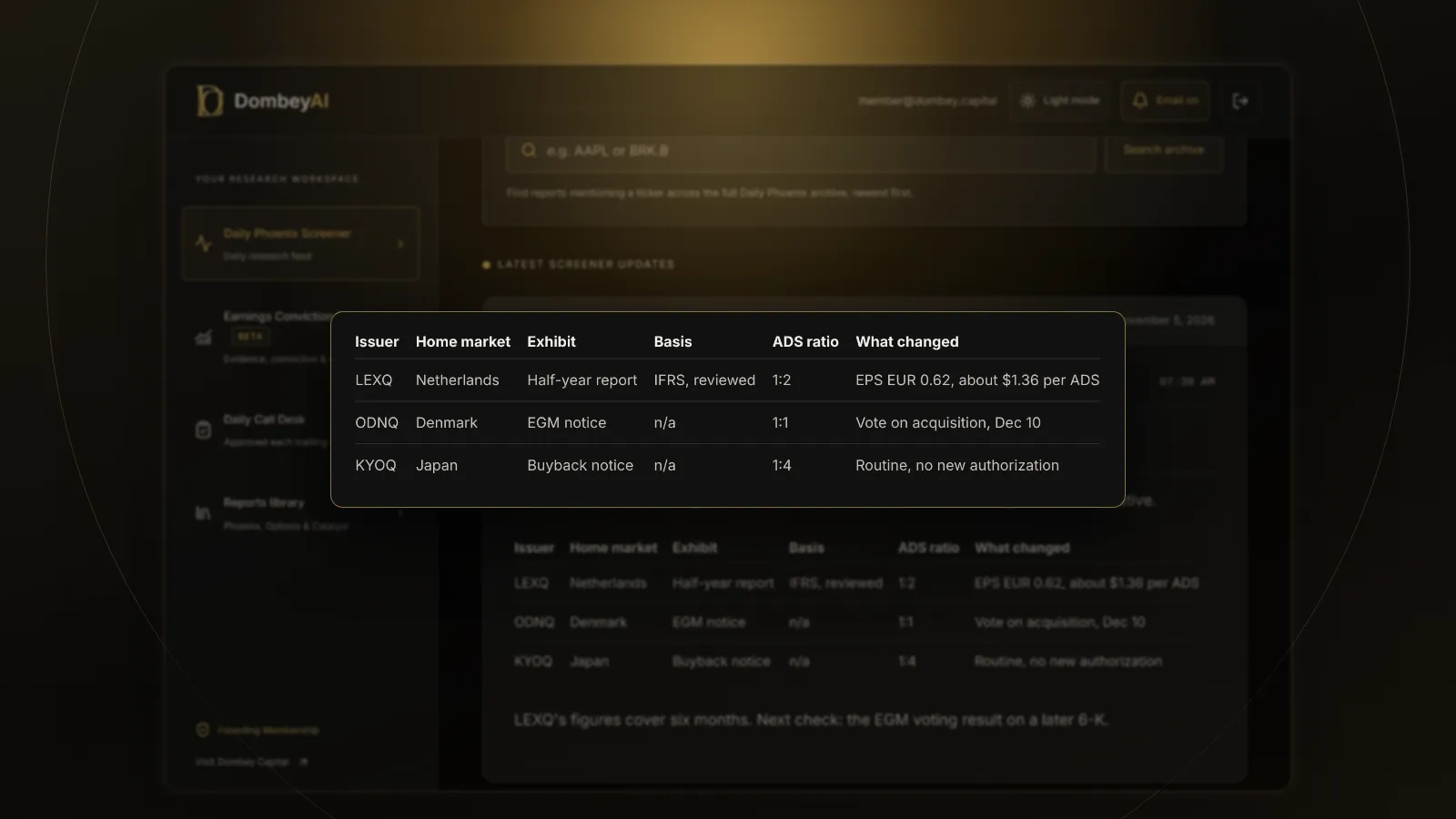
Worked example: reading a results 6-K
Before comparing with US peers, three conversions are needed:
- Per ADS: EUR 0.62 times two ordinary shares per ADS gives EUR 1.24 per ADS.
- Currency: at an illustrative rate of $1.10 per euro, that is about $1.36 per ADS for the half year.
- Period: the report covers six months, not three. Comparing it with a US peer's quarter would double-count.
A second 6-K a week later carries a notice of an extraordinary general meeting to approve an acquisition. A third, after the meeting, reports the vote. Read together, the three give the full picture that a domestic company would spread across a 10-Q, an 8-K and a proxy statement. Our guide on reading a proxy statement still applies to the substance of the meeting materials, even though foreign issuers are exempt from the US proxy rules.
Where this goes wrong
Assuming a quiet period means no news. If home rules require only half-year reports, there may be six months between financial updates. Material events still arrive on 6-Ks, but operating detail may be sparse.
Missing the important 6-K among routine ones. Some companies furnish several 6-Ks a week for buyback transactions, director dealings or exchange notices. Results and deal announcements can get lost.
Misreading per-share figures. The ADS ratio and the currency trip up many readers. A figure that looks like a large beat or miss is often a units error.
Relying on the summary. An English summary of a home-country report can leave out detail that matters. When in doubt, read the home-market document.
Treating timing as fixed. "Promptly" is not a number of days. Most issuers furnish 6-Ks the same day as home publication, but there can be a lag, especially across time zones.
Common mistakes
- Looking for a 10-Q. Foreign private issuers do not file one. Search for 6-Ks around the dates the company reports at home.
- Ignoring exhibits. The 6-K cover page is a one-page form; everything useful is attached.
- Comparing IFRS and US GAAP figures directly. Differences in leases, development costs and other items can change operating profit.
- Forgetting delisting risk notices. A foreign issuer that falls out of compliance with exchange rules often discloses it on a 6-K; see what a delisting means for shareholders.
All 6-Ks are free on EDGAR. Alert services can notify you when a company furnishes one, which matters because foreign issuers often publish during their home market's morning, before the US open. Our comparison of SEC filing tools and EDGAR alerts covers the options, and our list of the best stock research tools for individual investors notes which platforms handle foreign filers well. Reading the 6-K directly, rather than a summary of it, is the habit our article on primary and secondary sources recommends. Dombey's published research reads the latest 20-F and every 6-K since before writing on a foreign-listed situation; see the research archive.
The bottom line
A Form 6-K is how a foreign private issuer furnishes the SEC with whatever it makes public at home, files with an exchange or sends to its shareholders. It replaces the 10-Q and the 8-K, has no fixed item list, and is due promptly after home publication rather than by a set deadline. It is furnished, not filed, unless the company incorporates it into a registration statement. Read the exhibits, check the accounting basis, currency and ADS ratio, and follow a story across several 6-Ks rather than one.