

Where the idea comes from
Psychologist Gary Klein described the pre-mortem in a 2007 Harvard Business Review article on project planning. A team imagines the project has failed and each member writes the reasons. Klein's point was that people find it easier to explain a failure that has happened than to predict one that might. Daniel Kahneman later called it one of the more useful practical defenses against overconfidence.
Investing has the same problem in a sharper form. By the time you are ready to buy, you have read the filings, built a model and formed a view. Every new fact is weighed against that view, which is the pattern described in our piece on confirmation bias. A pre-mortem deliberately switches sides for half an hour.
How a pre-mortem works
The exercise has four parts.
- Set the scene. Pick a date and a loss. "It is twelve months from now and this position is down 40%" works better than "what could go wrong".
- Write the story. List every plausible reason for the loss, without ranking or defending. Aim for eight to fifteen causes.
- Rank the causes. Score each for likelihood and for size of loss. Keep the three to five that matter most.
- Attach signals and actions. For each remaining cause, name the earliest observable sign and what you would do when you see it.
The fourth step is where most of the value is. A risk with no signal attached is a worry, not a plan.
Pre-mortem against related tools
| Tool | When it runs | Question it asks | Main output |
|---|---|---|---|
| Pre-mortem | Before buying | Why did this fail? | Failure causes, signals and exits |
| Base and worst case | Before buying | What is it worth if things go badly? | Downside value and probability |
| Base rates | Before buying | How often do situations like this work? | A starting probability |
| Checklist | Before buying | Did I check the standard items? | Pass or fail on known risks |
| Post-mortem | After the outcome | What actually happened and why? | Lessons for the process |
The pre-mortem does not replace the others. A base and worst case puts a number on the downside, and base rates give a starting probability. The pre-mortem supplies the causes that sit behind both.
A worked example
The investor writes the failure story as if it is a year later and the stock is at $11:
- Store closures cost more than planned, through lease termination payments that ran through the cash balance.
- Same-store sales fell faster than closures cut costs, so losses widened.
- The new chief executive left after eight months.
- The board used the cash for an acquisition instead of a buyback.
- A key supplier tightened payment terms, consuming working capital.
- The market treated the company as a value trap and the multiple did not change even when results improved.
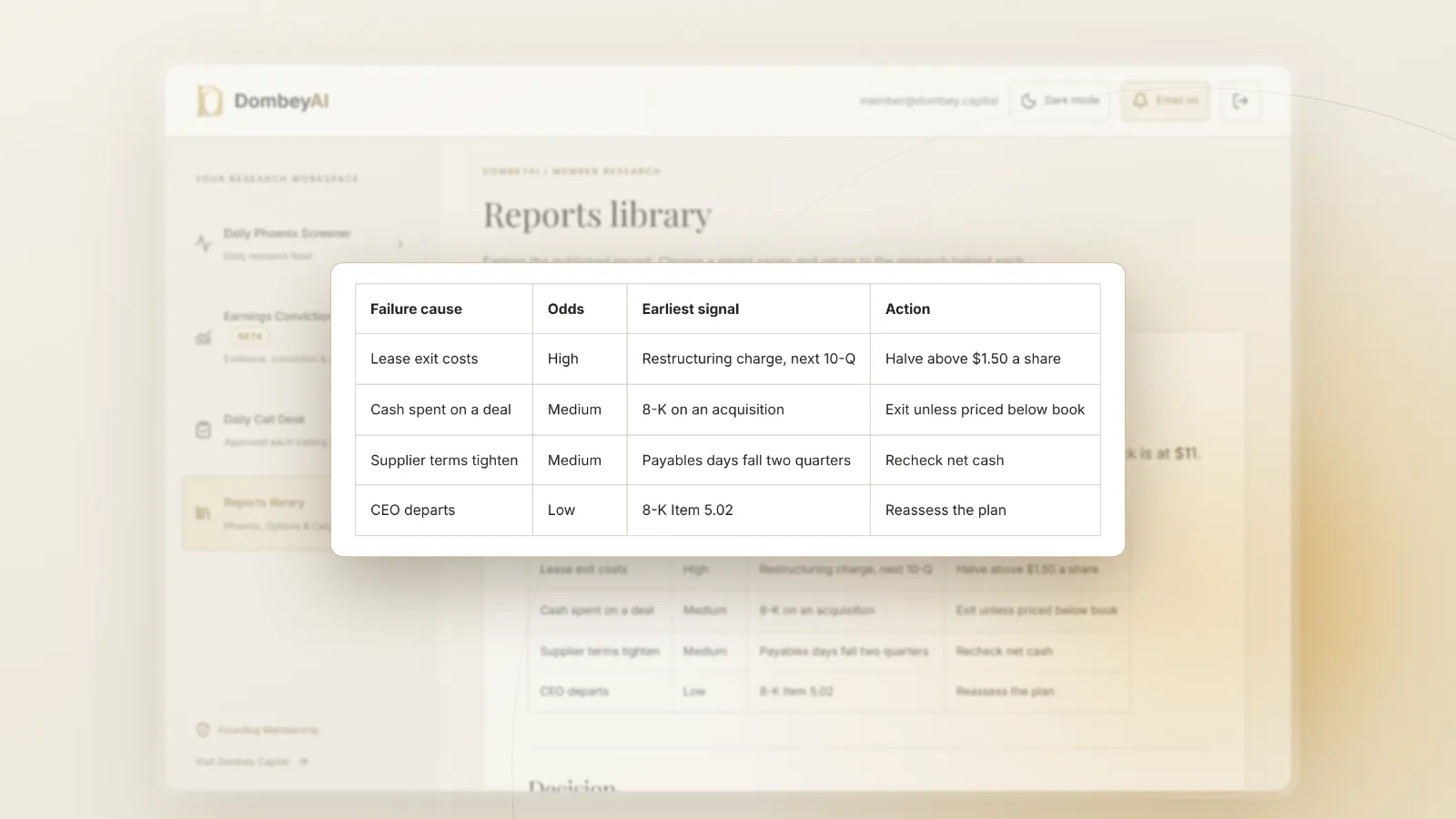
Ranking them, the investor keeps three: lease costs, the use of cash and supplier terms. Each gets a signal and an action.
| Failure cause | Earliest signal | Action |
|---|---|---|
| Lease exit costs | Lease liability note and restructuring charge in the next 10-Q | Cut the position by half if charges exceed $1.50 a share |
| Cash used for a deal | Any 8-K on an acquisition or a new credit facility | Exit unless the deal is small and priced below book |
| Supplier terms | Payables days falling in two straight quarters | Recheck the net cash estimate and resize |
The pre-mortem changed the plan. The investor started at half the intended size and wrote the three signals into the dated thesis.
Making it work for event-driven positions
Special situations have a named catalyst, which makes pre-mortems more concrete. For a merger arbitrage position, the failure causes are usually regulatory, financing or a shareholder vote. For a spin-off, they are often the parent's debt allocation or forced selling by index funds. For a litigation bet, they are the ruling, the timing and the settlement terms.
Two prompts help:
- Timing failure. Suppose the outcome you expected happened, but a year later than planned. Does the position still make money after carrying costs, option decay or a wider spread?
- Right outcome, wrong price. Suppose the catalyst arrived as expected and the stock still fell. What did the market already price in, and what did it care about instead?
These two prompts catch the failures that a thesis about the outcome alone misses. They also connect the pre-mortem to variant perception: if you cannot say what the market believes, you cannot say how you would be wrong about it.
Questions that make a pre-mortem specific
A blank page invites generic answers. A short set of prompts, each aimed at a different part of the thesis, produces better causes.
- The numbers. Which single input in the model, if it were 20% worse, would turn the result into a loss? How confident are you in it, and where did it come from?
- The people. Who has to act for the thesis to work: management, a regulator, a court, an acquirer, index funds? What would make each of them act differently?
- The balance sheet. When does debt mature, what covenants apply and how much cash does the business use in a bad quarter?
- The other side. Who is selling the stock to you, and what do they know or believe? A seller with better information is the most common hidden risk.
- Your own position. If the stock fell 25% next month with no news, would you add, hold or sell? If you cannot answer now, the answer under pressure is unlikely to be better.
Writing the answers takes longer than listing risks, but it is what turns the exercise into a plan. Each answer should either confirm the position as sized or change something about it.
Where this goes wrong
- Generic risks. "Macro risk" and "execution risk" fit every stock and change nothing. Each cause should be specific enough that you could tell when it starts to happen.
- No link to size. A pre-mortem that finds a serious risk but leaves the position size unchanged was theater. The usual result is a smaller starting position.
- Defending during the exercise. Writing a rebuttal next to each cause turns the exercise back into a thesis defense. Separate the steps: write first, judge later.
- Running it after buying. Once money is committed, the pull to justify the position grows. Run it before the order.
- Ignoring the list later. The signals only help if someone checks them. Put them on a calendar next to filing dates and the catalyst, and review them in the post-mortem whatever the outcome.
The bottom line
A pre-mortem assumes the investment has failed and asks why, before any money is at risk. Its value comes from specific causes tied to signals and actions, not from a long list of worries. Run it before buying, let it change the size or structure of the position, and check its list in the review afterward. It fits naturally into a written process; our investment checklist guide and list of stock research tools cover the rest of that process.