

Why utility deals need so many approvals
A regulated utility is a monopoly that earns a return set by its regulators. When it changes hands, the regulators want to know whether customers will pay more, whether service will suffer and whether the new owner can be trusted with an essential service. Each regulator looks at the part of the business it oversees.
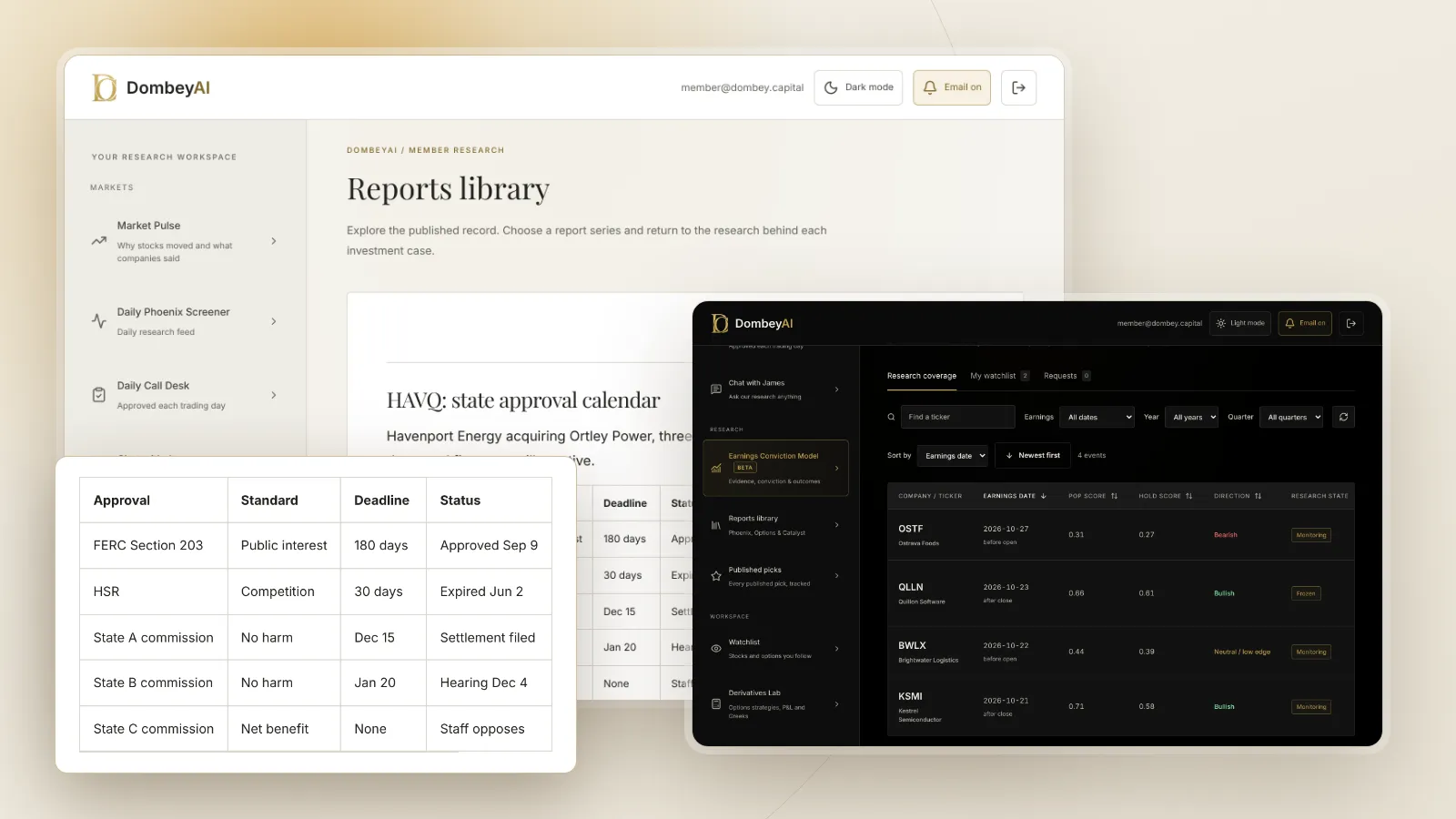
| Regulator | What it reviews | Clock | How often it is the binding constraint |
|---|---|---|---|
| FERC (Section 203) | Effect on competition, rates, regulation and cross-subsidies | 180 days from a complete filing, one extension of 180 days | Rarely |
| State public utility commissions | Customer harm or benefit, rates, service quality, financial strength, local control | Set by state law; often 6 to 12 months, sometimes longer | Usually |
| Antitrust agencies (HSR) | Competition | 30 days after both filings, unless extended by a second request | Rarely |
| Nuclear Regulatory Commission | Transfer of nuclear plant licenses | No fixed statutory deadline | Sometimes, for deals with nuclear plants |
| FCC | Transfer of radio and other licenses | Informal targets | Rarely |
The process looks similar to a bank merger approval in one respect: a federal regulator with a defined review and a set of state regulators with their own priorities. In a utility deal the state layer is much heavier.
How FERC reviews a merger
Section 203 requires FERC approval before a public utility sells, merges or consolidates jurisdictional facilities, and before a holding company acquires a transmitting utility or electric utility company above certain thresholds. FERC approves a transaction if it is consistent with the public interest and will not result in cross-subsidization of a non-utility affiliate, or pledge utility assets for the benefit of an affiliate, unless that is also consistent with the public interest.
In practice FERC looks at four things:
- Competition. Whether the combined company would have market power in wholesale electricity markets, often tested with a market concentration screen.
- Rates. Whether wholesale and transmission customers would pay more. Applicants often commit to hold customers harmless from merger costs.
- Regulation. Whether the deal would weaken effective regulation at the federal or state level.
- Cross-subsidization. Whether the regulated utility could end up supporting an unregulated affiliate.
The statute gives FERC 180 days to act on a complete application, extendable once for another 180 days. Many transactions are approved within the first period. A FERC order rarely surprises a careful reader of the application and the protests filed against it.
How state commissions review a merger
State review is where the outcome is uncertain. Each state's law sets the test and the process, and a target with utilities in five states needs five approvals.
The standard
States fall broadly into two groups. Some apply a no-harm test: the applicants must show the merger will not make customers worse off. Others apply a net-benefit test: the applicants must show customers will be better off. A net-benefit state usually expects something concrete, such as bill credits, a share of savings or investment commitments.
The process
Most states run the application as a contested case. The commission staff, the state consumer advocate, large industrial customers, cities and other groups file testimony. There are discovery rounds, hearings and often a settlement among some of the parties, which the commission can accept, modify or reject. Some states have a statutory deadline; others do not.
The conditions
Approvals almost always come with conditions. The common ones:
- Rate credits or rate freezes. A direct payment to customers or a pause in base rate increases.
- Ring-fencing. Limits on dividends to the parent, a minimum equity ratio at the utility, a separate credit rating, a bar on pledging utility assets and sometimes an independent director.
- Local commitments. A headquarters in the state, minimum staffing levels and charitable giving.
- No recovery of deal costs. The acquisition premium and transaction costs stay out of customer rates.
- Service quality targets. Reliability standards with penalties.
Real examples of state reviews
| Deal | What happened at the state level | Outcome |
|---|---|---|
| Exelon and Pepco Holdings | The District of Columbia commission rejected the first proposal in 2015, then approved a revised settlement | Closed in 2016 |
| NextEra Energy and Hawaiian Electric | The Hawaii commission rejected the deal in 2016 | Terminated |
| NextEra Energy and Oncor | The Texas commission rejected the deal in 2017 over ring-fencing and governance | Terminated |
| Great Plains Energy and Westar Energy | The Kansas commission rejected the original structure in 2017; the companies restructured it as a merger with no premium | Closed in 2018 as Evergy |
The pattern is consistent: in each case the outcome turned on a single state commission. A rejection was sometimes followed by a revised deal with more customer benefits or a different structure, and sometimes by a termination.
Reading the risk in a utility deal
A utility merger spread prices the chance that the deal closes, the time it will take and the conditions it will carry. The merger arbitrage math is the same as for any deal, but the inputs come from the regulatory dockets.
A practical checklist:
- Count the states. Each state that regulates a target utility is a separate approval. More states mean more chances for delay.
- Read the standard. Find out whether each state applies a no-harm or net-benefit test and whether it has a deadline.
- Follow the docket. Staff and consumer advocate testimony shows the likely conditions months before the order. Settlement filings show which parties are on board.
- Watch the politics. Commissioners are elected in some states and appointed in others. Local opposition, a new governor or an election can change the mood of a review.
- Price the conditions. Estimate the cost of rate credits and commitments against the buyer's expected savings. If the conditions approach the savings, the buyer's incentive to close weakens.
- Check the outside date. The merger agreement sets a termination date, often with extensions for pending regulatory approvals. Compare it with the slowest state's likely schedule.
Our guide to tracking a merger through approval covers how to build the calendar, and how to calculate a merger arbitrage spread covers the return math. For how regulated returns drive the value of the target itself, see how to value a utility stock.
How a utility deal timeline usually runs
| Stage | What happens | What to watch |
|---|---|---|
| Announcement | Merger agreement signed, filed on Form 8-K | Outside date, termination fees, conditions on regulatory approvals |
| Filings | Applications to FERC and each state; HSR filings | Which states, which standard, any deadlines |
| Interventions | Parties join the state cases | Who opposes: consumer advocate, cities, large customers |
| Testimony | Staff and intervenors file positions | Recommended conditions, outright opposition |
| Settlement | Some or all parties agree terms | Whether the staff and the advocate sign |
| Orders | FERC order, then state orders | Conditions that differ from the settlement |
| Closing | Usually days to weeks after the last approval | Any rehearing requests or appeals |
Shareholder votes, HSR clearance and FERC approval often finish early. The deal then waits on the last state order. Most of the dated catalysts in a utility deal sit in the state dockets, which is why we track them alongside the other dated events in the market coverage.
Where this goes wrong
- Treating FERC approval as the finish line. It is usually the easy part. The state reviews decide most deals.
- Ignoring rehearing and appeal rights. Parties can seek rehearing of a commission order and then appeal. That can delay closing even after approval.
- Assuming a settlement binds the commission. A commission can reject or rewrite a settlement, as several have.
- Missing the financing. A buyer that funds the deal with heavy holding company debt may face pressure for tighter ring-fencing, and rating agencies may react to the conditions.
- Forgetting the acquirer's shareholders. If the conditions grow expensive, the buyer's own investors may push it to walk away when the agreement allows. Our piece on deal breaks covers what happens to both stocks when that occurs.
Remedies matter too. In some deals, the parties divest a plant or a business line to address competition concerns; merger remedies explains how those sales work.
The bottom line
A utility merger needs FERC approval and approval from every state commission that regulates the target's utilities. FERC's review is predictable and has a statutory clock. The state reviews are not: each applies its own standard, runs its own process and sets its own conditions. To judge a utility deal, read the state dockets, count the approvals, price the conditions and compare the slowest state's schedule with the outside date.