

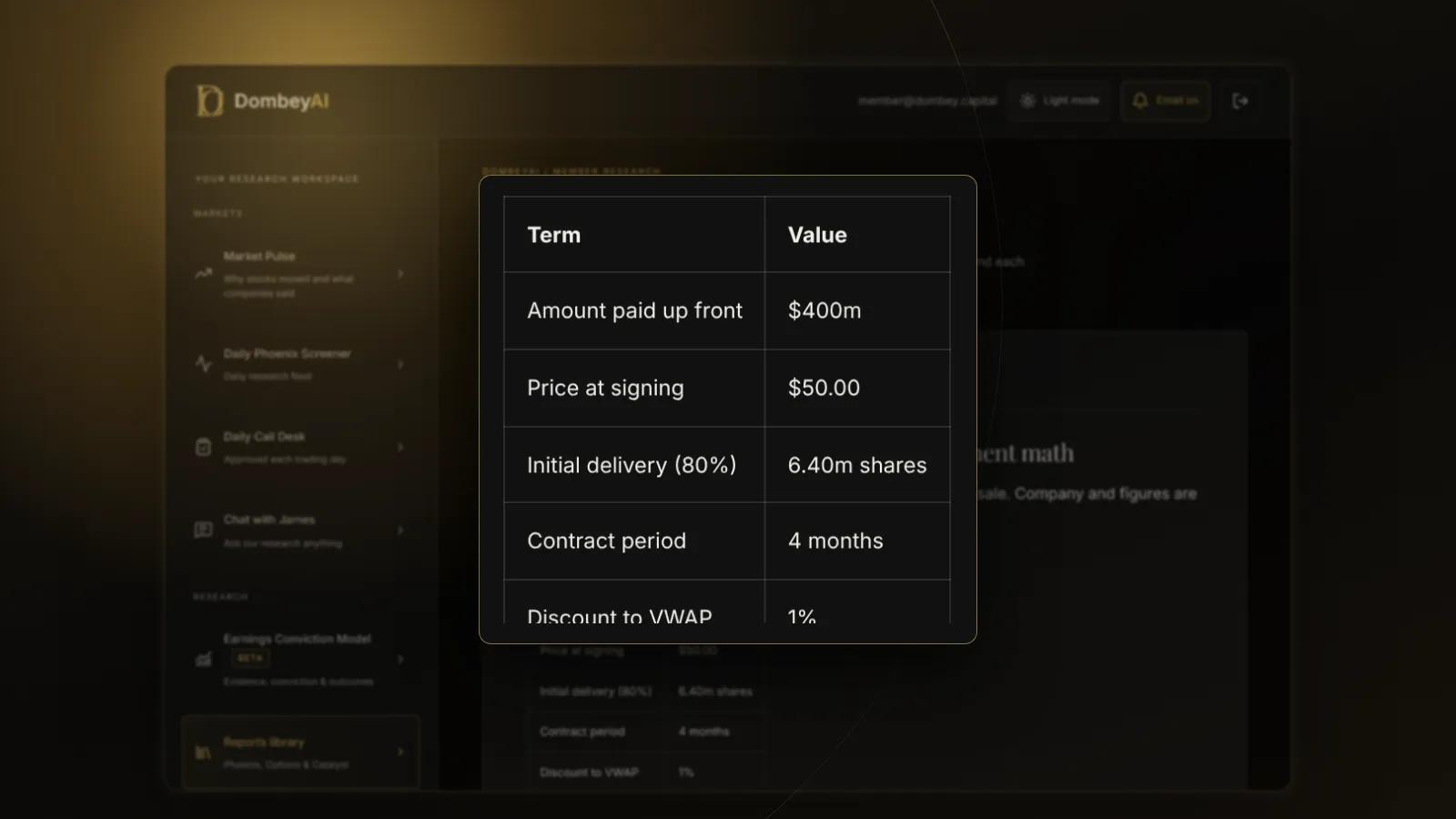
A short definition
In an ordinary buyback, a company holds an authorization from its board and buys shares in the open market over months or years, at its own pace. In an ASR, the company signs a contract with a bank, pays the whole amount on day one and gets most of the shares delivered straight away. The rest follow at the end of the contract, once the average price is known.
The effect is a large, immediate drop in shares outstanding and a fixed commitment of cash, in exchange for giving up the flexibility to stop buying.
Where ASRs show up in practice
| Situation | Why an ASR fits | What to check |
|---|---|---|
| After a large asset sale | The company has cash to return and wants to offset the earnings lost from the sold business | Price paid against the value of what remains; see asset sales |
| Leveraged recapitalization | Debt is raised specifically to buy back shares | New leverage and interest cover; see leveraged recapitalizations |
| After a spin-off | The parent receives a cash distribution from the spun-off company | Whether the cash came from new debt at the spin-off |
| Large, mature companies with steady cash flow | Apple and other large US companies have disclosed ASRs in their filings alongside open-market buybacks | Size relative to market value and to free cash flow |
| Activist pressure | A board commits capital quickly to answer an activist's demands | Whether the price makes sense or the buyback is defensive |
ASRs are disclosed in 8-Ks or press releases when they are signed, and in the equity footnote and the issuer repurchase table in the 10-Q and 10-K afterwards.
How an ASR works, step by step
- The agreement. The company signs an ASR agreement with one or more banks for a fixed dollar amount, for example $500 million, over a set period, often three to nine months.
- Upfront payment and initial delivery. The company pays the full amount. The bank delivers an initial number of shares, often around 70% to 85% of the amount divided by the current price. The rest is held back to cover price changes.
- The bank's short position. The bank borrowed those initial shares from other holders, so it is short. Over the contract period it buys shares in the market to cover.
- Final settlement. At the end, the total number of shares due is the amount paid divided by the volume-weighted average price (VWAP) during the period, usually less an agreed discount. The bank delivers the remaining shares. If the price rose sharply, the company may owe shares or cash back, depending on the contract.
Why companies choose an ASR
Speed. The share count falls immediately by the initial delivery. Earnings per share rise from the next quarter, rather than gradually over a year of open-market buying.
Commitment. An open-market authorization can sit partly unused for years. An ASR spends the money. That makes it a clearer signal of what management intends to do with the cash.
Execution handled by the bank. The bank buys the shares over the period, typically spreading purchases to limit the price impact. The company pays for this through the discount or a fee built into the contract.
Matching a cash event. When a company receives a large sum at once, such as proceeds from a sale or a distribution from a spin-off, an ASR lets it return the cash on a similar timetable.
How an ASR is accounted for
Under US GAAP, the initial share delivery is recorded as a treasury stock purchase, which reduces shares outstanding for earnings per share from that date. The part of the payment tied to the shares not yet delivered is treated as a forward contract on the company's own stock and recorded in equity. When final settlement occurs, the remaining shares are added to treasury stock. The company describes the terms in its equity footnote.
Since 2023, US companies have also paid a 1% excise tax on net share repurchases under the Inflation Reduction Act, which applies to ASRs as well as open-market buybacks. The SEC's issuer repurchase table in periodic reports shows the monthly purchases, including those under an ASR.
What an ASR signals and how the market reacts
An ASR announcement usually says the company thinks its shares are a good use of cash and is willing to commit to it. It is often paired with another event, such as an asset sale or a debt raise, and the market reacts to the package as a whole. Our article on buybacks as catalysts covers when repurchases move a stock.
The bank's buying also adds demand during the contract period. For a large ASR relative to daily trading volume, that steady buying can support the price while it lasts. When the contract ends, that demand stops.
For our coverage of dated events across the market, see the market section.
Valuing the effect
To judge whether an ASR adds value, compare the price paid with your estimate of intrinsic value per share.
- If the stock is worth more than the price paid, remaining shareholders gain, because the company has bought value at a discount.
- If the stock is worth less, the company has transferred value to the shareholders who sold.
- If the ASR is funded with debt, the extra interest and risk come out of the value of the remaining shares. Check net debt to EBITDA and interest cover after the deal.
Earnings per share accretion is not the test. Almost any buyback raises EPS when the company's earnings yield is above the after-tax cost of the cash or debt used. That says nothing about whether the price was right. Shareholder yield puts buybacks alongside dividends and debt reduction for comparison.
Dombey's published research looks at capital returns alongside other dated corporate events; see the research archive.
Where this goes wrong
- Confusing EPS growth with value. An ASR lifts EPS immediately, but buying back overvalued stock still destroys value per share.
- Ignoring the funding. A debt-funded ASR increases leverage. If the business weakens, the same buyback that lifted EPS can leave the balance sheet stretched.
- Missing the final settlement. The final share count is not known until the end. A rising stock means fewer shares than the announcement implied.
- Overlooking dilution elsewhere. Share-based compensation can offset much of a buyback. Check the net change in diluted shares; our article on dilution shows how.
- Reading support as value. The bank's buying during the contract can hold the price up temporarily. When the contract ends, the price has to stand on the business.
The bottom line
An accelerated share repurchase is a buyback in which the company pays a bank up front and receives most of the shares at once, with the final count set by the average price over the contract. It reduces the share count quickly and commits the cash, which makes it a stronger signal than an open-ended authorization. The test of whether it adds value is the same as for any buyback: the price paid against what the shares are worth, and how the purchase was funded.