

A short definition
"Ex" means without. A share bought before the ex-dividend date comes with the next declared dividend; a share bought on or after it does not. The exchange sets the ex-date based on the company's record date and the settlement cycle, so that everyone who buys before the ex-date is on the company's books in time.
Since May 28, 2024, most US stock trades settle one business day after the trade date (T+1). As a result, the ex-dividend date and the record date now usually fall on the same day. Before that, under two-day settlement, the ex-date came one business day before the record date.
The four dividend dates
| Date | What happens | What it means for you |
|---|---|---|
| Declaration date | The board announces the dividend, its amount, the record date and the payment date | The dividend becomes a commitment; the announcement itself can move the stock |
| Ex-dividend date | The stock starts trading without the dividend | Own the shares before this day to receive it |
| Record date | The company identifies its shareholders of record | Under T+1, usually the same day as the ex-date |
| Payment date | The cash is paid to holders of record | The money arrives in your account |
What happens to the price
At the open on the ex-dividend date, each share is worth less by about the dividend, because the dividend now belongs to the previous owner. If the stock closed at $40.00 before a $0.50 dividend and nothing else changed, you would expect it to open near $39.50.
In practice the drop is rarely exact, for three reasons:
- Other news. The ex-date is a normal trading day. Earnings, market moves and sector news all affect the price at the same time.
- Taxes. Dividends are taxed differently from capital gains, and different holders pay different rates. Academic studies have found that the average price drop is often a little smaller than the dividend, which many attribute to taxes.
- Tick size and spreads. Prices move in cents, and on thinly traded stocks the bid-ask spread can be larger than a small dividend.
Total value does not change. A shareholder who owned a $40.00 share before the ex-date owns a share worth about $39.50 and a claim to $0.50 in cash. The investor is no richer and no poorer, before taxes.
Price charts and return figures often adjust for this. An adjusted price series lowers past prices by each dividend so that the chart shows total return; an unadjusted chart shows a small gap down on every ex-date.
Open orders on the ex-date
Under FINRA Rule 5330, brokers generally reduce the price of open buy limit orders and sell stop orders by the amount of a cash dividend on the ex-date, so that the order keeps the same relation to the market price. A customer can mark an order "do not reduce" to keep its original price. Sell limit and buy stop orders are not reduced. Rules and broker practice differ, so check how your broker handles orders around dividends.
Large and special dividends
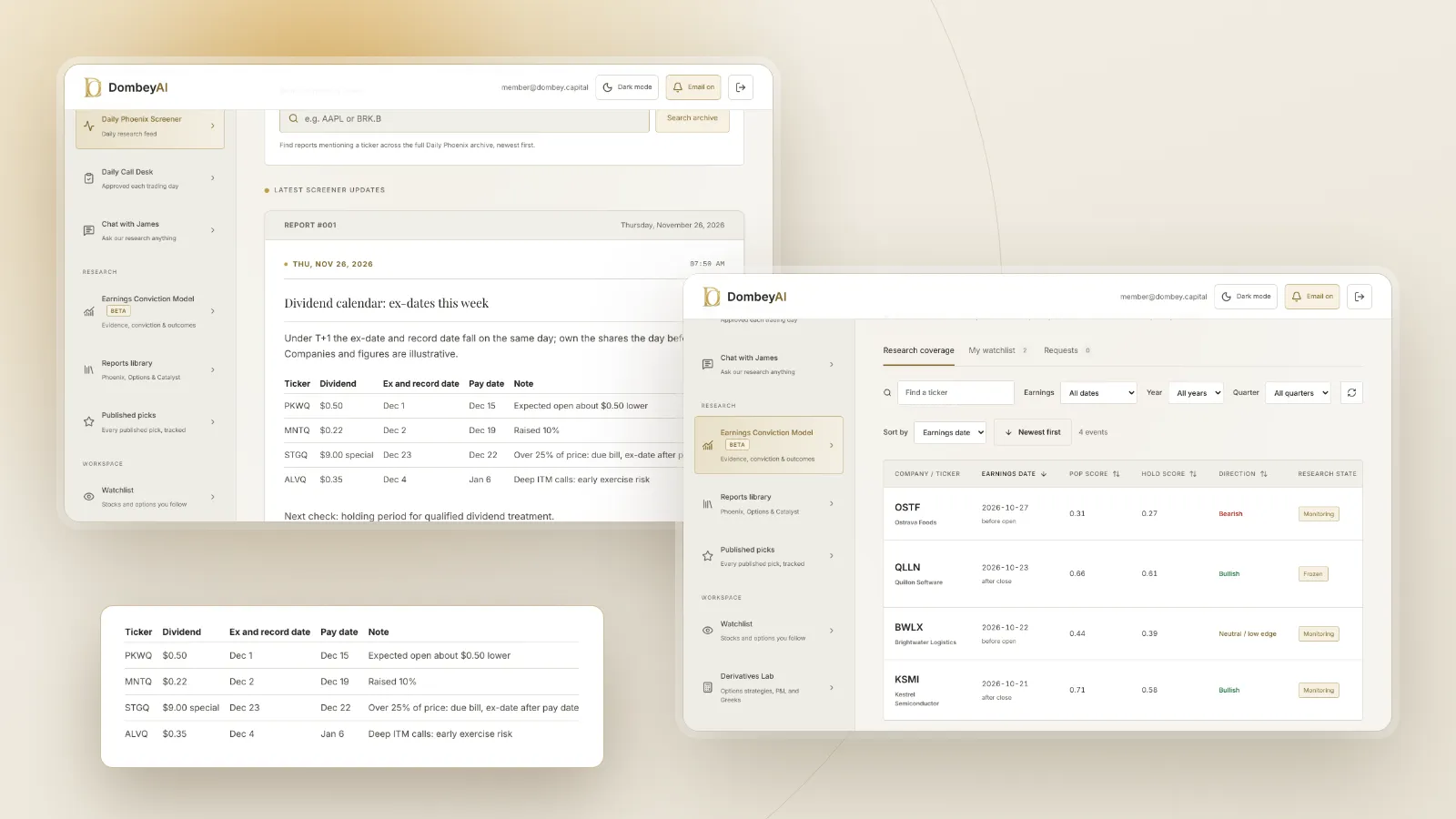
When a dividend equals 25% or more of the share price, a different rule applies. The ex-dividend date is set as the first business day after the payment date, not on or before the record date. Between the record date and the ex-date, the shares trade with a due bill attached: a seller who owned the shares on the record date must pass the dividend to the buyer.
The rule exists because a very large dividend changes the share price so much that the market needs the stock to keep trading with the dividend until it is paid. It applies most often to special dividends paid out of asset sales or excess cash. Large special dividends can also lead the options industry to adjust listed contracts; our piece on adjusted options explains how.
The ex-date and options
Option holders do not receive dividends; only shareholders do. That creates two effects:
- Option prices already reflect the dividend. A known dividend before expiration lowers call prices and raises put prices, because the stock is expected to drop by the dividend. Nothing special happens to the option's value on the ex-date if the dividend was expected.
- Early exercise. A holder of an American-style call that is deep in the money may exercise the day before the ex-date to collect the dividend, when the dividend exceeds the call's remaining time value. Sellers of covered calls can be assigned early as a result. Our guide on early exercise of options walks through the math.
The ex-date and taxes
In the United States, ordinary dividends can be taxed at lower qualified dividend rates if, among other conditions, you held the stock for more than 60 days during the 121-day period that begins 60 days before the ex-dividend date. A trader who buys just before the ex-date and sells soon after usually fails that test, so the dividend is taxed as ordinary income. IRS Publication 550 sets out the full rules. If you are unsure how they apply to you, check with a tax adviser.
Dividend capture, and why it rarely works
Dividend capture means buying shares just before the ex-date and selling them soon after, to collect the dividend. It looks like free money and usually is not:
- The price falls by about the dividend, so the trade starts roughly even.
- The dividend may be taxed at a higher rate because of the short holding period.
- Spreads and commissions cut into a small payment.
- The stock can move by far more than the dividend during the holding period.
The ex-date is better understood as a scheduled accounting event than as a trade.
When the ex-date tells you something
The ex-date itself carries no news. The information sits in the declaration. A first dividend, a raise, a cut or a special payout is a signal about cash flow and management's confidence. Our pieces on dividend initiations and dividend cuts cover how those announcements move stocks, and the dividend payout ratio is the first check on whether a dividend can last. The stock's ex-date, record date and payment date are listed in the company's declaration, usually in a press release or an 8-K. For dated corporate events on specific stocks, see the market coverage.
Where this goes wrong
- Buying on the ex-date to get the dividend. It is too late; you need to own the shares the day before.
- Reading the drop as bad news. A gap down equal to the dividend is arithmetic, not a signal.
- Comparing unadjusted prices. A chart that is not adjusted for dividends understates the total return of a high-yield stock.
- Forgetting the due bill on a large dividend. For dividends of 25% or more, the usual timing rule does not apply.
- Selling covered calls into a dividend without checking assignment risk. Deep in-the-money calls are likely to be exercised early.
The bottom line
On the ex-dividend date, a stock starts trading without its next dividend, and its price usually opens lower by about the dividend. To receive the payment you must own the shares before the ex-date, which under T+1 settlement is usually the same day as the record date. The drop moves value from the share into cash and does not make shareholders poorer before taxes. Watch the special cases: large dividends with due bills, early exercise of calls and the holding period for qualified dividend tax rates.