

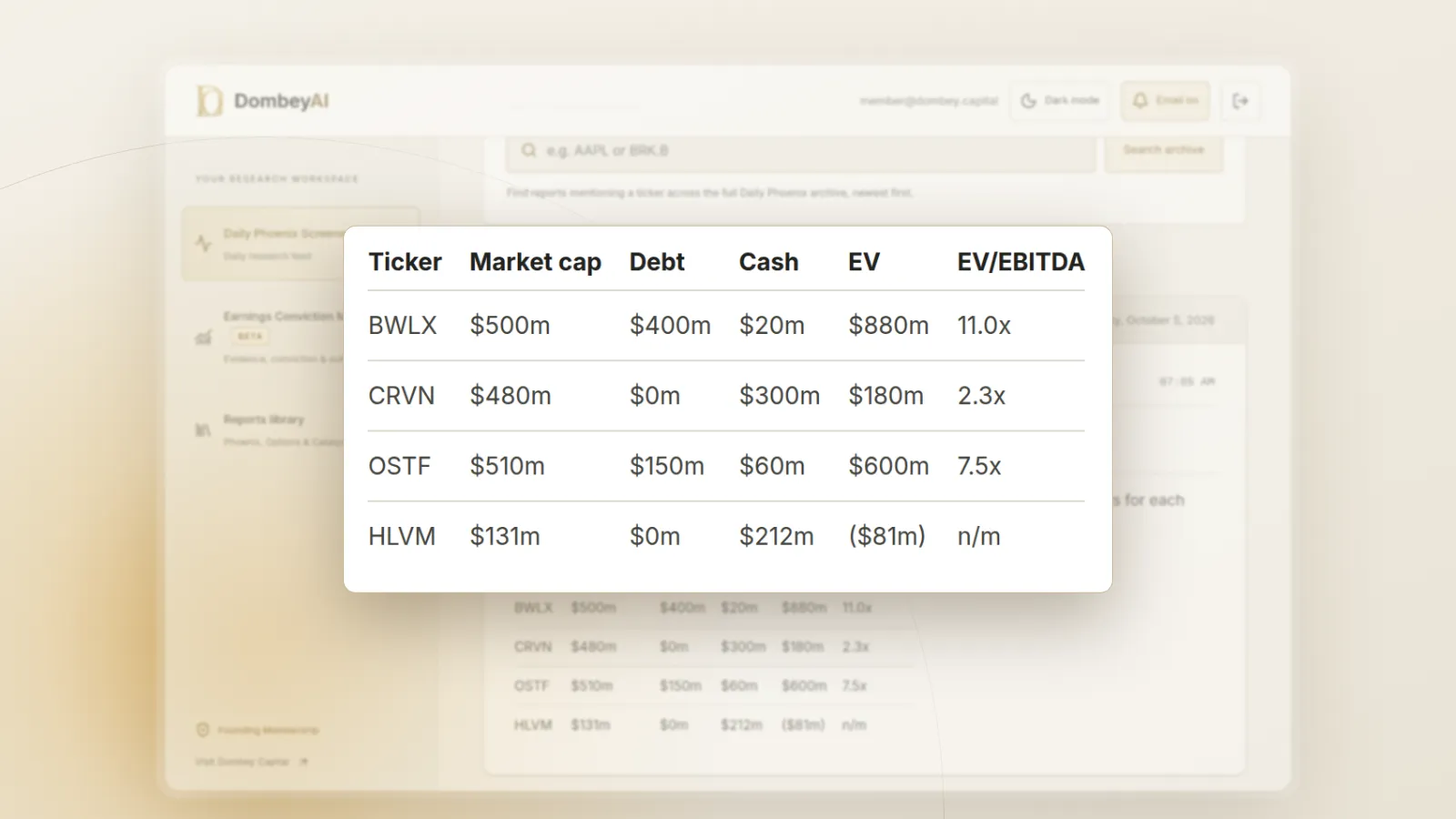
The enterprise value formula
The standard formula is:
Enterprise value = equity market value + total debt + preferred stock + noncontrolling interest minus cash and cash equivalents
Each piece has a reason to be there.
- Equity market value. Share price times the fully diluted share count. This is what it costs to buy every share.
- Total debt. Short-term and long-term borrowings, including bonds, loans and convertible notes not already counted as equity. A buyer inherits these.
- Preferred stock. A claim that ranks ahead of common shareholders.
- Noncontrolling interest. The share of consolidated subsidiaries owned by outsiders. The parent's financial statements include 100% of those subsidiaries' sales and earnings, so the outside stake belongs in EV too.
- Cash and cash equivalents. Subtracted because a buyer gets it and can use it to repay debt or return capital.
The result is the value of the operating business, independent of how it is financed. That is what makes it useful for comparison.
Why enterprise value matters
Market cap tells you what the equity costs. It ignores the balance sheet. Two companies with the same market cap can be very different investments.
This is also why enterprise value shows up in takeover work. In merger arbitrage, a buyer's offer price per share is only part of the cost. The buyer usually has to refinance the target's debt as well, so deals are often described and compared in EV terms.
A full worked example
The figures below are illustrative. Company C is hypothetical. Pull each figure from the latest 10-Q or 10-K; our guide to reading a 10-Q for special situations shows where each line sits.
| Component | Source in the filing | Amount |
|---|---|---|
| Share price | Market quote | $25.00 |
| Basic shares outstanding | Cover page | 40.0 million |
| Dilutive options and RSUs (treasury stock method) | Equity compensation note | 1.2 million |
| Fully diluted shares | Calculated | 41.2 million |
| Equity market value | $25.00 x 41.2m | $1,030m |
| Short-term and long-term debt | Balance sheet, debt note | $350m |
| Preferred stock | Balance sheet | $50m |
| Noncontrolling interest | Balance sheet, equity section | $30m |
| Cash and cash equivalents | Balance sheet | ($160m) |
| Enterprise value | Sum | $1,300m |
With $1,300 million of EV, $1,000 million of revenue and $130 million of EBITDA, Company C trades at 1.3 times EV/sales and 10.0 times EV/EBITDA.
Enterprise value multiples
Enterprise value is the numerator in several common ratios. The rule for every one is that the denominator must be an earnings or sales figure available to all the capital holders in the numerator, which means a figure before interest.
| Multiple | Denominator | Useful for | Watch for |
|---|---|---|---|
| EV/Sales | Revenue | Unprofitable or early companies, cross-margin comparison | Ignores profitability entirely |
| EV/EBITDA | Earnings before interest, taxes, depreciation and amortization | Comparing companies with different debt and tax positions | Ignores capital spending; adjusted EBITDA can flatter |
| EV/EBIT | Operating income | Capital-intensive businesses where depreciation is a real cost | One-off items in operating income |
| EV/Free cash flow (unlevered) | Cash flow before interest, after capital spending | Cash generation across capital structures | Swings in working capital |
A P/E ratio, by contrast, pairs equity value with earnings after interest. Mixing the two, such as EV divided by net income, gives a meaningless number.
The adjustments that change the answer
The basic formula is a starting point. These items often matter more than the headline numbers.
- Dilution. Use the cover page share count plus in-the-money options, restricted stock units and convertible securities that are likely to convert. Using basic shares understates equity value.
- Leases. Since US lease accounting changed, operating lease liabilities sit on the balance sheet. If you include them in EV, use an earnings figure before lease costs. If you leave them out, use one after. Either is fine; mixing is not.
- Pensions. An unfunded pension obligation behaves like debt. Many analysts add it, net of tax.
- Restricted and trapped cash. Cash held as collateral, in escrow, or in a country that limits repatriation is not freely available. Subtract only the cash a buyer could actually use.
- Short-term investments. Treasury bills and other liquid securities are usually treated like cash. Long-term or illiquid investments deserve a discount.
- Non-operating assets. Equity stakes in other companies, surplus real estate or legal claims can be subtracted at a conservative value to isolate the core business.
- Timing. The share price is today's; the balance sheet may be months old. If the company has raised debt, bought back stock or burned cash since the last filing, adjust for it.
When enterprise value turns negative
If cash exceeds equity value plus all other claims, EV is below zero. On paper, the market is paying less than nothing for the operating business. This is where enterprise value meets net cash per share: a negative EV means the stock trades below its net cash.
That is a flag, not a verdict. The cash may be burned by losses, held abroad, needed for a lawsuit or simply spent badly. Our piece on negative enterprise value stocks covers how to tell the difference, and the below net cash guide shows how to screen for them. When a company with negative EV is winding down rather than operating, the analysis moves to a liquidation valuation.
Where this goes wrong
- Stale balance sheet. A quarter of cash burn or a new loan can move EV materially. Always ask what has changed since the filing date.
- Mismatched numerator and denominator. Including leases in EV but using EBITDA after rent, or using net income, distorts the multiple.
- Trusting adjusted EBITDA. Company-defined adjustments can remove recurring costs. Rebuild EBITDA from the income statement and cash flow statement where you can.
- Ignoring capital intensity. Two businesses on the same EV/EBITDA can generate very different free cash flow if one spends heavily on equipment.
- Treating all cash as excess. A business needs some cash to operate. Subtracting every dollar overstates how cheap it is.
- Comparing across industries. EV multiples differ widely by sector. A low multiple in one industry can be normal in another.
How investors use it
- If you are comparing two companies with different debt levels, use EV multiples rather than P/E.
- If you are looking at a possible takeover target, estimate EV first, because that is closer to what a buyer pays.
- If EV is small relative to cash, check cash burn, debt maturities and contingencies before treating the stock as cheap.
- If a company holds large non-operating assets, subtract them at a conservative value to see what the market pays for the core business.
- If book value matters more than earnings, as in a bank or a holding company, pair EV with price to book rather than relying on EBITDA.
Dombey's published research works from enterprise value and net cash before each catalyst; see the research archive.
The bottom line
Enterprise value is equity market value plus debt, preferred stock and minority interest, minus cash. It measures what the operating business costs, regardless of how it is financed, which makes it the fairer basis for comparing companies. The formula is simple; the judgment is in the share count, the treatment of leases, pensions and trapped cash, and the date of the balance sheet. Match every claim in the numerator to the right denominator and EV multiples become a reliable first test of value.