

What a 10-Q contains
The SEC's form instructions split the 10-Q into two parts. Part I holds the financial information. Part II holds other information that may or may not apply in a given quarter.
Part I: Financial information
- Item 1. Financial statements. Balance sheet, income statement, statement of comprehensive income, cash flow statement and changes in equity, with notes. The income statement usually shows both the quarter and the year to date, against the same periods a year earlier.
- Item 2. Management's discussion and analysis (MD&A). Management's explanation of results, liquidity and capital resources.
- Item 3. Quantitative and qualitative disclosures about market risk. Exposure to interest rates, currencies and commodity prices. Smaller reporting companies do not have to provide it.
- Item 4. Controls and procedures. Management's conclusion on whether disclosure controls are effective, and any change in internal control during the quarter.
Part II: Other information
- Item 1. Legal proceedings. New material cases or developments in existing ones.
- Item 1A. Risk factors. Material changes to the risk factors in the 10-K. Many companies write "no material changes" here, so an actual update stands out.
- Item 2. Unregistered sales of equity securities and use of proceeds. This is where the table of share repurchases during the quarter appears.
- Items 3 to 5. Defaults on senior securities, mine safety disclosures and other information, which in recent years includes whether directors or officers adopted or ended trading plans.
- Item 6. Exhibits. Including the CEO and CFO certifications required by the Sarbanes-Oxley Act and any material contracts signed in the quarter.
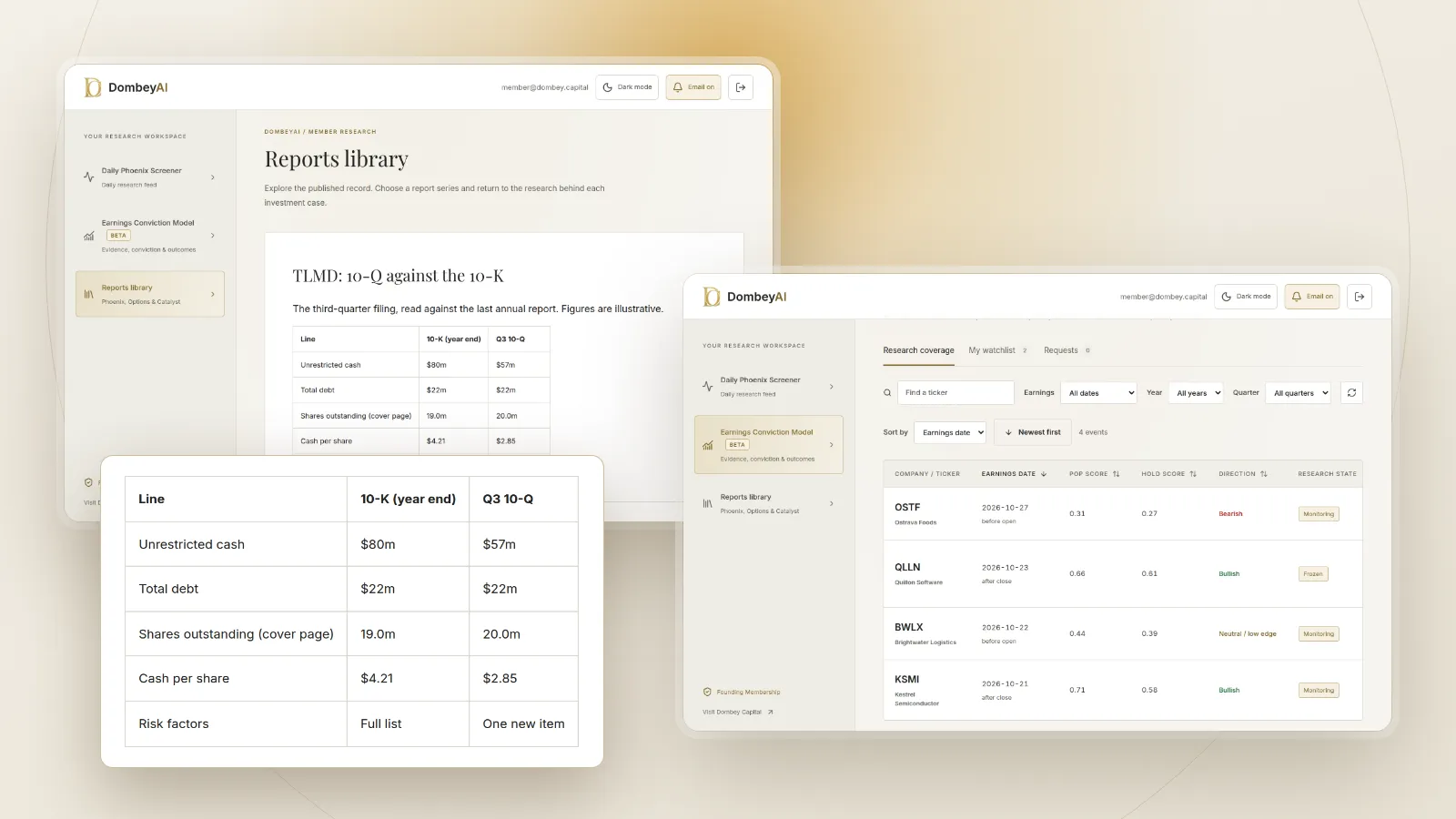
The cover page matters too. It lists the number of shares outstanding as of a recent date, usually a few weeks after quarter end. That is the most current share count in the filing, and it is the figure to use for per-share math such as net cash per share.
10-Q vs 10-K: the differences at a glance
| 10-Q | 10-K | |
|---|---|---|
| Covers | One fiscal quarter and year to date | The full fiscal year |
| Filed | Three times a year (Q1, Q2, Q3) | Once a year |
| Financial statements | Reviewed by the auditor, not audited | Audited, with the auditor's report |
| Business description | Not required | Full description of the business |
| Risk factors | Only material changes since the 10-K | The complete list |
| Deadline, large accelerated filers | 40 days after quarter end | 60 days after year end |
| Deadline, accelerated filers | 40 days | 75 days |
| Deadline, all other filers | 45 days | 90 days |
| Internal control | Changes in the quarter | Management's annual assessment, plus an auditor's attestation for larger filers |
| Typical length | Shorter | Longer, often several times the 10-Q |
The audit difference is the one investors most often overlook. A review is a narrower set of procedures, mostly inquiry and analysis, and it gives limited assurance. Quarterly figures can be revised when the year-end audit is done. That does not make 10-Q numbers unreliable, but it does mean the 10-K is the firmer anchor.
For a full walk through the annual filing, see what a 10-K is.
When a 10-Q is due
Deadlines depend on filer status, which is set mainly by the company's public float.
- Large accelerated and accelerated filers: 40 days after the end of the quarter.
- Non-accelerated filers, including most small companies: 45 days.
A company that cannot meet the deadline files a Form 12b-25, the notification of late filing. That gives it up to five extra calendar days for a 10-Q. The reason given on the 12b-25 is worth reading. "Additional time to complete the review" is common and usually harmless. A reference to an internal investigation, a restatement or a disagreement with the auditor is not.
How to read the two filings together
The 10-Q is written on the assumption that you have read the 10-K. Its notes often say that they should be read with the annual statements, and its risk factor section may only say what changed. That creates a simple order of work.
- Read the latest 10-K once. Note the business segments, the full risk factors, the debt schedule and the accounting policies.
- Read each 10-Q against it. Look for what moved: cash, debt, share count, segment results, new lawsuits, new risk factors.
- Rebuild the fourth quarter yourself. Subtract the nine-month figures in the Q3 10-Q from the annual figures in the 10-K.
- Keep the same fields each quarter. A table of cash, debt, operating cash flow and diluted shares across four quarters shows a trend a single filing hides.
The guide on reading a 10-Q for special situations turns this into a step-by-step checklist, and how to search SEC EDGAR filings covers finding each filing quickly.
Where to look first in a 10-Q
Most readers start with the income statement. For many purposes, other parts carry more information.
- If you care about survival, start with the liquidity section of MD&A and the cash flow statement. They say how long the cash lasts and whether management expects to raise more.
- If you care about dilution, compare the cover page share count with the last filing, then read the equity note for new warrants, convertibles and option grants.
- If you follow a pending event, read the subsequent events note at the end of the financial statements. Asset sales, financings and settlements signed after quarter end often appear here first in a filing.
- If you follow litigation, read Part II Item 1 and the commitments and contingencies note. A newly recorded accrual tells you management now considers a loss probable and estimable.
- If you care about capital returns, read the repurchase table in Part II Item 2 for shares bought, average price and the remaining authorization.
For a special situation, the 10-Q is often the first formal record of a change that matters to the thesis. For a dated event such as a spin-off, the parent's 10-Q may disclose costs, timing and the shape of the separated business before the new company files on its own.
The 10-Q and earnings season
Many companies publish an earnings release on a Form 8-K and hold a call before or on the same day they file the 10-Q. The release is the company's own presentation of results, often with adjusted figures. The 10-Q is the formal filing.
That gap matters around a stock catalyst like earnings. Prices move on the release and the call. The 10-Q can arrive the same day or days later, with details the release did not mention: a covenant amendment, a customer concentration, a change in a reserve. Reading the 10-Q after the release is one of the cheapest checks an investor can do.
| Filing | Who writes it | What it is for | Audited or reviewed |
|---|---|---|---|
| Earnings release (8-K exhibit) | The company | Presenting results, often with adjusted measures | Neither |
| 10-Q | The company, under SEC form rules | The formal quarterly report | Reviewed |
| 10-K | The company, under SEC form rules | The formal annual report | Audited |
Where this goes wrong
The 10-Q is a primary source, but it has real limits.
- Unaudited figures. Quarterly numbers can change at year end. A large adjustment in the 10-K's fourth quarter sometimes reflects issues that were already present earlier in the year.
- Stale by the time it is filed. A 10-Q can arrive up to 45 days after the quarter closed, and the balance sheet is a snapshot from that date. A company burning cash quickly may hold much less by the filing date.
- Year-to-date blur. Cash flow statements are usually reported year to date. To get one quarter's cash flow, subtract the prior 10-Q's year-to-date figures.
- Seasonality. Comparing a strong quarter with a weak one in a seasonal business can mislead. Compare each quarter with the same quarter a year earlier.
- Boilerplate risk factors. "No material changes" is the most common answer in Part II Item 1A. It can hide gradual changes that never cross the company's own threshold.
- What it does not include. The 10-Q does not describe the business in full or give the complete risk factor list. Reading it without the 10-K leaves gaps.
Dombey's published research reads each new 10-Q against the prior filings before a catalyst date; see the research archive.
The bottom line
A 10-Q is a public company's quarterly SEC report: reviewed financial statements, MD&A and updates on legal matters, risks and buybacks, filed within 40 or 45 days of each of the first three quarters. The 10-K is the audited annual report and the full description of the business. Read the 10-K once as the baseline and each 10-Q as the update to it, and keep the same figures from filing to filing so you can see the trend.