

What triggers a restatement
Accounting standards require a company to correct an error in previously issued statements. An error can be a mistake in arithmetic, a misapplied rule, an oversight of facts that existed at the time, or misuse of information. A change in estimate, such as a new view of an asset's useful life, is not an error and is handled going forward instead.
Common causes include:
- Revenue recognized in the wrong period, or gross instead of net.
- Leases, warrants or convertible instruments classified the wrong way.
- Inventory or cost of goods sold misstated, sometimes at a single subsidiary.
- Tax provisions calculated incorrectly.
- Errors in segment reporting, earnings per share or the cash flow statement.
- Deliberate misstatement, which tends to come with an internal investigation.
The cause shapes the reaction. A warrant classification fix changes no cash and no customer behavior. Revenue booked early changes the growth rate investors paid for.
Big R and little r: two kinds of correction
The key test is materiality to the periods already reported.
| Feature | Big R restatement | Little r revision |
|---|---|---|
| When it applies | The error is material to prior statements | The error is immaterial to prior periods but correcting it all in the current period would be material |
| Non-reliance 8-K | Yes, Item 4.02 | No |
| How prior numbers are fixed | Prior statements are reissued, often in an amended 10-K or 10-Q | Comparative figures are revised in the next regular filing |
| Typical market signal | Larger, because prior statements are withdrawn | Smaller, often noticed only in the notes |
| Compensation clawback analysis | Required | Required |
| Where to read it | The 8-K, the amended filing and the error correction note | The error correction note in the next 10-Q or 10-K |
Since the 2023 clawback rules took effect, the 10-K cover page has two check boxes: one says whether the statements include the correction of an error to previously issued statements, and one says whether any of those corrections are restatements that required a recovery analysis. Those boxes are a quick way to spot a little r revision that would otherwise sit deep in the notes. For a refresher on where those notes live, see what a 10-K contains.
How to read an Item 4.02 filing
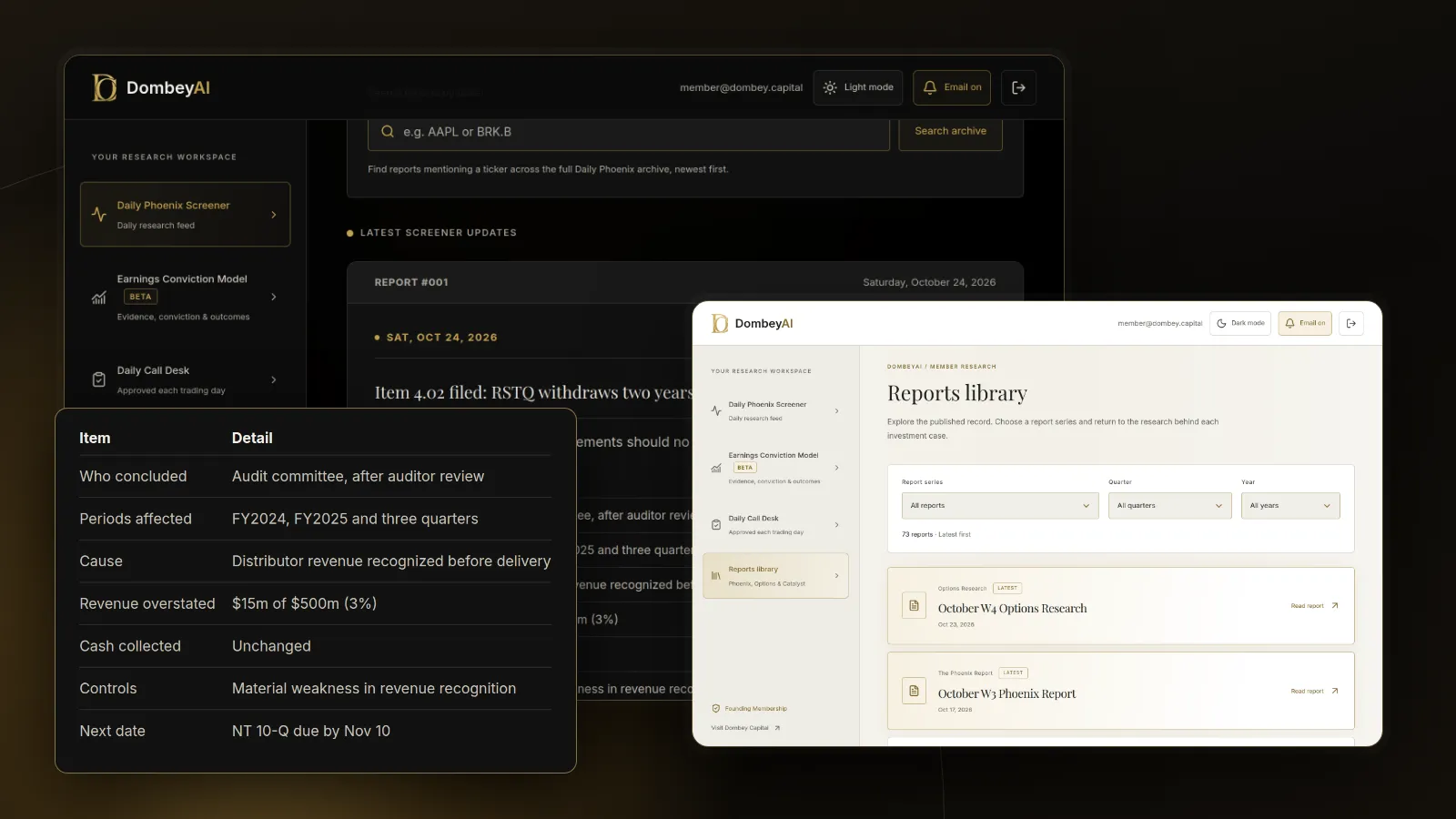
Item 4.02 asks the company to say when it reached its conclusion, which periods and statements are affected, a brief description of the facts, and whether the audit committee discussed the matter with the auditor. If the auditor, rather than management, told the company that its reports should not be relied on, the company must say so under Item 4.02(b) and give the auditor a copy so the auditor can respond in a letter filed as an exhibit.
Read it in this order:
- Who concluded. A company-initiated conclusion is different from an auditor telling the company its work cannot be relied on. The second suggests disagreement.
- Which periods. One quarter is a narrow fix. Three years of annual statements and the quarters inside them is a review.
- Which line items. Revenue, cash and operating cash flow matter most. Classification between debt and equity, or between operating and investing cash flows, can matter for covenants and screens.
- Estimated size. Many companies give a range, or say the effect on net income or equity. If they give none, the work is not finished.
- Controls. A restatement usually comes with a statement that internal control over financial reporting was not effective because of a material weakness. Read the description: a weakness in one complex area is easier to fix than one in the control environment.
- Investigations. Words such as "special committee", "independent counsel" or "forensic accountants" mean the company is examining conduct, not only arithmetic.
You can find these filings with EDGAR full-text search by searching for "Item 4.02" or "Non-Reliance on Previously Issued Financial Statements" and narrowing by form type and date. Our guide to reading an 8-K for catalysts covers the other items that often arrive in the same filing.
Sizing the damage
A restatement headline says the old numbers were wrong. Your job is to find out how wrong and whether it changes value.
Restate the model before you judge the price. Rebuild the affected periods, then ask what the corrected figures say about growth, margins and free cash flow yield. A restatement that leaves cash untouched and shifts revenue between quarters can matter less than it looks. One that reveals revenue that never turned into cash matters more.
What usually follows: a timeline
Restatements set off a series of dated events, and each can move the stock.
| Event | Typical timing | What to check |
|---|---|---|
| Item 4.02 8-K | Within four business days of the conclusion | Periods, line items, who concluded, estimated size |
| Form 12b-25 (NT 10-K or NT 10-Q) | By the day after the original due date | Whether the company expects to file within the 15 or 5 day extension |
| Exchange deficiency notice | Shortly after a missed deadline | The cure period the exchange grants and any plan the company must submit |
| Amended filings | When the review is complete | The error correction note, restated tables and the auditor's report |
| Clawback analysis | With the restatement | Whether incentive pay is recovered and how much |
| Lender waivers | Around the late filing | Covenants that require timely audited statements |
| Shareholder suits and SEC inquiries | Weeks to years | Disclosed contingencies and any accrual |
A late annual report can matter more than the error itself. Many credit agreements require audited statements within a set number of days, and missing that date can be a default unless lenders sign a waiver, sometimes for a fee. Check the credit agreement, filed as an exhibit, and whether the company has disclosed a waiver. Our explainer on going concern warnings covers what happens when financing doubts build on top of a filing delay.
Restatements as event-driven situations
For event-driven investors, a restatement is a catalyst with a sequence: the shock, the review, the refiling and the resolution of legal and listing questions. Prices often move most at the first 8-K, when uncertainty is widest, and again when amended statements arrive and the range of outcomes narrows. Dated events of this kind sit alongside earnings and deal votes in the market coverage we publish on large moves.
Questions that separate a fixable problem from a deeper one:
- If the error is technical and cash is unchanged, the main risk is the delay, not value.
- If revenue or cash is affected, rebuild the model before looking at the multiple.
- If the auditor initiated the non-reliance or resigned, treat the review as open until amended statements are filed.
- If a special committee is investigating conduct, expect management changes and more disclosure before the end.
- If the company relies on a credit facility, check the reporting covenants and waiver status first.
Where this goes wrong
Restatement analysis fails in predictable ways.
- Trusting the first estimate. Early ranges can widen as the review finds more. The first 8-K is a starting point, not a cap.
- Ignoring the controls finding. A material weakness that is not fixed can produce another error, and remediation often takes several quarters to test.
- Missing the financing link. A filing delay can trip debt covenants, block a planned share offering or delay a merger that needs current audited statements.
- Overreacting to small revisions. A little r revision in the notes may be the whole story. Not every correction is a warning sign.
- Assuming the market has priced it. Early on, few investors have rebuilt the numbers. Neither have you, until you do.
Dombey's published research tracks filing events such as these alongside other dated catalysts; see the research archive.
The bottom line
A financial restatement corrects statements investors already relied on, and an Item 4.02 8-K tells you the old numbers are withdrawn. The headline matters less than the details: who concluded, which periods and line items, the size of the error, the state of controls and whether conduct is being investigated. Rebuild the model with the corrected figures, then track the dated events that follow, from the late filing notice to the amended statements and any lender waivers. That sequence, not the first day's drop, is where the situation resolves.