

How a stock gets into the S&P 500
The S&P 500 is not a list of the 500 largest US companies. It is a list chosen by the S&P U.S. Index Committee at S&P Dow Jones Indices, using published rules and its own judgment. The rules set a floor; the committee decides who clears it and when.
The main eligibility tests in the methodology are:
- Domicile. The company must be a US company under the index provider's definition, which looks at filings, listing, headquarters and where assets and revenue sit.
- Size. Unadjusted market capitalization must be above a threshold that S&P reviews and updates from time to time.
- Float. A meaningful share of the stock must be available to the public. Companies with very large insider or strategic holdings carry a smaller weight, or may not qualify.
- Liquidity. The stock must trade enough, measured against its float, for index funds to buy and sell it.
- Earnings. The sum of the most recent four quarters of reported GAAP earnings must be positive, and so must the most recent quarter.
Meeting all of these makes a company eligible. It does not put it in the index. The committee also weighs sector balance and the overall makeup of the index, and it usually adds a company only when there is a slot to fill.
Where the slots come from
The index holds about 500 companies, so an addition needs an opening. Openings come from a few sources:
- Acquisitions. When an S&P 500 company is being taken over, it leaves at or near the deal's close, and a replacement is named.
- Quarterly rebalances. Changes tied to the rebalance take effect after the close on the third Friday of March, June, September and December.
- Companies that no longer qualify. A company that has shrunk well below the size range or no longer meets other rules can be moved to the S&P MidCap 400 or SmallCap 600.
- Spin-offs and restructurings. A spun-off company is sometimes added directly, which can mean the parent's slot is shared or another member is moved down.
Most additions arrive by one of two routes: a migration from the S&P MidCap 400, or a direct entry from outside the S&P indexes. The route matters for the size of the buying.
The timeline from announcement to effective date
Index changes run on a short calendar once they are public. S&P usually announces them after the market close, a few business days to about a week before they take effect. The stock trades on the news the next morning.
| Stage | What happens | What to check |
|---|---|---|
| Before the announcement | Traders estimate who is eligible and likely | Run-up in price and volume |
| Announcement (after the close) | S&P names the addition and the effective date | Is it a migration or a direct entry? |
| Run-up period | Traders buy ahead of index funds | Price move versus estimated demand |
| Effective date close | Index funds buy in the closing auction | Closing volume and imbalance |
| After the effective date | Forced buying ends | Whether the price holds or eases |
Index funds aim to match the index at the close on the effective date. That is why their buying tends to cluster in that day's closing auction, and why the closing print on that date can be one of the highest volume trades in the stock's history.
How large the buying can be
The useful number is not how much money tracks the S&P 500 in total. It is how many shares tracking funds must buy compared with how many shares trade on a normal day, net of anyone forced to sell at the same time.
Four things set the size of the pressure:
- Passive ownership the index will require. The share of float held by funds that track the S&P 500, directly or through benchmarked mandates.
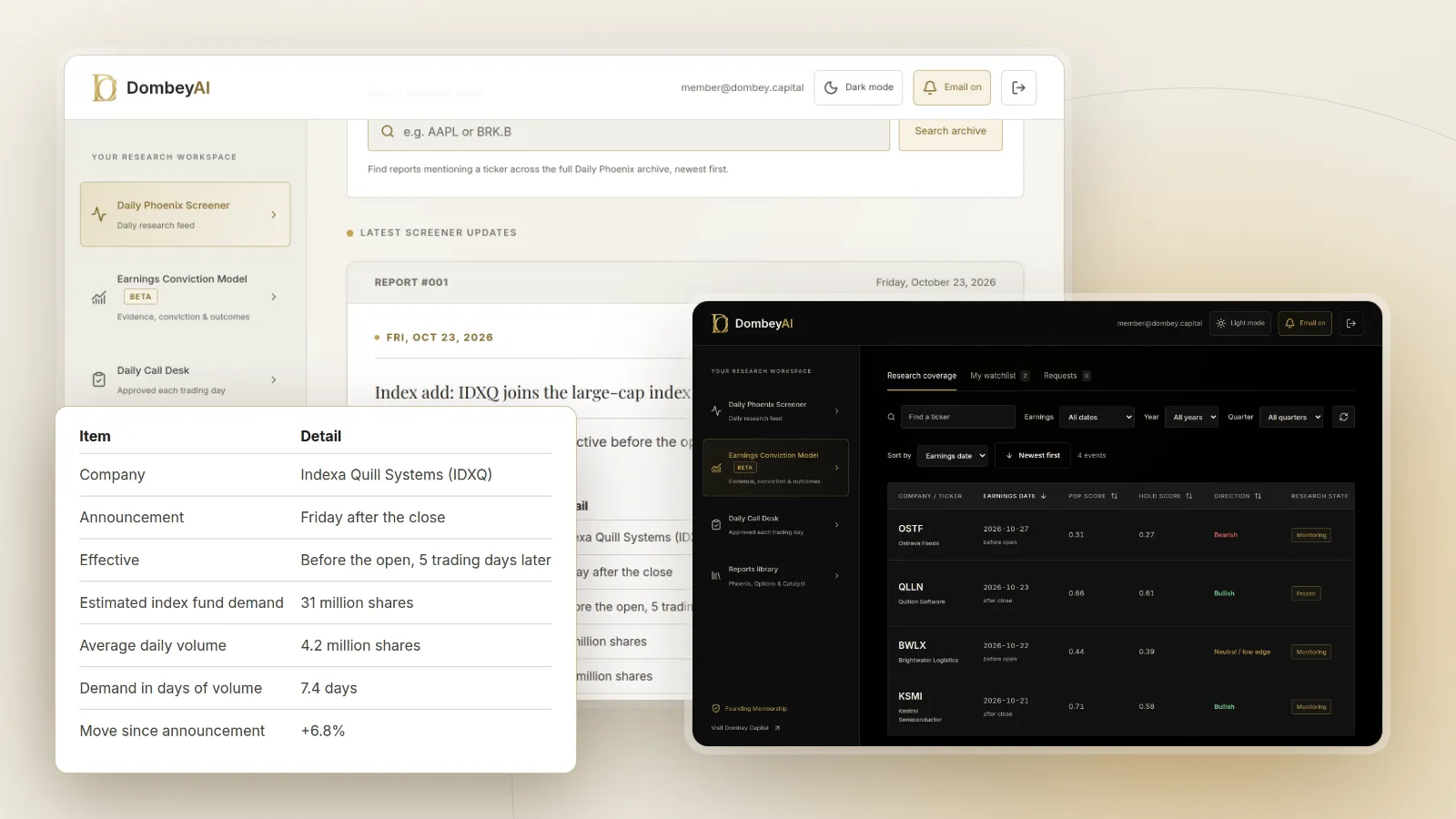
- Days of volume to absorb. Divide the net shares to be bought by average daily volume. A high figure means the price has to rise to draw out sellers.
- The old index. A migration from the MidCap 400 brings a matching group of forced sellers. A direct entry does not.
- Who else is moving. Benchmarked active managers who do not own the stock may add some to reduce tracking risk, and traders who bought before the announcement become sellers into the close.
The days-of-volume arithmetic is the same one used for short interest. It tells you how crowded the entrance is.
Why the effect is weaker than it used to be
Inclusion was once one of the most cited price effects in equity markets. Several changes have made it less dependable:
- Anticipation. Eligibility rules are public, and many traders run the same screens. Stocks that look likely to be added often rise before any announcement, which leaves less for the announcement itself.
- Pre-positioning. Some arbitrage traders buy candidates in advance and sell to index funds at the close on the effective date. They supply the shares index funds need, which dampens the spike.
- Better liquidity. Most new members are already large, heavily traded companies, so the forced buying is smaller relative to volume than it was for additions decades ago.
- Index fund trading practice. Some managers spread their buying around the effective date to reduce cost, rather than concentrating it all at the close.
The practical result is that the move between announcement and effective date is often smaller than headlines suggest, and part of it can reverse after the index funds have finished buying.
What inclusion does and does not change
Inclusion changes the owner base, the trading volume and the stock's visibility. It does not change revenue, margins, cash flow or the balance sheet. That difference is the whole analysis.
Things that do change after inclusion:
- More passive holders. A larger share of the stock is held by funds that never sell for valuation reasons.
- More coverage. Analysts and media pay more attention to S&P 500 members.
- Higher volume and tighter spreads. Index trading adds daily liquidity, which helps any holder who later wants to sell.
Things that do not:
- The business. Earnings and cash flow are the same the day after the effective date as the day before.
- The valuation case. A stock that was expensive before inclusion is more expensive after a run-up driven by forced buying.
It helps to write out the value case without the index: free cash flow, growth, balance sheet and the catalysts that would move the price on their own. If the case only works because index funds are about to buy, it is thin.
Dombey's published research treats index changes as dated events and checks the value case separately; see the research archive. Recent single-stock moves, including some tied to index news, are covered in our market coverage.
Where this goes wrong
- The move was priced in early. A stock that rose sharply on speculation can open flat or lower on the announcement, because traders who bought early sell into the news.
- The reversal after the effective date. Once forced buying ends, the stock has to find new buyers at a higher price. If none arrive, part of the gain fades over the following weeks.
- The company raises equity. Some newly added companies issue shares while demand is strong. A secondary offering adds supply and can absorb much of the index demand.
- Options are already pricing the event. Implied volatility can rise around an expected addition, which makes options a costly way to express a view. Our guide to implied volatility explains how to read that.
- The net demand is smaller than it looks. Migrations from the MidCap 400 come with forced sellers, and a large insider stake lowers the float weight. Gross index demand can overstate the real pressure.
- Expected additions that never come. Eligibility is not inclusion. A stock can meet every rule for many quarters and still not be chosen, and the price can fall when a widely expected addition goes to another company.
The bottom line
S&P 500 inclusion forces index funds to buy a stock on a known date for reasons unrelated to value. The buying can lift the price when it is large compared with daily volume and few holders are willing to sell. The effect is smaller and less reliable than it once was, because the rules are public, traders anticipate them and many additions come with forced sellers from another index. Check whether the addition is a migration or a direct entry, measure the net buying in days of volume, and value the business as if the index did not exist.