

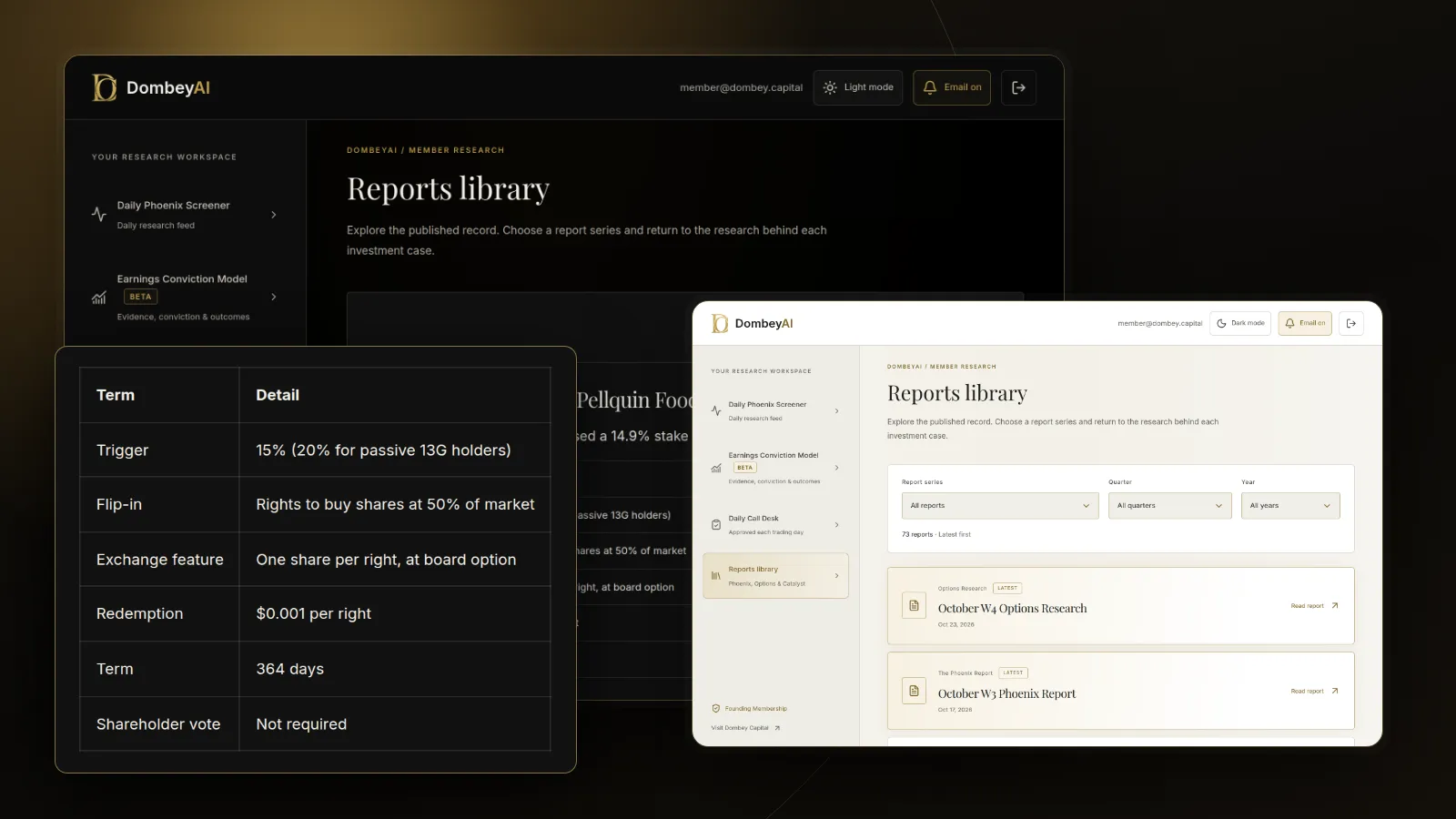
How a rights plan works
A board adopts a rights plan by declaring a dividend of rights, usually one right for each share outstanding. Until something happens, the rights trade with the shares and have no separate value.
The plan sets a trigger, a percentage of ownership. If a person or group, the "acquiring person", crosses it without board approval, the rights become exercisable by everyone except that person:
- Flip-in. Each right lets its holder buy the company's shares worth twice the exercise price, so holders effectively buy stock at half price. The acquiring person's rights are void, so its stake is diluted. This is the provision that does the work.
- Flip-over. If the company is later merged into the acquiring person, holders can buy the acquirer's shares at a discount. This matters less in practice.
- Exchange feature. Many plans let the board swap each right for one share instead of requiring holders to pay the exercise price, which dilutes the acquirer without asking shareholders for cash.
Plans usually let the board redeem the rights for a nominal amount, such as a fraction of a cent per right, before anyone crosses the trigger. That redemption feature is why a pill is a negotiating tool: a bidder that offers a price the board accepts can have the pill removed.
A worked example of dilution
The math is meant to be prohibitive. In practice, almost no bidder deliberately triggers a modern pill.
The main types of pill
| Type | Typical trigger | Why it is adopted | Typical term |
|---|---|---|---|
| Takeover defense pill | 10% to 20% | Responds to a hostile bid or a rapid stake build | Often one year or less |
| Activist pill | Often 10% to 15%, sometimes higher for passive holders | Slows an activist building a stake through open-market purchases | Often one year or less |
| NOL or tax-asset pill | Just under 5% | Protects net operating losses from a Section 382 ownership change | Several years, often put to a shareholder vote |
| "Shelf" pill | Not yet adopted | Board has a pill drafted, ready to adopt within a day if needed | Not applicable |
Many pills include an "acting in concert" definition, so investors who coordinate can be counted together. Some exempt passive holders who file on Schedule 13G up to a higher level. These details decide who is affected, so read the plan rather than the press release.
How courts and investors treat pills
In Delaware, where most large US companies are incorporated, courts have upheld rights plans as a legitimate board tool since the mid-1980s. Directors who adopt one in response to a threat must show the pill is a reasonable and proportionate response, and courts have struck down plans they found too broad, such as one with a low trigger and wide "acting in concert" language adopted without a specific threat.
Investors have their own standards. Proxy advisers and many institutions generally look more favorably on pills with a term of one year or less, or on longer pills that shareholders approve. Directors who adopt a long pill without shareholder approval may face votes against them at the next meeting.
What a pill means for the stock
A pill changes the path of a contest but not its end point. Its usual effects:
- It forces negotiation. A bidder must make an offer the board will accept, or win control of the board.
- It buys time. The board can seek other bidders, run a strategic review or argue its standalone plan.
- It caps an activist's stake. Below the trigger, an activist can still campaign but cannot build a controlling position cheaply.
- It does not stop a vote. A bidder can run a proxy fight, replace directors and redeem the pill.
So the dated events around a pill are the catalysts:
| Event | Where you see it | What to check |
|---|---|---|
| Pill adopted | 8-K, Form 8-A and press release | Trigger level, term, exemptions, acting-in-concert language |
| Bidder's response | 13D amendment, letter or tender offer | Whether the bid rises or a proxy fight is launched |
| Nomination window | Company bylaws and proxy filings | The deadline for a bidder to nominate directors |
| Annual or special meeting | Proxy statement | Whether the board's slate or the bidder's wins |
| Pill expiry or redemption | 8-K | Whether a deal was agreed or the pill lapsed |
Our guides to 13D filings and hostile takeovers cover the bidder's side of this sequence, and takeover premiums explains how to judge whether an offer is high enough.
Reading a pill as an event-driven investor
The question is what the pill tells you about the board and the bidder.
- If the board adopts a short pill right after a bid and says it will evaluate the offer, a negotiated higher price is a common outcome.
- If the board adopts a long pill with a low trigger and rejects every approach, the contest may move to a proxy fight, and the meeting date becomes the catalyst.
- If the pill is an NOL plan, it is about tax assets, not control, and says little about a bid.
- If the bidder is a strategic buyer with financing in hand, the board's leverage may last only until the next meeting.
Our market coverage of large single-stock moves includes deal and contest news as it happens.
Where this goes wrong
Pill analysis misleads in a few ways.
- Assuming the pill ends the bid. Bidders often come back with more money or take the contest to shareholders.
- Assuming the pill guarantees a deal. Some boards use the time to say no, and the bidder walks away. The stock can fall back to where it was before the approach.
- Ignoring the meeting calendar. If the next annual meeting is a year away and the bylaws block a special meeting, the board has more time than it seems.
- Missing the plan's terms. Exemptions, acting-in-concert language and passive-holder thresholds decide who the pill actually stops.
- Overlooking the NOL motive. Tax-asset pills look like takeover defenses on the surface but serve a different purpose.
Dombey's published research follows contested situations like these with their dated steps; see the research archive.
The bottom line
A poison pill gives every holder except a hostile buyer the right to buy discounted shares once the buyer crosses a trigger, which makes an unapproved stake too costly to build. Its purpose is leverage: the buyer must negotiate with the board or replace it. Read the plan's trigger, term and exemptions, then track the dated steps that follow, from the bidder's response to the nomination window and the next shareholder meeting. Those steps, not the adoption itself, decide where the stock ends up.