

What an advisory committee is
The FDA runs a set of standing advisory committees, each organized around a field such as oncology, cardiology, or neurology. They operate under the Federal Advisory Committee Act, and the FDA's own rules for public advisory committees sit in 21 CFR Part 14.
The FDA uses committees when it wants independent advice on a hard question. Common reasons include:
- A new drug or biologic with a novel mechanism or a first-in-class claim.
- Trial results that are mixed, or that rest on a surrogate endpoint.
- A safety signal that has to be weighed against the benefit.
- A question that affects a whole class of drugs, not one application.
The FDA does not have to convene a committee. For a new molecular entity that is not referred to one, the law requires the agency to explain why in the action letter or a summary of it. In practice, most applications are approved or rejected without a meeting, which is why a scheduled meeting is itself a signal that the agency sees something worth debating in public.
Who sits on the panel
Voting members are mostly outside physicians, scientists and statisticians appointed as special government employees. Each committee also has a consumer representative who votes, and many have a patient representative. An industry representative sits at the table and joins the discussion but does not vote.
The FDA can add temporary voting members for a specific meeting when the topic needs expertise the standing members lack. Members are screened for conflicts of interest before each meeting, and the FDA posts conflict-of-interest information, including any waivers it grants, on the meeting page.
How a meeting runs
Most meetings follow a set order over one day, sometimes two.
- Opening and introductions. The chair opens, members introduce themselves, and the FDA reads the conflict-of-interest statement.
- Sponsor presentation. The company presents its data and its case for approval.
- FDA presentation. The agency's reviewers present their analysis, which may agree or disagree with the sponsor.
- Clarifying questions. Members question both sides.
- Open public hearing. Members of the public who registered in advance speak, often patients, physicians and advocacy groups.
- Discussion and voting. The panel works through the FDA's questions, discussing some and voting on others.
The meeting is public and usually webcast. The FDA later posts the transcript and minutes on the meeting page.
How the voting works
The FDA writes the questions. A typical voting question asks whether the data show the drug is effective for the proposed use, or whether the benefits outweigh the risks for a defined population. Some questions are discussion only, with no vote.
Members vote at the same time, usually by pressing a button, so no one can follow the room. After the tally is shown, each voting member states the vote and gives the reasons on the record. Those explanations are often more useful than the count. A 7 to 4 vote where the "yes" members all add conditions about the label reads differently from a 7 to 4 vote where they do not.
Members can vote yes, no, or abstain. The FDA records the tally for each question, and the questions are not always the ones investors expect. A panel can vote yes on efficacy and still raise safety concerns that shape the label.
Briefing documents: the information that arrives first
Before the meeting, the FDA posts the briefing documents on the meeting page, generally no later than two business days ahead. There are usually two packages: the FDA's own briefing document and the sponsor's.
The FDA briefing document is often the single most informative item in the whole review that the public gets to see. It shows:
- The reviewers' analysis of the trials, including any reanalysis that differs from the company's.
- The safety review, with adverse events the company may have described more briefly.
- The draft questions the FDA plans to ask, which show where the agency sees risk.
- The framing. The tone of the document, measured or skeptical, often foreshadows the discussion.
Because the documents come out before the vote, the stock often moves on them first. A briefing document that questions the primary endpoint can move a stock more than the eventual vote, because by meeting day the market has already absorbed the concern.
How the meeting relates to the PDUFA date
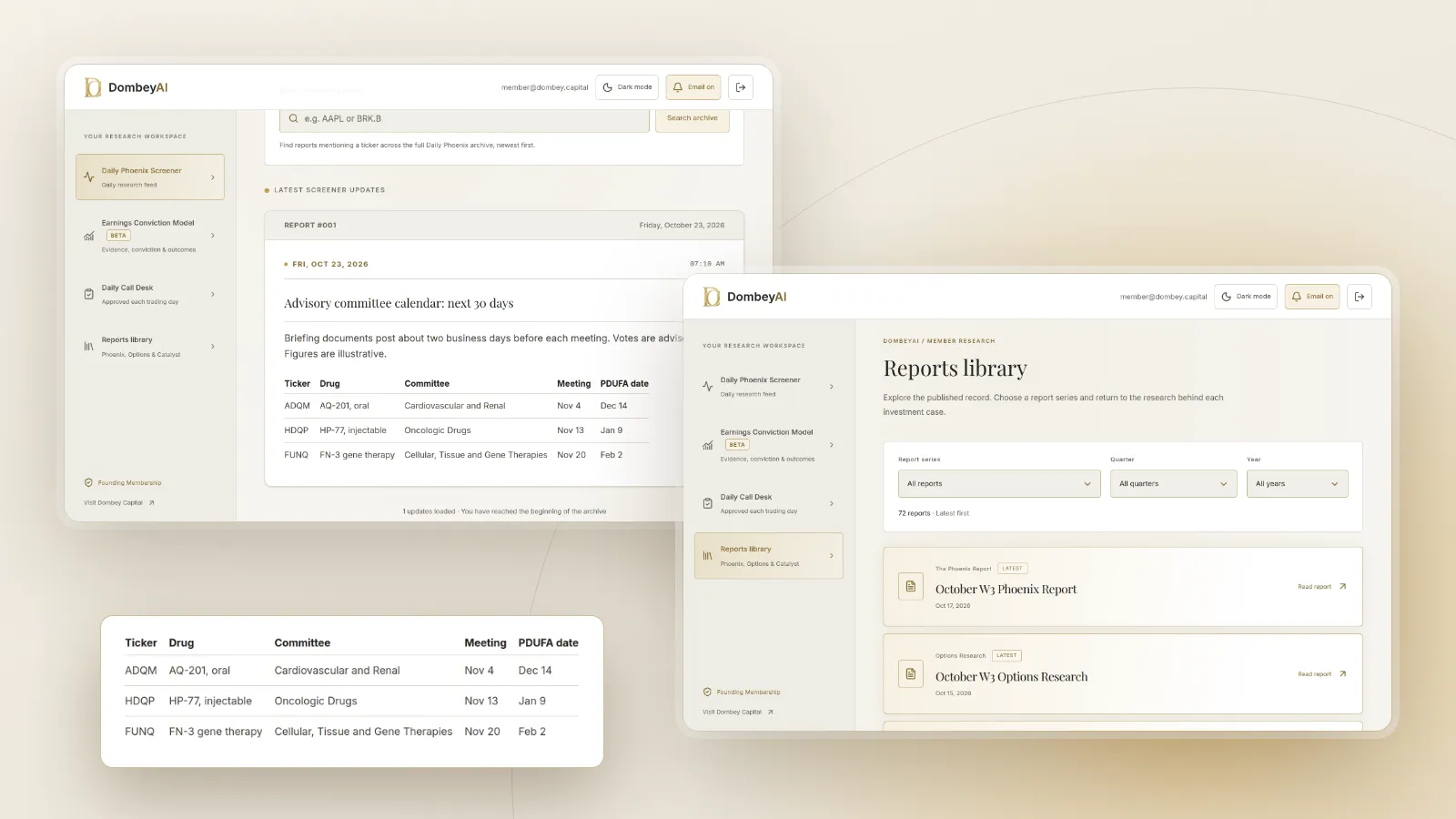
The meeting happens inside the review clock, not at the end of it. Under the PDUFA VII goals, the FDA intends to hold an advisory committee meeting no later than 2 months before the goal date for a standard review and 6 weeks before for a priority review. The late-cycle meeting between the FDA and the company comes before it.
That gives an application up to three dated events the market can trade on, each with its own information:
| Event | Typical timing | What it tells you | Binding? |
|---|---|---|---|
| Meeting announced | Federal Register notice, at least 15 days before | The FDA wants public expert input | Not applicable |
| Briefing documents posted | Generally at least 2 business days before the meeting | The FDA reviewers' concerns and questions | No |
| Committee vote | Meeting day | The panel's view on each question | No |
| FDA action | By the PDUFA goal date | Approval or complete response letter | Yes |
The FDA calendars and biotech catalyst trackers list these dates, but the FDA's own calendar and meeting pages are the source of record. Log each one separately in a catalyst calendar, because each can move the stock on its own.
A worked example
The example shows why the documents matter more than they first appear. The vote had not happened, and nothing binding had changed, but the inputs to a probability-weighted valuation shifted on the FDA's written analysis alone.
The meeting can then shift them again. A clear positive vote with members citing the reanalysis as a minor issue might push the weight back up. A split vote where several members flag the same endpoint keeps it low. Each step narrows the range only when the information is clear.
Options prices often carry high implied volatility into the meeting, and that volatility can collapse once the vote is known, the same mechanism as IV crush after earnings. Because there are two events, the briefing release and the vote, options can price in movement at both.
Dombey's published research tracks dated catalysts like these alongside cash and dilution risk; see the research archive.
Where this goes wrong
Advisory committees look like a preview of the decision. They are an imperfect one.
- The vote is not the decision. The FDA can and does depart from the panel. Pricing a positive vote as an approval ignores that risk.
- The question set shapes the vote. A narrow question can produce a positive tally on a point that does not settle the main issue. Read the exact wording.
- Mixed votes are hard to read. A split vote widens the range of outcomes. It does not resolve them.
- The label is a separate fight. A yes on efficacy can still lead to a narrow label, a boxed warning or a risk program that disappoints.
- Meetings get postponed or cancelled. A cancellation can mean the FDA no longer needs advice, or that something changed in the review. The reason is often not public.
- Cash decides what a rejection costs. If a negative outcome means a new trial, check whether the company can fund it, as in how to estimate cash runway.
- Third-party dates go stale. Calendars copy dates between sites. The FDA meeting page and the Federal Register notice are the sources to check.
For a wider view of how approvals fit into event-driven work, see regulatory approvals as catalysts.
The bottom line
An FDA advisory committee meeting is a public review where outside experts discuss an application and vote on questions the FDA writes. The vote is nonbinding, and the FDA makes the final decision by the PDUFA goal date, which usually falls 6 weeks to 2 months or more after the meeting. The briefing documents, posted shortly before the meeting, are often the most useful information in the process, because they show the agency's concerns in writing. Treat the documents, the vote and the decision as three separate dated events, and value each step for what it actually changes.