

What you need
- The latest 10-K and 10-Q, plus any 8-Ks since, from SEC EDGAR. The EDGAR search guide shows how to find them quickly.
- The court docket for the case, for the complaint, the main motions, the scheduling order and any rulings. Federal dockets are on PACER; state courts run their own systems.
- Any litigation funding agreement, insurance disclosure or settlement offer the company has described.
- A spreadsheet with one row per outcome.
- A view of what the rest of the company is worth without the case.
Step 1: Read what the company is required to disclose
Start with the filings, because they set out the case in a fixed format. Item 3 of the 10-K and Part II Item 1 of the 10-Q both call for the information in Regulation S-K Item 103. For each material pending proceeding, that means the court or agency, the date the case began, the principal parties, the factual basis alleged and the relief sought.
Item 103 has limits worth knowing. It excludes ordinary routine litigation incidental to the business. It also excludes claims mainly for damages that do not exceed 10 percent of consolidated current assets, with related cases added together for that test. So a small company may disclose a case that a large company would not, and the absence of a case from Item 3 does not prove it is immaterial.
Then read the commitments and contingencies note. If the company is the defendant, the note says whether a loss has been accrued and often gives a range of reasonably possible loss. A new accrual is a signal: management now considers a loss probable and can estimate it. The 10-Q explainer covers where these updates appear between annual reports.
Step 2: Separate the case from the rest of the company
Value the company without the case first. Net cash, the operating business and any other assets give you a stand-alone value per share. The sum-of-the-parts guide covers how to value each piece.
The gap between the share price and that stand-alone value is what the market is paying for the case. A plaintiff trading at $5.00 with a stand-alone value of $4.20 has $0.80 a share priced in for the claim. A defendant trading below its stand-alone value has a liability priced in. You will need this number in Step 7.
Step 3: Map the case as a decision tree
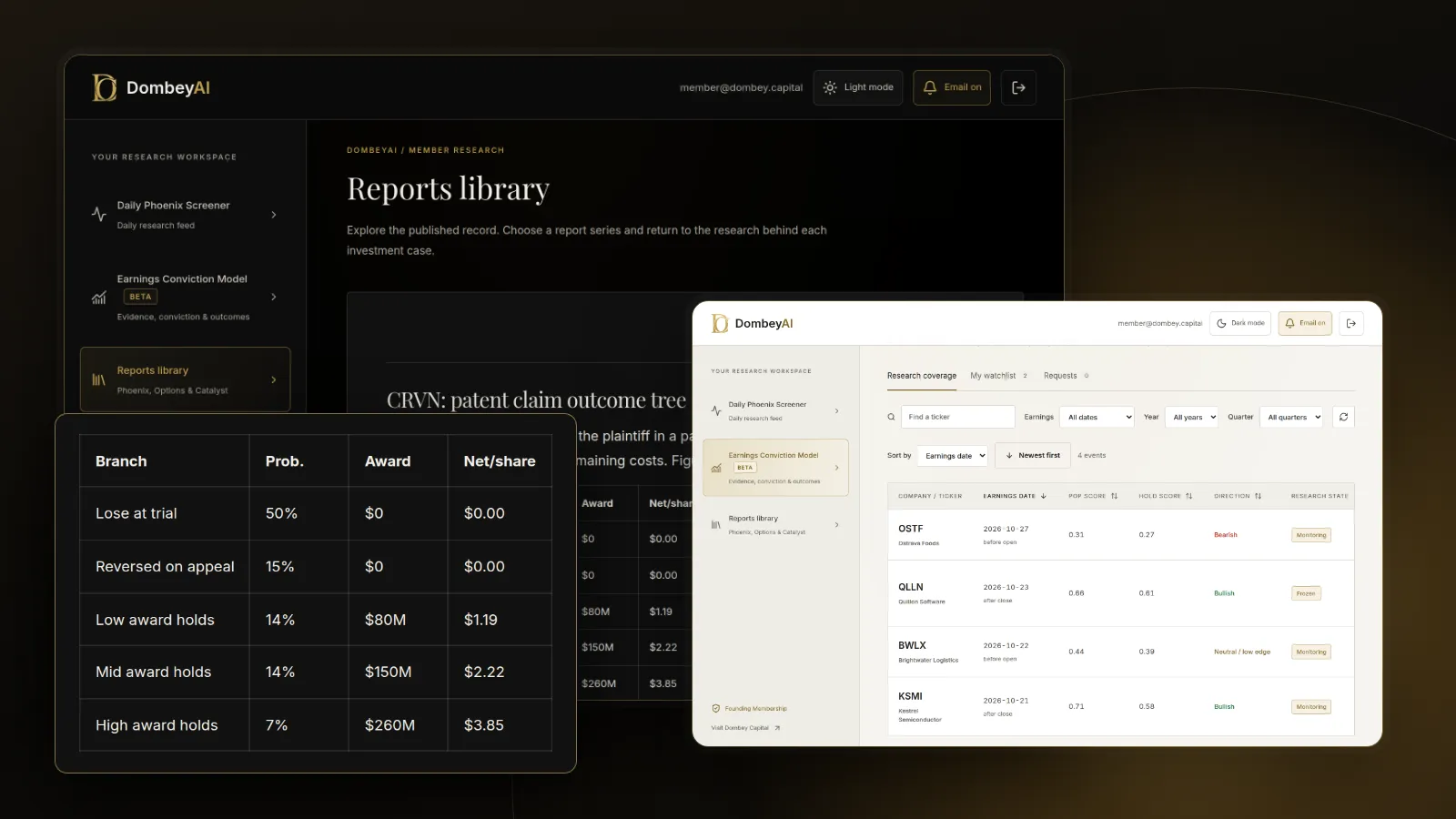
Draw the stages the case still has to pass, and keep it small. Three to five end branches are enough for most cases. A typical patent or contract claim at an early stage looks like this:
- The case is dismissed or lost at trial.
- The case is won at trial but reversed on appeal.
- The case is won and a low damages award holds.
- The case is won and a middle award holds.
- The case is won and a high award holds.
Settlement is not a separate branch at this point. A rational settlement tends to land near the expected value of the tree, so it is a check on your work, not an input. If a firm offer is on the record, add it as its own branch with its own probability.
Each stage should match a real event on the docket: a ruling on a motion to dismiss, a summary judgment decision, a trial date, an appeal. Those dates become your catalyst calendar.
Step 4: Set the probabilities
Give each stage a probability and multiply along each branch. The branch probabilities must add to 100 percent.
Base the stage probabilities on what the record shows, not on the company's press releases. Useful evidence includes rulings already made in the case, how the judge has ruled on claim construction or key motions, whether the defendant has challenged the claim elsewhere, and whether related cases on the same facts have gone one way or the other. A party that has survived a motion to dismiss and summary judgment has a stronger position than one that has only filed a complaint.
Step 5: Set the damages or the liability range
For each winning branch, set a gross award. Start from the damages theory in the filings: lost profits, a reasonable royalty, a contract price, or statutory damages. The relief sought is the top of the range, not the middle. Courts often reduce awards, and appeals courts can cut them further.
For a defendant, set the payment the company would owe on each losing branch, then subtract insurance that the filings say applies and add any indemnity it owes others.
Keep the low, middle and high awards far enough apart that they mean something. If they are within 10 percent of each other, you have one branch, not three.
Step 6: Take out costs, funders, tax and time
The gross award is not what shareholders receive. Work down to the net figure in this order:
- Litigation funder or contingency fee. If a funder or a law firm on contingency is entitled to a share of the recovery, take it off first. The funding agreement or the notes give the terms.
- Tax. A damages award to a company is generally taxable income. Apply the company's expected rate, less any usable losses.
- Remaining legal costs. These are paid on every branch, including the losing ones. Subtract them from the total, not from each winning branch.
- Time. Discount the recovery from the date you expect to collect, which is after the last appeal, not after the trial.
Worked example
| Branch | Probability | Gross award | Net to Company A | Weighted |
|---|---|---|---|---|
| Lose at trial | 50% | $0 | $0 | $0 |
| Win, reversed on appeal | 15% | $0 | $0 | $0 |
| Win, low award holds | 14% | $80M | $47.4M | $6.6M |
| Win, middle award holds | 14% | $150M | $88.9M | $12.4M |
| Win, high award holds | 7% | $260M | $154.1M | $10.8M |
| Total | 100% | $29.9M |
Collection is three years away. At a 12 percent discount rate, $29.9 million today is worth about $21.3 million. Company A still expects to spend $8 million on the case, which leaves about $13.3 million, or $0.33 a share.
Step 7: Compare your value with the price the market implies
The market is paying $0.80 a share, or $32 million, for the claim. Your tree says $0.33. Rather than stop at "overpriced", back-solve the probability the price implies.
Add the $8 million of costs to the $32 million, giving $40 million. Grossed up for three years at 12 percent, that is about $56.2 million of expected net recovery at collection. With an average net award of $85.3 million if the case wins and holds, the market is implying about a 66 percent chance of collecting. Your tree gives 35 percent.
That gap is the real question. Either the market knows something about the case that you do not, or it has anchored on the headline damages.
- If the implied probability is well above yours, find the ruling or filing that would justify it before trusting your tree.
- If the implied probability is well below yours, check whether the stand-alone value is too high, since the market may be discounting the business rather than the case.
- If the two are close, the case is fairly priced and the stock should be judged on the business.
- If a single ruling would move your probability by 20 points or more, the stock is a bet on that ruling, and its date matters most.
This comparison sits naturally inside a base and worst case: the losing branches set the worst case, and the expected value sits in the base case.
Step 8: Date the triggers and update at each ruling
Write the next three docket events and the date of each, and note how each outcome would change your tree. A denied motion to dismiss might lift the trial-win probability. A narrow claim construction might cut the high award branch to zero. A verdict collapses most of the tree at once.
Update the cash, burn and share count every quarter as well. Long cases are often paid for with equity, and a raise in year two lowers the value per share of any recovery. Record each update with its date in a dated thesis, so you can see later which assumptions held. Dombey's published research applies this kind of outcome tree to legal catalysts; see the research archive.
| Docket event | What it can change | Where to find it |
|---|---|---|
| Motion to dismiss ruling | Whether the case continues at all | Docket, 8-K |
| Summary judgment ruling | Trial-win probability, which claims survive | Docket, 10-Q Part II Item 1 |
| Trial verdict | Most branches at once, the gross award | Docket, 8-K, press release |
| Post-trial motions | Size of the award, a new trial | Docket |
| Appeal decision | Whether a win holds, final amount | Appeals court docket, 8-K |
| Settlement | Replaces the tree with a fixed payment | 8-K, contingencies note |
Where this goes wrong
The probabilities are estimates, and small changes move the answer a lot. In the example, raising the appeal probability from 70 to 85 percent lifts the value from $0.33 to about $0.45 a share. Test a range of probabilities and see whether the conclusion survives.
Timing is usually worse than expected. Appeals, remands and stays can add years, and the discount compounds. A case worth $0.33 at three years is worth noticeably less at five.
Collection is not automatic. A defendant can be unable to pay, or can pay over time, and a judgment is only worth what can be recovered. Check the defendant's own balance sheet.
Finally, a tree cannot capture everything a judge or jury might do. Treat the result as a range, and size any position knowing the losing branches carry most of the probability in many cases.
Common mistakes
- Using the damages claimed as the value. The relief sought is a ceiling. Build the award range from the evidence.
- Forgetting the funder and tax. In the example they take about 40 percent of every dollar awarded.
- Discounting to the trial date. Money arrives after the last appeal, often years later.
- Counting legal costs only on winning branches. The company pays its lawyers whether it wins or loses.
- Treating settlement as a bonus branch. Settlements tend to reflect the expected value, so adding one on top double counts.
- Ignoring the defendant's ability to pay. A large judgment against a weak defendant is worth less than it looks.
The bottom line
A litigation outcome is worth the probability-weighted value of its possible endings, after funders, tax, remaining costs and the time to collect. Build a small decision tree from the filings and the docket, keep the damages range honest, and work down to a value per share. Then back-solve the probability the share price implies, because the gap between that and your own estimate is where the research question lies. Update the tree at every ruling, since each one changes the branches more than anything else.