

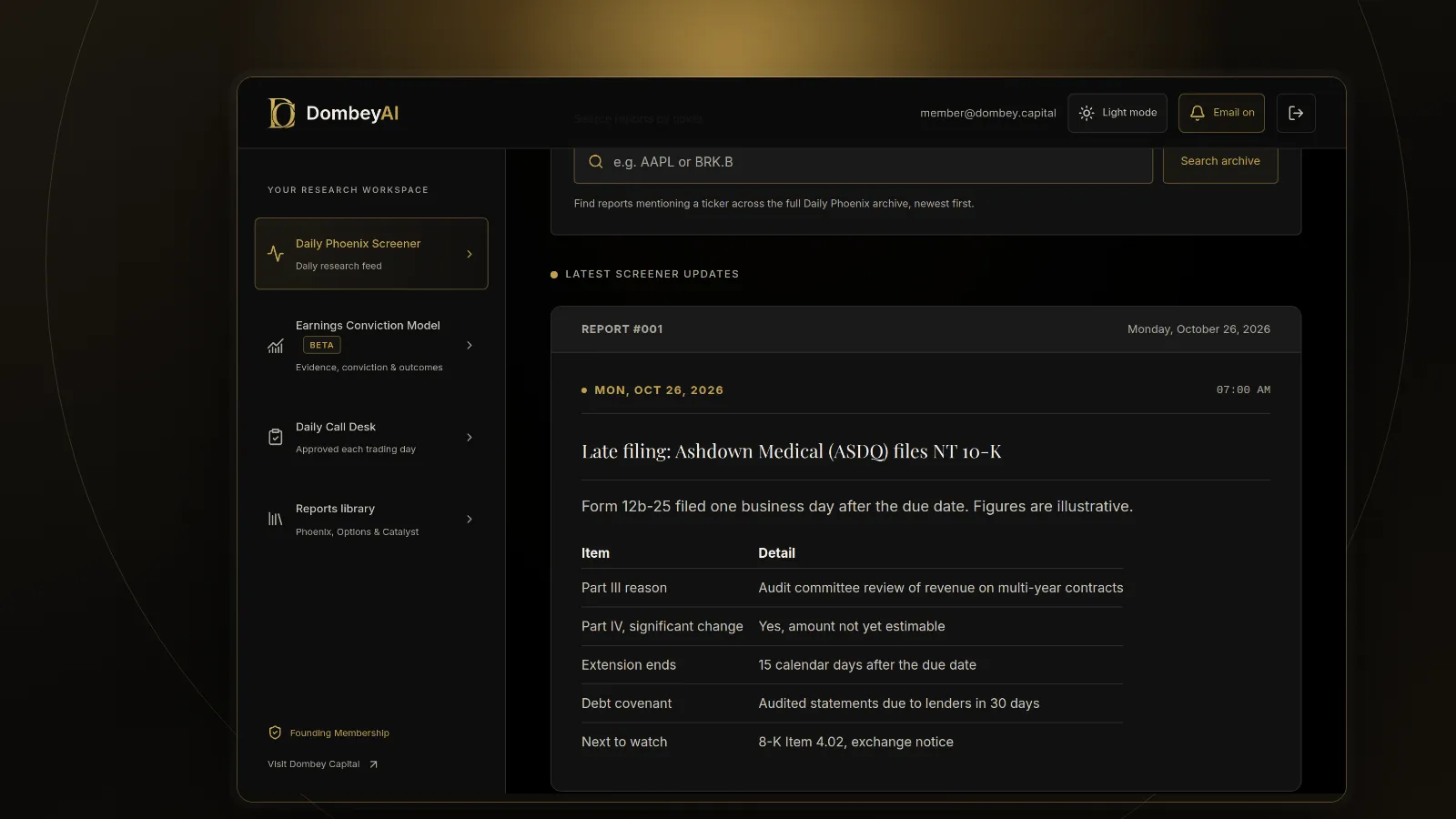
When a 10-K is due
The deadline depends on the company's filer status, measured mainly by public float:
| Filer status | 10-K due after fiscal year end | 10-Q due after quarter end | NT extension |
|---|---|---|---|
| Large accelerated filer | 60 days | 40 days | 15 days for 10-K, 5 for 10-Q |
| Accelerated filer | 75 days | 40 days | 15 days for 10-K, 5 for 10-Q |
| Non-accelerated filer | 90 days | 45 days | 15 days for 10-K, 5 for 10-Q |
So a calendar-year non-accelerated filer's 10-K is due around the end of March, and an NT 10-K would push that to mid-April. Our explainers on the 10-K and the 10-Q cover what the reports contain.
What the form says
Form 12b-25 is short. Four parts matter:
- Part I, registrant information. Name and address.
- Part II, Rule 12b-25(b) and (c). A box the company checks to say the reason could not be eliminated without unreasonable effort or expense, that it will file within the extension, and that any required accountant's statement is attached.
- Part III, narrative. A description in reasonable detail of why the report could not be filed on time.
- Part IV, other information. A contact person, whether all other required reports have been filed, and whether the company expects results to show a significant change from the same period last year, with an explanation and, if possible, an estimate.
If the company cannot check the Part II box, it is not relying on the extension, and the report may be late by more than 15 days. If the delay is caused by someone other than the company, such as the auditor, Rule 12b-25(c) requires a statement from that party explaining why.
How to read the narrative
The reason given in Part III ranges from routine to serious. A rough scale:
- Routine. Additional time to complete the audit of a recent acquisition, a new reporting system, or a subsidiary's late financials.
- Worth watching. Ongoing evaluation of a specific accounting matter, a material weakness in internal control, or a pending impairment.
- Serious. An audit committee investigation, a review of previously issued financial statements, a disagreement with the auditor, an auditor resignation, or uncertainty about the company's ability to continue as a going concern.
Then read Part IV. A "yes" to a significant change in results, especially with a large loss or impairment estimate attached, often matters more than the delay itself.
What a late filing can signal
A late filing is information about the company's accounting and its relationship with its auditor. Situations that often appear alongside an NT 10-K:
- A restatement. If the company concludes that earlier statements cannot be relied on, it files an 8-K under Item 4.02. Our explainer on financial restatements covers what follows.
- An auditor change. An auditor resignation or dismissal is disclosed under 8-K Item 4.01, with a letter from the auditor. Our guide on how to read an 8-K shows where to find it.
- A going-concern question. If the auditor doubts the company can meet its obligations for the next year, the 10-K may carry a going-concern warning, and agreeing the wording can delay the filing.
- Debt covenant issues. Many credit agreements require audited statements by a set date. A late 10-K can trigger a default or require a waiver, which the company may disclose in the notice or an 8-K.
What happens if the extension runs out
Missing the extended deadline makes the company delinquent, with several consequences:
| Consequence | What happens | Where to look |
|---|---|---|
| Exchange deficiency notice | Nasdaq notifies the company under its periodic filing rule and generally allows 60 calendar days to submit a compliance plan; staff can grant up to 180 calendar days from the original due date. The NYSE runs a separate cure process. | 8-K disclosing the notice |
| Loss of Form S-3 eligibility | Short-form shelf registration requires timely filing of reports for the past 12 months, which limits quick capital raising, including at-the-market offerings | Later registration statements |
| Covenant pressure | Lenders may require waivers or amendments | 8-K, credit agreement amendments |
If the company cannot regain compliance, the exchange can begin delisting proceedings, which the company can usually appeal.
How to track late filings
On SEC EDGAR, search a company's filings for the form types NT 10-K and NT 10-Q, or use full-text search filtered by form type to see every recent notice. Late-filing notices cluster around deadlines: for calendar-year companies, around the start of March, mid-March and the end of March for annual reports.
A practical checklist when a notice appears:
- Read the Part III reason and classify it.
- Check the Part IV answer on results.
- Look for an accompanying 8-K or press release.
- Mark the end of the extension and check whether the 10-K arrives.
- If it does not, watch for an exchange notice, an Item 4.02 8-K or an auditor change.
Dombey's market coverage follows filings like these when they move a stock.
NT 10-K versus a late 10-Q
The same form covers quarterly reports, filed as an NT 10-Q, with a five-day extension instead of fifteen. A late annual report usually matters more, because the 10-K carries the full audit, the auditor's opinion and management's assessment of internal control. A late 10-Q involves a review, not an audit, so delays are more often about timing than about a disagreement over the numbers.
Patterns matter more than any single notice. A company that files late two or three periods in a row is telling investors something about its finance team, its systems or its auditor relationship. When an NT 10-Q follows an NT 10-K, check whether the reason is the same one, and whether the earlier problem was ever fully explained.
Where this goes wrong
- Treating every NT 10-K as a red flag. Many are filed for routine reasons and followed by an unremarkable 10-K within days.
- Treating every NT 10-K as routine. The serious cases often start with a notice that looks ordinary.
- Reading only the headline. The narrative and the Part IV answer carry the information.
- Assuming the extension will be used. Some companies file the notice knowing they will miss the extended date too.
- Ignoring the follow-on filings. The 8-Ks that come after the notice usually say more than the notice itself.
The bottom line
An NT 10-K is the Form 12b-25 a company files when its annual report will be late. It buys 15 calendar days, and a report filed within that window counts as timely. Read the narrative and the answer about results: routine reasons usually resolve quickly, while accounting reviews, auditor changes and going-concern questions can lead to restatements, exchange notices and lost access to quick financing. Mark the end of the extension and watch what is filed next.