

Who files an S-1 and why
The Securities Act of 1933 requires a company to register an offering of securities with the SEC unless an exemption applies. Form S-1 is the general form for domestic issuers. It is used for:
- Initial public offerings. The most common use, including the IPOs of special purpose acquisition companies.
- Direct listings. A company that lists existing shares without an underwritten offering still registers them, usually on an S-1.
- Follow-on offerings by public companies that do not yet qualify for the shorter Form S-3, which generally requires at least 12 months of timely reporting.
- Resale registrations. Shares sold in a private placement are often registered on an S-1 so the buyers can resell them in the market.
Foreign private issuers generally use Form F-1 instead. Mergers that issue shares to a target's holders use Form S-4, which our explainer on the S-4 merger registration covers. Spin-offs usually register on Form 10, covered in what a Form 10 is.
The IPO filing timeline
An S-1 is not a single filing. It is a process with several public documents along the way, and knowing the sequence tells you how close a deal is to pricing.
| Stage | Filing or event | What to check |
|---|---|---|
| Confidential review | Draft registration statement (DRS) | Not public yet; appears on EDGAR later |
| Public filing | S-1 | Business, financials, risk factors, ownership |
| SEC comments | S-1/A amendments | What changed between versions |
| Marketing | S-1/A with price range (the "red herring") | Range, share count, implied valuation |
| Effectiveness | SEC declares the registration effective | Final terms are set at pricing |
| Pricing | Final prospectus under Rule 424(b) | Final price, shares sold, greenshoe |
| Trading | Shares begin trading | Lockup dates, first 10-Q or 10-K |
Confidential submission
Most IPO candidates now start with a draft registration statement submitted for nonpublic SEC review. The SEC expanded this option beyond emerging growth companies in 2017. The company must file the registration statement publicly at least 15 days before it starts the roadshow, so a public S-1 often means marketing is weeks, not months, away. The draft submissions and the SEC correspondence are posted to EDGAR later.
Comments and amendments
SEC staff in the Division of Corporation Finance review the filing and send comment letters asking for more disclosure, clearer risk factors or changes to accounting presentation. The company answers by letter and by filing an amended registration statement, the S-1/A. A typical IPO goes through several rounds. The price range and offering size usually appear in a late S-1/A, the preliminary prospectus that bankers call the red herring.
Effectiveness and the 424(b) prospectus
Once comments are resolved, the SEC declares the registration statement effective. The S-1 can go effective without the final price; Rule 430A lets the company add that information afterward. After pricing, the company files the final prospectus under Rule 424(b), generally within two business days. On EDGAR it usually shows as a 424B4. That is the document with the final price, the number of shares sold, the underwriting discount and the size of the overallotment option.
How an S-1 is structured
Part I is the prospectus that investors receive. Part II holds information that does not go in the prospectus, including offering expenses, indemnification of directors, recent sales of unregistered securities and the exhibit list. The prospectus sections appear in a fairly standard order:
- Prospectus summary. The company's own pitch, with key metrics and a summary of the offering. Read it last, not first.
- Risk factors. Long and partly generic. The specific ones, about customer concentration, losses, controlling holders or a dual-class structure, are the ones to note.
- Use of proceeds. What the company will do with the cash. "General corporate purposes" says little; repaying a named loan or paying a sponsor says a lot.
- Capitalization. Cash and debt before and after the offering.
- Dilution. How far the IPO price sits above net tangible book value per share, and what earlier investors paid.
- MD&A and financial statements. Usually two or three years of audited statements, depending on whether the company is an emerging growth company.
- Management, executive compensation and related-party transactions. Pay, option grants made just before the IPO, and dealings with insiders.
- Principal and selling stockholders. Who owns what before and after the offering, and who is selling.
- Description of capital stock. Share classes, voting rights and anti-takeover provisions.
- Shares eligible for future sale. The lockup terms and when restricted shares can be sold.
- Underwriting. The banks, the discount, the overallotment option and lockup waivers.
What to read first
A practical order for an IPO S-1:
- The offering summary and use of proceeds. Separate primary shares (new money to the company) from secondary shares (existing holders cashing out).
- Principal and selling stockholders. See who controls the company after the deal and how much insiders keep.
- Description of capital stock. Check for multiple share classes, sunset provisions and controlled-company status.
- Capitalization and dilution. Confirm post-offering cash, debt and fully diluted shares.
- MD&A and the cash flow statement. Look at cash burn and how long the new cash lasts.
- Shares eligible for future sale. Note the lockup length, often 180 days, and any early-release triggers.
The share count math here ties to how dilution changes share count, and the lockup date is a dated supply event covered in what a lockup expiration does to a stock.
Why the S-1 matters after the IPO
The S-1 stays useful long after the first trade. Its ownership table is the baseline for tracking insider sales on Form 4. Its lockup terms tell you when the next wave of supply arrives. Its capital stock section tells you whether a future buyer needs the founders' consent. When the company later sells more stock, the follow-on may come on another S-1 or an S-3; our explainer on secondary offerings covers how those are priced.
A resale S-1 filed by an already public company deserves attention. It often follows a private placement or a convertible deal, and once it goes effective, holders who bought at a discount can sell into the market. For SPACs, the S-1 sets the trust terms that later drive SPAC redemption math.
After the IPO, the company files 10-Qs, 10-Ks and current reports. Our guide to reading an 8-K for catalysts covers the event filings, and the guide to searching SEC EDGAR filings shows how to pull every S-1/A, 424B4 and correspondence letter in date order. Many stock research tools for individual investors summarize IPO terms, but the filing itself is the source.
Where this goes wrong
- Reading the summary as analysis. The prospectus summary is written to sell the offering. Adjusted metrics that appear there need checking against the audited statements.
- Ignoring secondary shares. A large secondary component means existing holders are reducing exposure at the IPO price. That is not automatically negative, but it changes who benefits.
- Missing the control structure. Dual-class shares, voting agreements and controlled-company exemptions can leave public holders with little say for years.
- Using an early S-1/A. Financials, share counts and risk factors change between amendments. Use the latest S-1/A and the 424(b) prospectus.
- Forgetting the lockup calendar. Restricted shares that become sellable can outnumber the public float several times over.
- Overlooking related-party dealings. Leases, loans or service agreements with founders or sponsors are disclosed in the S-1 and tend to persist after the IPO.
How Dombey uses the S-1
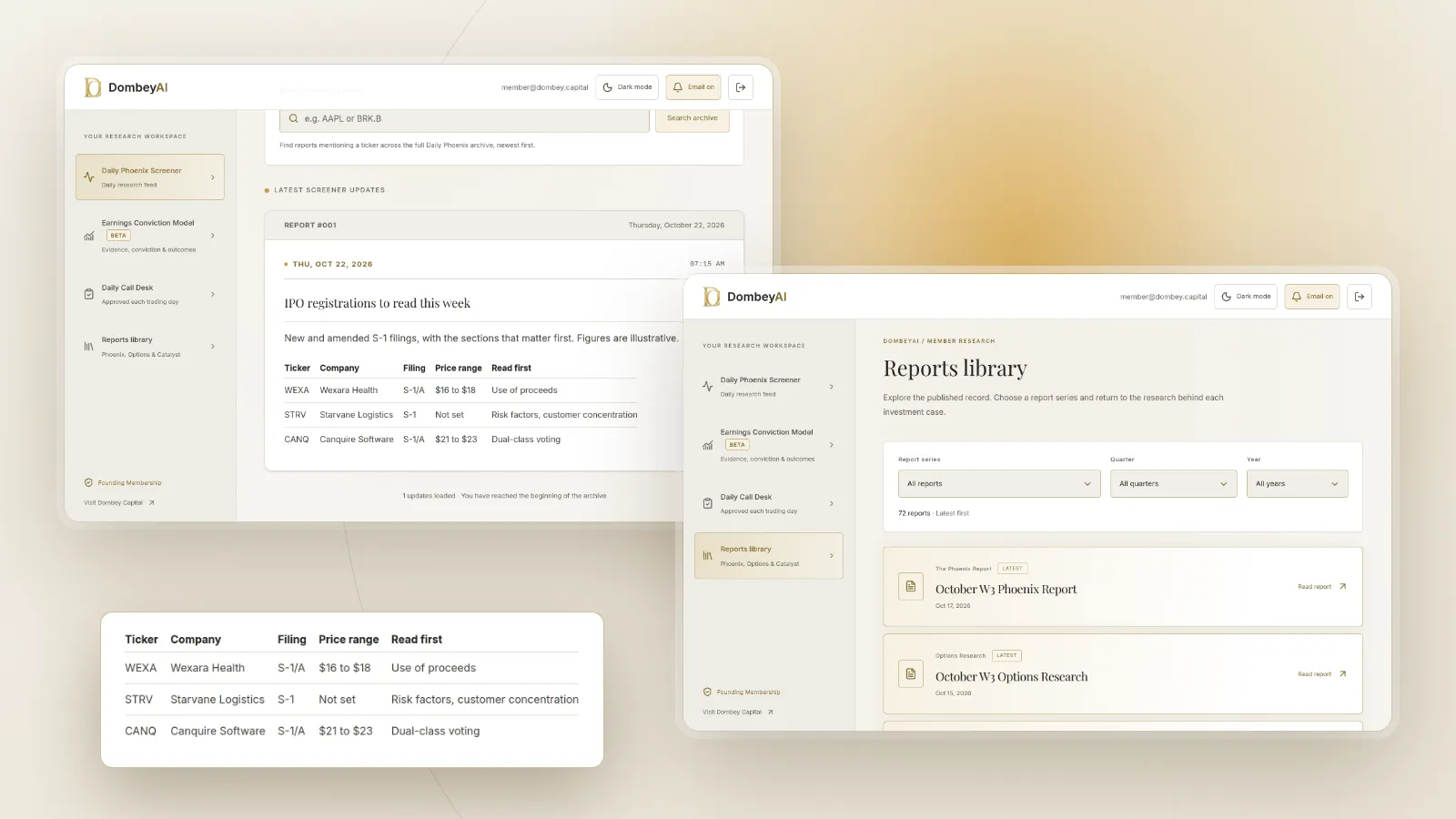
When a recent IPO becomes a special situation, through a lockup, a broken deal or a sharp fall below the offer price, Dombey's analysis starts from the S-1 and the 424(b) prospectus; see the research archive.
The bottom line
An S-1 is the registration statement a US company files with the SEC to sell securities publicly, most often in an IPO. It usually begins as a confidential draft, becomes public, passes through S-1/A amendments in response to SEC comments, and ends with a final prospectus filed under Rule 424(b) after pricing. Read the offering terms, ownership, capital structure, dilution and lockups before the business story. The answers tell you who gets the money, who keeps control and when new supply reaches the market.