

What counts as primary and what counts as secondary
A source is primary when it is the first official or first-hand record of the fact. A source is secondary when someone else has read that record and passed it on.
Primary sources for a US public company
- Annual and quarterly reports: the 10-K and 10-Q, including the notes.
- Current reports on Form 8-K and their exhibits, such as signed merger agreements, credit agreements and earnings releases.
- Proxy statements, registration statements such as S-4 and Form 10, and tender offer documents.
- Ownership filings: Form 4 for insider trades, Schedule 13D and 13G for large holders.
- The company's own press releases, slide decks and the full audio or transcript of its calls.
- Court dockets, agency decisions, regulator notices and exchange notices.
Secondary sources
- News articles and wire stories that report on filings.
- Data terminals, screeners and financial data websites.
- Sell-side and independent analyst reports.
- Newsletters, blogs, forums and social media posts.
- AI tools that summarize or answer questions about filings.
Quick reference: common sources ranked
The table ranks common sources by how close they sit to the original fact for a typical company question. Closer is not always better for speed, but it is better for accuracy.
| Source | Type | Written under | Best use | Main risk |
|---|---|---|---|---|
| 10-K, 10-Q, notes | Primary | SEC form rules, audit or review | Financial facts, debt, share count | Stale by filing date |
| 8-K and exhibits | Primary | SEC form rules | Signed deals, events, exact terms | Exhibit filed later than the item |
| Proxy, S-4, Form 10 | Primary | SEC form rules | Deal background, votes, projections | Long, projections are management's |
| Press release, slides | Primary, not neutral | Company choice, with antifraud liability | Management's framing, guidance | Adjusted figures, selective emphasis |
| Call transcript or audio | Primary | Company call, Regulation FD | What management said and avoided | Third-party transcripts can contain errors |
| Court docket, regulator notice | Primary | Court or agency | Rulings, deadlines, conditions | Hard to search, legal language |
| Data terminal or screener | Secondary | Vendor methods | Screening and comparison | Reclassified or lagged figures |
| News story | Secondary | Editorial standards | Speed, context | Simplified terms, early errors |
| Analyst report | Secondary for facts | Firm policy | Questions to ask, consensus view | Interpretation presented as fact |
| Forum, social post, AI summary | Secondary | None or unknown | Leads only | Errors repeated without a citation |
Two features separate the top of the table from the bottom. The top rows were written by the party responsible for the fact, under rules that carry legal liability. The bottom rows were written by someone else, under their own methods, often from another secondary source.
Why the gap matters more in special situations
Most secondary sources are built for the average question about the average company: revenue growth, margins, a price multiple. Event-driven work asks narrower questions, and the answers sit in places standard data fields do not capture.
- Deal terms. The headline price in a merger story leaves out the collar, the financing condition, the outside date and the termination fee. Those sit in the merger agreement filed as an exhibit to the 8-K. See how to read an 8-K for catalysts.
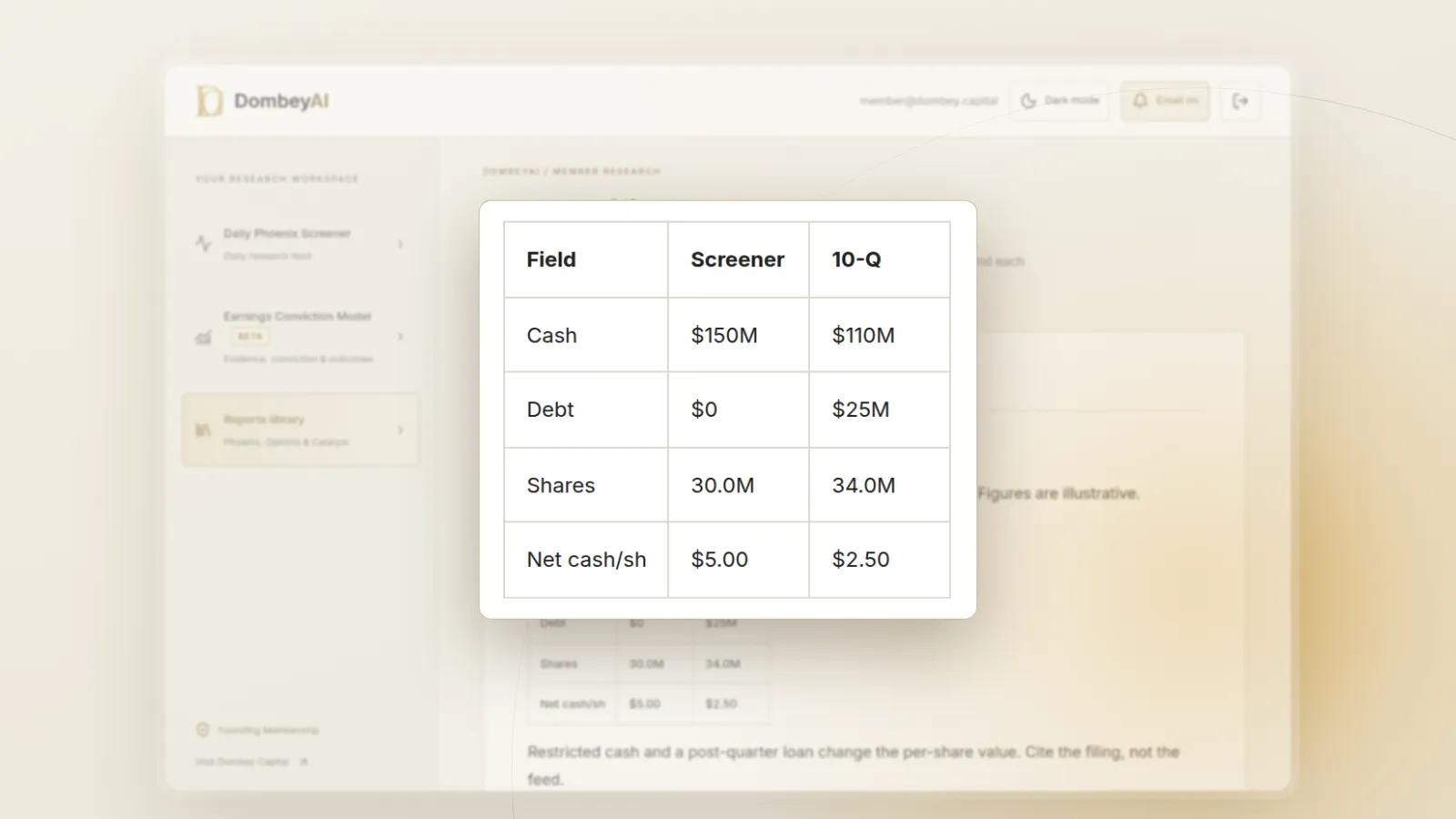
- Share count. Screeners often use a share count from the last periodic filing. A rights offering, a conversion or a buyback since then changes per-share values. The most recent count is usually on the cover page of the latest 10-Q.
- Cash and debt. A data field called "cash" may include restricted cash or exclude short-term investments. The balance sheet and its notes tell you which, and that changes enterprise value and net cash per share.
- Timing. A data feed records when it processed a filing, not when the event occurred. For a dated catalyst, the dates in the filing are the ones that count.
For a stock trading near or below its cash, a small error in any of these can turn a margin of safety into none. That is why the fact behind each line of a thesis needs a primary citation.
How fast primary sources arrive
Primary sources are not always slow. SEC rules set clear clocks for several of them, which tells you when a secondary report is likely ahead of the record and when it is simply repeating it.
- Form 8-K: for most listed events, a company must file within four business days of the event.
- Form 4: insiders must report most changes in ownership within two business days of the transaction. The guide on tracking insider buying with Form 4 covers how to read one.
- Form 10-Q: due 40 days after quarter end for large accelerated and accelerated filers, and 45 days for all other filers.
- Regulation FD: when a company intentionally shares material nonpublic information with market professionals or holders likely to trade on it, it must make the same information public at the same time.
If a secondary source reports a material company fact and you cannot find it in a filing, a press release or a public call, ask where it came from. It may be a leak, a rumor, an estimate or an error.
How to trace a number back to the record
The habit that matters most is simple: for every number that changes your conclusion, find where it was first published.
- List the load-bearing facts. Most theses rest on four to eight numbers or terms. Write them down.
- Note where you first saw each one. A screener, an article, a call, a post.
- Find the primary record. Use SEC EDGAR search to locate the filing, then the exact table, note or section.
- Check the definition and the date. Confirm the period, the units, what is included and the "as of" date.
- Record the citation. Form type, filing date, page or section. A dated investment thesis keeps these alongside each claim.
- Re-check at each new filing. The primary record changes every quarter, and secondary sources update on their own schedules.
When a secondary source is the right tool
Primary sources are slow to read, and nobody can read every filing. Secondary sources earn their place in four jobs.
- If you are screening, a data platform or screener sorts thousands of companies in seconds. The stock research tools comparison covers the main options.
- If you need context, an industry article or analyst report explains what a figure means relative to peers and history.
- If you need speed, a news alert can reach you before you would have checked EDGAR yourself.
- If you need to find where to look, an AI summary or a transcript tool can point you to the right section. The comparison of ChatGPT, Claude and Perplexity for stock research sets out what those tools can and cannot read.
The rule is to let secondary sources raise the question and primary sources settle it. Dombey's published research cites the filing behind each figure it relies on; see the research archive.
Where this goes wrong
Primary sources are better records, not perfect ones.
- Primary does not mean neutral. Press releases, slide decks and call remarks are written by management. They are primary for what the company says, not for whether it is true. Audited statements carry more weight than an investor deck.
- Primary does not mean current. A 10-Q balance sheet is a snapshot of the quarter end, filed up to 45 days later. A company burning cash quickly may hold far less by the time you read it.
- Projections in filings are still projections. Management forecasts in a proxy or S-4 are disclosed under SEC rules, but they remain estimates made for a purpose, often to support a deal.
- Transcripts can be secondary in disguise. A transcript from a third party is a copy of the primary record. For an exact quote that matters, check the company's own webcast or filed materials.
- Some facts have no single primary source. Short interest, for example, is reported by exchanges and FINRA on a schedule, and many tools add estimates between those reports. Know which number you are using; see what short interest is.
- Reading the record wrongly is still an error. A primary source misread is no better than a secondary source read correctly. Definitions in the notes are the usual trap.
Common mistakes
- Citing the outlet instead of the document. "Reported by a data site" is not a citation. Name the filing and the page.
- Trusting a number because several sites agree. Many sites draw from the same feed, so agreement can mean one error copied many times.
- Stopping at the press release. The release may lead with adjusted figures. The 8-K exhibits and the next periodic filing hold the formal numbers and the notes.
- Ignoring exhibits. The 8-K item text is a summary. The signed agreement attached to it is the record.
- Skipping the "as of" date. A share count or cash balance without its date cannot be compared with today's price.
The bottom line
A primary source is the original record of a fact, mostly filings, exhibits, official dockets and the company's own words, while a secondary source passes that record on in summarized or reprocessed form. Use secondary sources to screen, add context and find where to look. Before you rely on a number, trace it to the primary record, check its definition and date, and write down the citation. In event-driven investing, where the outcome often turns on a single term or a single date, that one habit catches more errors than any tool.