

Why companies uplist
Companies on the OTC markets give up access that exchange-listed companies take for granted. Some institutional investors have mandates that exclude OTC securities. Some brokers restrict or add friction to buying them. Index providers generally require an exchange listing. Research coverage, market makers and options listings tend to follow exchange status.
An uplisting tries to fix that. The reasons companies give usually include:
- Access to institutional investors and index funds that cannot hold OTC shares.
- Better liquidity and narrower bid-ask spreads.
- Easier capital raising, because exchange-listed shares can be sold to a wider market.
- Use of shares as acquisition currency.
- Credibility with customers, partners and lenders.
Not every company on the OTC markets is small or weak. Some foreign companies trade OTC through American depositary receipts, and some profitable firms stay OTC by choice to save cost. The uplisting story usually involves smaller domestic companies that have grown into the standards, or want to.
How the listing standards work
Each exchange publishes its own initial listing requirements, and each has more than one standard a company can qualify under. The tests fall into a few groups.
| Requirement group | What it measures | What to check in the filings |
|---|---|---|
| Minimum bid price | Share price at the time of listing | Recent trading price and any planned reverse split ratio |
| Publicly held shares | Shares held by people other than officers, directors and large holders | The beneficial ownership table and the float after any offering |
| Holders | Number of round-lot holders | Whether the offering is meant to add holders |
| Market value of public float | The value of publicly held shares | Price times public float after the offering |
| Equity, market value or income | One of several financial size tests | Stockholders' equity, market capitalization or net income in the latest filings |
| Governance | Independent directors, audit committee, code of conduct, shareholder approval rules | The proxy statement and board changes before listing |
The exact thresholds change from time to time and differ between the Nasdaq Capital Market, the Nasdaq Global Market, NYSE American and the NYSE. Read the exchange's current listing guide rather than relying on a figure you saw in a press release. The governance rules are often overlooked: a company with a two-person board may need to add independent directors and form an audit committee before it can list.
The usual sequence
Most uplistings follow the same steps, and each step leaves a public record.
| Step | Filing or signal | What it tells you |
|---|---|---|
| Plan announced | Press release or 8-K | Intent only; no approval yet |
| Shareholder approval of a reverse split | Proxy statement | The ratio range and the board's discretion |
| Application filed | Usually disclosed in a press release or registration statement | The company believes it meets a standard |
| Offering registered | S-1 or amended S-1 | Size, price range and underwriter |
| Reverse split effective | 8-K and new CUSIP | The new share count and price |
| Approval letter | Press release or 8-K | The catalyst: listing is approved, often conditional on the offering closing |
| Form 8-A filed | Registration of the class under Section 12(b) | Listing is imminent |
| First day of exchange trading | New ticker or same ticker on the exchange | Liquidity, new holders and early selling |
Two documents matter most. The registration statement for the offering shows the dilution and the use of proceeds. The beneficial ownership table shows who could sell once the stock has an exchange's liquidity. Our explainers on S-1 filings and dilution walk through both.
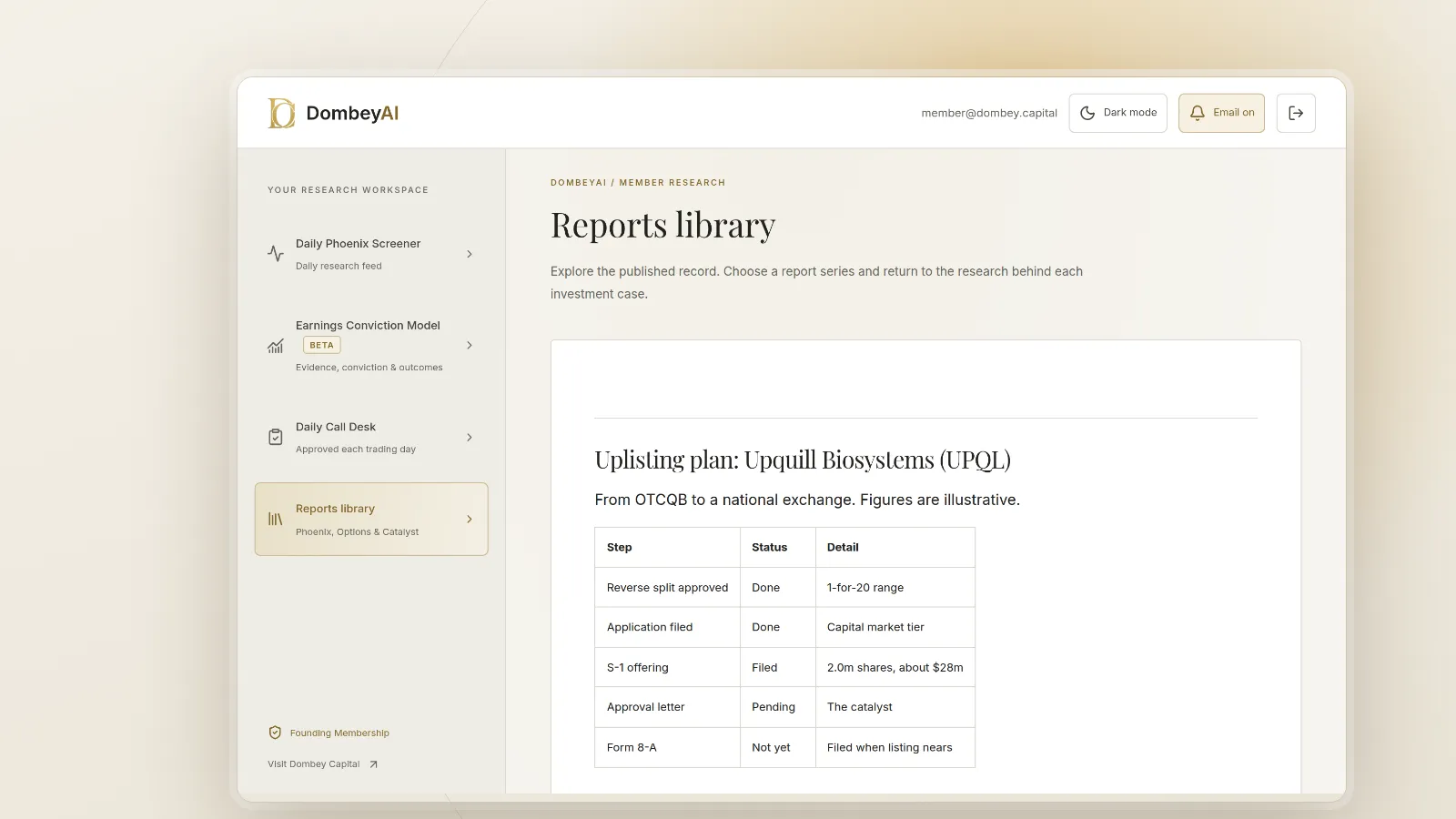
A worked example
The example shows why the terms matter. The offering is priced at a discount to attract buyers. Pre-split holders keep their value per share only if the offering raises cash the company uses well, and only if the stock holds up as new liquidity arrives. Our guide to reverse stock splits covers the split mechanics in more detail.
Uplistings as special situations
An uplisting is a structural change in who can own a stock. That is the same theme behind index additions, where a change in eligibility creates new demand. In an uplisting, the new demand is less mechanical: funds are allowed to buy, but none are required to.
The situations worth studying share a few features:
- If the company already meets the financial tests and needs no large offering, dilution risk is lower.
- If insiders hold most of the shares and have no lock-up, the new liquidity may become their exit.
- If the company has a real business with audited revenue and cash flow, the move can bring it to investors who never looked.
- If the plan depends on a reverse split and an offering in a weak market, expect delays.
For a wider view of how structural changes create mispricing, see what is a special situation. For sources that track these setups, our list of the best investing newsletters for special situations covers who follows smaller, less-covered events.
Where this goes wrong
Uplistings disappoint in several common ways.
- The reverse split does not hold. Shares that were cheap on the OTC market can fall after the split, especially if the market reads the split as a sign of weakness. A post-listing price below the exchange's continued listing minimum brings a deficiency notice.
- The offering is larger or cheaper than expected. A deal priced well below the market resets the price and leaves the new holders ahead of the old.
- Early holders sell. Convertible note holders, warrant holders and long-time insiders may use exchange liquidity to exit.
- The plan slips. Applications can stall over financial statements, governance gaps or market conditions.
- The business does not change. A listing gives access to buyers. It does not give the company better products, margins or cash flow.
Dombey's published research looks for structural changes like this when they sit beside a valuation discount; see the research archive.
The bottom line
An uplisting moves a stock from the OTC markets to a national exchange, which can widen its investor base and improve liquidity. The company must meet the exchange's listing tests and governance rules, and the path often runs through a reverse split and a share offering. Judge the move on its terms: the split ratio, the size and price of the offering, who can sell once the shares list and whether the business underneath can hold the higher profile. The approval letter, not the press release announcing a plan, is the event that counts.