

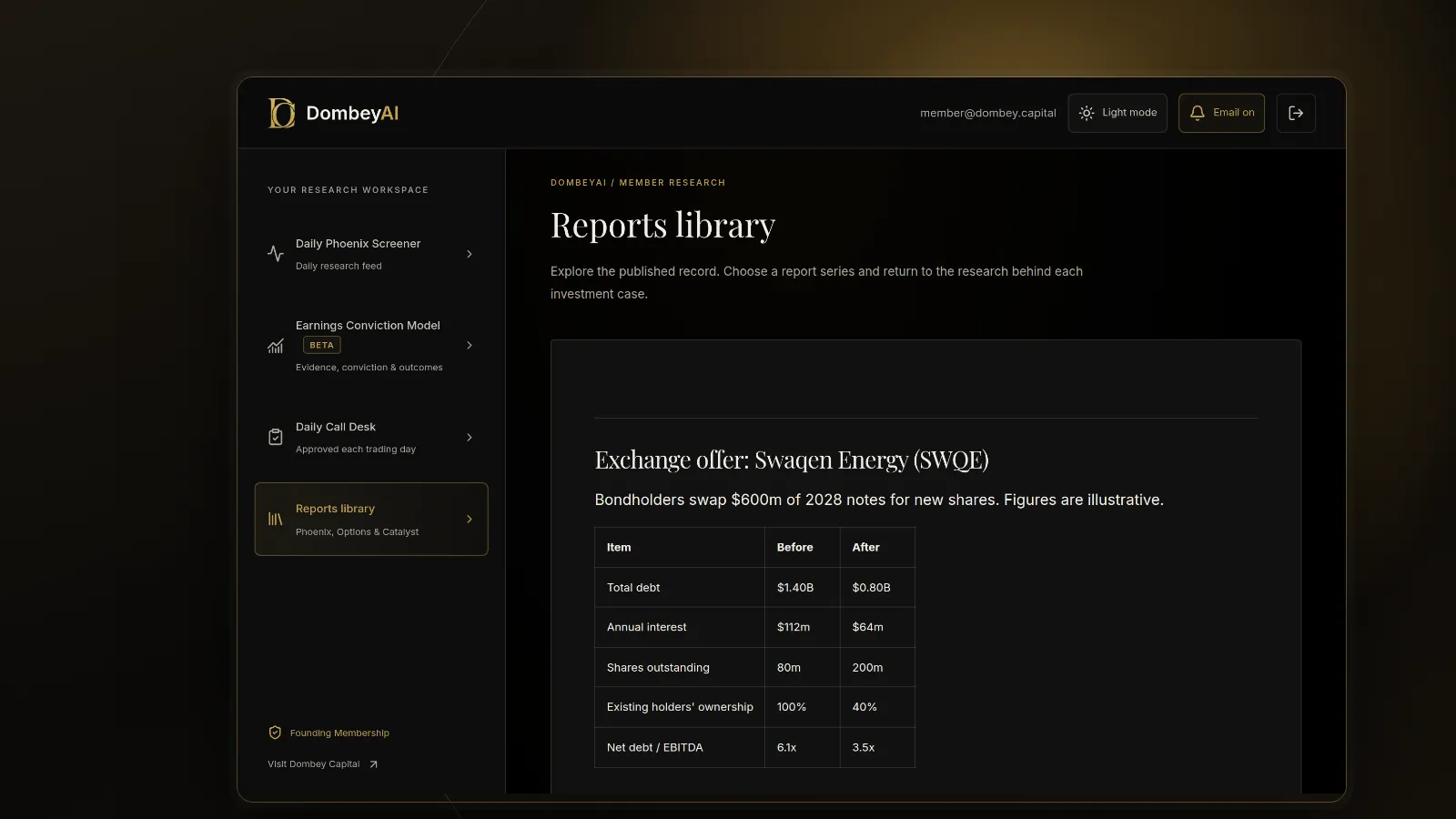
How a debt-for-equity swap works
The mechanics are simple even when the negotiations are not. The company and a group of creditors agree on three things: which claims are exchanged, how many new shares each dollar of claim receives, and what, if anything, existing shareholders keep.
The creditors' claims are cancelled at closing. The company issues the agreed shares, records the reduction in debt, and starts life with a smaller interest bill. Lenders who did not take part keep their original claims, so a partial swap can leave a meaningful debt load in place.
The exchange ratio is usually set in one of two ways. In an out-of-court deal, creditors and the company negotiate a ratio that reflects the bond's trading price and the value the creditors believe the equity will have afterwards. In Chapter 11, the ratio follows from a plan valuation: the court-supported value of the reorganized business is allocated down the priority ladder, and each class receives shares worth roughly what its claim recovers.
Creditors take equity for practical reasons. If the company cannot refinance a debt maturity wall, a forced sale or long bankruptcy may recover less than owning the business. Shares give them the upside if the operations recover.
Out of court versus in Chapter 11
Where the swap happens largely decides what the old shareholders receive.
| Feature | Out-of-court exchange | Chapter 11 plan |
|---|---|---|
| How it is done | Exchange offer, private exchange or negotiated deal with a creditor group | Plan of reorganization voted on by creditor classes and confirmed by the court |
| Who must agree | Each creditor that exchanges; holdouts keep their claims | Required majorities within each voting class; dissenters can be bound |
| Typical result for old shares | Diluted but still listed and outstanding | Often cancelled, sometimes with a small stake or warrants |
| Shareholder vote | Often needed under exchange rules and for more authorized shares | Handled through the plan process, not a normal proxy vote |
| Speed and cost | Faster and cheaper when holders cooperate | Slower and more expensive, with court and adviser fees |
| Main risk | Holdouts who refuse to exchange and stay senior | Absolute priority leaves little or nothing for equity |
Out of court, holdouts are the main problem. A creditor who refuses to exchange keeps a full claim while others take shares, so many deals set a minimum participation level and sometimes use a prepackaged bankruptcy as the backstop if participation falls short. The article on what happens to stock in Chapter 11 explains why in-court swaps tend to be worse for the old equity: senior creditors generally must be paid in full before junior classes receive anything unless they agree otherwise.
What it means for existing shareholders
The first number to compute is pro forma ownership. Divide the old share count by the old share count plus the new shares issued to creditors. That is the share of the company the old holders will own after closing, before any warrants, management incentive plan or rights offering.
Three outcomes are common:
- If the old holders keep a majority, the swap is usually small relative to the company and functions like a balance sheet clean-up.
- If the old holders keep a minority stake, often under 20%, the creditors now control the company and the old shares become a small, diluted piece of a less levered business.
- If the old holders receive nothing, which is common in Chapter 11, the shares are cancelled and trading in them ends.
Old holders sometimes receive warrants that only pay off if the reorganized equity rises above a set level. Those warrants are an option on a recovery, not a claim on today's value. The guide to dilution and share count changes shows how to fold warrants and incentive shares into a fully diluted count.
A swap can also change listing status and the share structure around it. Companies with very low share prices often pair a swap with a reverse stock split to stay above the exchange's minimum bid, which does not change ownership but does change every per-share number you see quoted.
A worked example
After closing, Company A has 500 million shares and $200 million of debt. The old holders own 50 million of 500 million shares, or 10%.
Now value the result. If the business is still worth $550 million, the equity is worth $550 million less $200 million of debt, or $350 million. Spread across 500 million shares, that is $0.70 per share. The old holders' 10% is worth $35 million, well below the $100 million the market was paying before.
That looks like a loss, and against the pre-deal price it is. But the pre-deal price may have been too high. With $600 million of debt against a $550 million business, the equity had no value on a liquidation basis. The swap gave the old holders $35 million of value that a bankruptcy might have given them none of.
The example also shows why the business value matters most. If the reorganized company is worth $700 million because interest savings let it invest again, equity becomes $500 million, or $1.00 a share. If it is worth $450 million, equity is $250 million, or $0.50. The swap moves risk from lenders to shareholders, and the share price moves with the enterprise value.
What to check in the filings
Swap terms are spread across several documents. This checklist covers the items that drive value:
- The announcement 8-K. It usually describes the agreement and attaches the restructuring support agreement or exchange agreement as an exhibit. Note which creditors signed and what share of each class they hold.
- The exchange ratio and share count. Write down the number of new shares, the old share count and any warrants or incentive plan shares. Compute pro forma ownership yourself.
- Remaining debt. List every tranche that survives, with its maturity and rate. A swap that leaves a large near-term maturity in place may only delay the next problem. The article on the debt-to-equity ratio helps judge whether the new balance sheet is still stretched.
- Shareholder vote. Nasdaq and NYSE generally require shareholder approval when a listed company issues 20% or more of its outstanding shares below a minimum price outside a public offering, subject to exceptions. Check the proxy for the vote date and whether large holders have agreed to support it.
- Rights offering or new money. Many swaps come with a backstopped rights offering that lets holders buy more shares at a fixed price. Participation can change your final ownership.
- Tax note. Cancelling debt can create taxable income, though exclusions can apply in bankruptcy or insolvency, and a change of control can limit the use of net operating losses under Section 382 of the tax code. The filing usually says whether the company expects such a limit.
- Lockups and registration rights. Creditors who receive large blocks may be free to sell soon after closing. Registration rights agreements tell you when.
A prior going-concern warning often sets the stage for a swap, so the liquidity note in the last 10-K or 10-Q is a useful starting point.
Where this goes wrong
Debt-for-equity swaps are easier to analyze than to call. The common failures:
- Anchoring on the old share price. The pre-deal price can reflect hope rather than value. Measure the swap against what the equity was worth, not what it traded at.
- Missing part of the share count. Warrants, management incentive shares and rights offering shares can add a large slice. Ownership figures based only on the headline exchange understate dilution.
- Ignoring the debt that remains. A partial swap can leave the company exposed to the same refinancing problem a year or two later.
- Assuming the deal closes. Out-of-court swaps can fail on low participation or a failed shareholder vote. A failed swap often leads straight into Chapter 11, where the old shares usually fare worse.
- Overlooking selling pressure. Creditors who did not want to own equity may sell their new shares after closing, which can weigh on the price regardless of value.
- Trusting plan valuations as market prices. Chapter 11 plan values are negotiated numbers. The article on post-bankruptcy equities explains why reorganized shares often trade away from them in either direction.
Where swaps fit in special situations work
For a special situations investor, a swap is a dated event with documents that state the terms. The share count, the remaining debt and the closing conditions are all knowable in advance, which is what makes the situation analyzable. The uncertain part is the value of the business afterwards.
Some investors look at the old equity before a swap, when the market may misjudge how much the holders keep. Others prefer the new equity after closing, when former creditors sell shares they never wanted. Both depend on the same arithmetic: enterprise value, minus remaining debt, divided by the full share count. Readers who want to follow restructurings more closely can compare sources in our list of the best investing newsletters for special situations and the guide to bankruptcy and restructuring research sources.
This article is education, not a recommendation to trade any security.
The bottom line
A debt-for-equity swap trades ownership for solvency. Creditors cancel debt and take new shares, and existing holders are diluted, sometimes to a small stake or to nothing. Whether that is a good outcome depends on the value of the business after the deal, the debt left behind and the full share count, not on the headline dilution alone. Read the 8-K, the agreement and the proxy, compute pro forma ownership yourself, and treat the old share price as a number to test rather than a baseline.