

What a mutual bank is
A mutual savings bank, savings and loan association or cooperative bank has no stockholders. Its depositors, and in some cases its borrowers, are its members. They vote on certain matters, such as electing directors and approving a conversion, but they hold no transferable ownership stake and receive no dividends. Profits stay in the institution as retained earnings.
Over decades, those retained earnings build up into the bank's equity. Nobody can sell that equity or take it out while the bank stays mutual.
Mutual institutions convert for several reasons: to raise capital for growth, to pay management and directors with stock, to make acquisitions with shares, or to prepare for a sale. Conversion is usually the first step on any of those paths.
How a standard conversion works
In a standard conversion, the bank reorganizes into a stock institution owned by a new holding company, and the holding company sells all of its shares to outside buyers. The main steps are below.
| Stage | What happens | Where to find it |
|---|---|---|
| Plan of conversion | The board adopts a plan and sets the record dates for depositor priority | Plan attached to the regulatory application and the prospectus |
| Regulatory review | The bank's regulator reviews the plan, and the Federal Reserve reviews the holding company | Regulatory approval notices |
| Appraisal | An independent appraiser sets a pro forma market value and an offering range | Appraisal summary in the prospectus |
| SEC registration | The holding company registers the shares | Form S-1 prospectus on EDGAR |
| Subscription offering | Depositors and other priority groups order shares | Order forms mailed with the prospectus |
| Member vote | Members vote on the plan of conversion | Proxy materials sent to members |
| Community and syndicated offerings | Unsold shares go to local residents, then the general public | Prospectus supplement and closing press release |
| Closing and listing | Shares are issued and usually begin trading | Form 8-K and exchange listing notice |
The regulator depends on the charter. The OCC oversees federal savings associations, the FDIC oversees state savings banks that are not Federal Reserve members, and state banking departments also review state-chartered institutions. The Federal Reserve has supervised savings and loan holding companies, including mutual holding companies, since the Office of Thrift Supervision was abolished in 2011.
The offering price is almost always $10.00 per share. The number of shares sold is what moves: the appraiser sets a midpoint value and a range, which in standard practice runs 15% either side of the midpoint, with room to increase above the top of the range if demand and market conditions support it. If orders fall short of the minimum, the offering can be extended, resized or abandoned.
Who gets to buy first
Federal conversion rules set an order of priority for subscription rights. Under the OCC rules for federal savings associations, it is generally:
- Eligible account holders. Depositors with qualifying balances on the eligibility record date in the plan. That date comes before the board adopts the plan, so opening an account after a conversion is announced does not help.
- Tax-qualified employee stock benefit plans, such as the bank's employee stock ownership plan (ESOP).
- Supplemental eligible account holders. Depositors on a later record date, used when the first record date is old by the time the regulator approves the plan.
- Other members, such as depositors on the voting record date who did not qualify above.
If the offering is oversubscribed, shares are allocated down this list, and within the first group allocations generally follow the size of each depositor's qualifying balance. Each plan also sets individual and group purchase limits. Directors and officers buy at the same price as everyone else, though their purchases count toward limits of their own.
Any shares left after the subscription offering go to a community offering, usually with a preference for residents of the bank's local counties, and then to a syndicated community offering run by a broker-dealer for the general public. For a popular deal, little or nothing reaches the public stage, and outside investors buy in the market after the shares list.
Why the stock often starts below book value
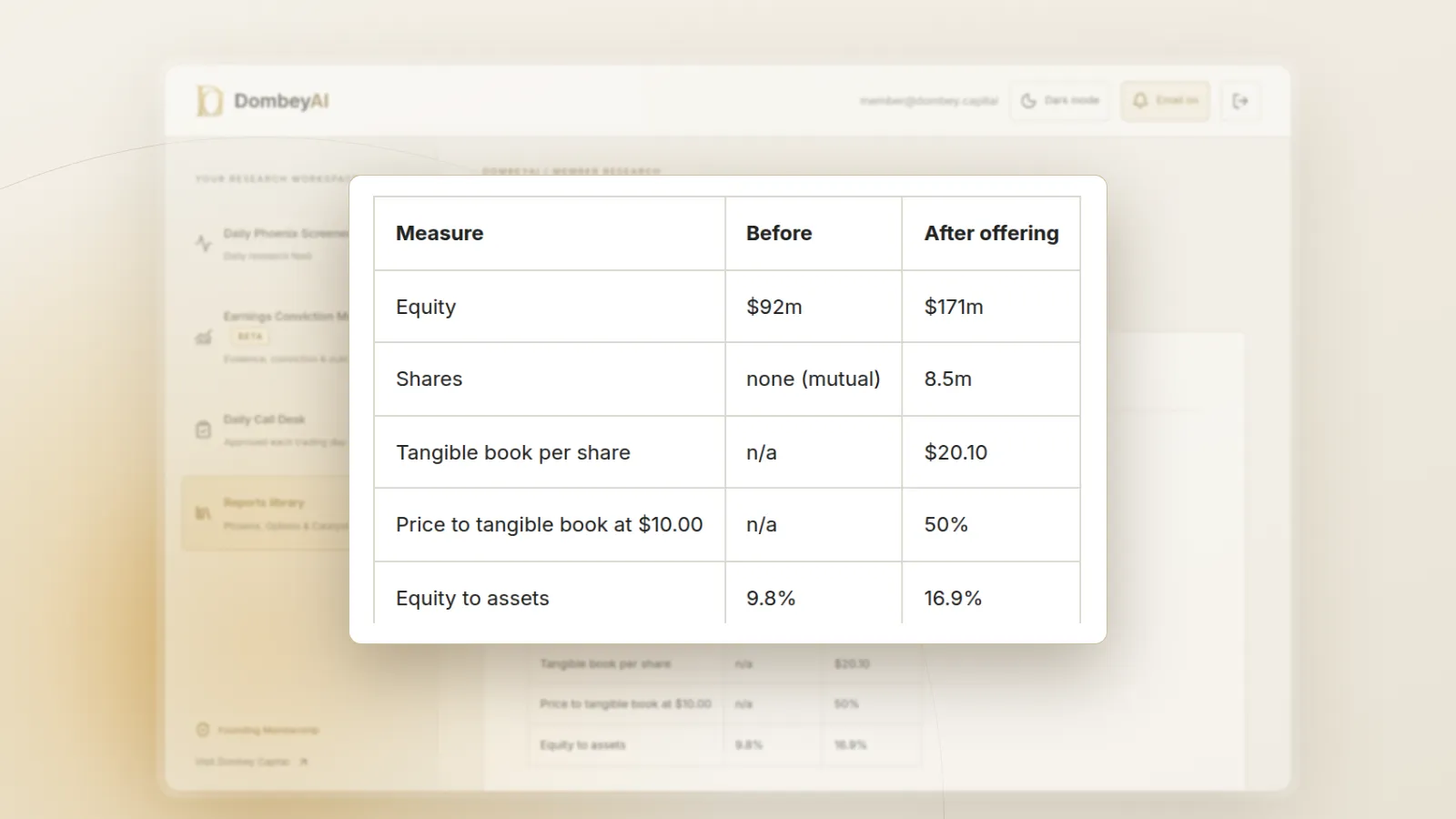
Before the conversion, the bank's equity belongs to no shareholder. After it, that equity belongs to whoever bought the new shares. The buyers pay for their own cash going into the bank and receive a pro rata share of the existing equity on top.
The ratio has a ceiling built into it. If the bank raises P and had existing equity E, the price-to-book ratio is roughly P divided by (E plus P), so it can never reach 1.0 at the offering price. The more equity the mutual built up relative to the size of the raise, the deeper the discount.
The appraiser does not pick the value in a vacuum. Appraisals compare the converting bank with a peer group of recently converted and publicly traded thrifts on price to book, price to earnings and price to assets. The prospectus contains this peer table, and it is worth reading alongside our guide on how to value a bank stock.
The mutual holding company structure and second steps
Not every bank sells 100% at once. Under a mutual holding company (MHC) reorganization, the mutual becomes a mutual holding company that owns a majority of a new stock company, and the stock company sells a minority stake to the public. The MHC must keep a majority of the voting stock, so the public owns less than half. Federal Reserve Regulation MM governs mutual holding companies.
The MHC structure lets a bank raise some capital without fully giving up mutual control. It also has costs for outside holders: the MHC controls every shareholder vote, so the public minority cannot force a sale or block management's plans. Dividends paid by the stock company go partly to the MHC, and whether the MHC may waive its share is governed by Federal Reserve rules.
A second-step conversion finishes the job. The MHC converts to stock form and sells its majority stake in a new offering, and the existing public holders exchange their shares for shares of the new fully public company. The exchange ratio is set so that the public holders keep roughly the same percentage ownership they had before, adjusted for any assets the MHC held on its own. Depositor priority applies to the new shares sold, just as in a standard conversion.
| Structure | Share sold to public | Who controls votes | Can be acquired |
|---|---|---|---|
| Mutual | None | Members | Only through a mutual merger or after conversion |
| MHC minority offering | Less than 50% | Mutual holding company | Not without the MHC's agreement |
| Standard conversion | 100% | Public shareholders | Subject to post-conversion limits |
| After a second step | 100% | Public shareholders | Subject to post-conversion limits |
What happens after the conversion
The converted bank usually has more capital than it can use. Equity that was adequate for a mutual has been increased by the offering, often substantially. Until that capital is lent out, used for buybacks or used in an acquisition, it earns a low return, and return on equity falls.
Several rules shape the first few years. Under the OCC rules for converted savings associations, the holding company generally cannot repurchase its stock in the first year after conversion, apart from limited exceptions. For three years after conversion, no person may acquire more than 10% of any class of the company's equity without regulatory approval. Members whose deposits gave them priority also receive an interest in a liquidation account, a claim that applies only if the bank is completely liquidated and declines as their deposits fall.
Management and directors usually adopt stock option and restricted stock plans after the conversion, subject to a shareholder vote. These plans dilute outside holders, and the prospectus shows their likely size in its pro forma tables.
Many investors therefore watch for three things: buybacks once they are allowed, the three-year anniversary of the conversion, when the acquisition limit lapses, and any sign that the board is open to a sale. A takeover would typically be priced as a multiple of tangible book, and our article on the takeover premium explains how bidders and boards think about that premium.
Where this goes wrong
The discount to book can be permanent. A bank that converts and keeps earning a low return on its equity has little reason to trade at book value. The market prices it on what the capital earns, not on what it is. Our guide on price-to-book ratio covers why a low multiple alone is not a signal.
Management may never sell. Conversion gives insiders stock and options, but it does not force a sale. Boards of small converted banks can stay independent for years, and a bank with no path to deploy or return its capital can become a value trap.
Credit and interest rate risk do not go away. Many savings institutions hold long-term fixed-rate mortgages funded by deposits that reprice faster. A rise in rates can cut both net interest margin and the value of the securities and loans on the balance sheet. Tangible book can fall even while the new capital sits on it.
Small, illiquid shares. Many converted banks are small, with thin trading volume.
The pro forma book is an estimate. Offering costs, the ESOP loan, a foundation contribution and the final number of shares sold all change the actual book value per share. Check the post-closing filings, not just the midpoint table in the prospectus.
How to research a conversion
The prospectus, filed on Form S-1 on SEC EDGAR, is the main document. Read the pro forma data at the minimum, midpoint, maximum and adjusted maximum, the appraiser's peer comparison, the use of proceeds, the description of benefit plans and the risk factors on interest rate exposure. Later, the company's proxy statements show the stock plans and any shareholder proposals, and our guide on how to read a proxy statement walks through them. For broader coverage of tenders, spin-offs, conversions and similar events, see the best investing newsletters for special situations.
This article is education, not investment advice.
The bottom line
A mutual bank conversion turns a depositor-owned savings institution into a stock company through an offering that eligible depositors get first access to. Because buyers pay for their own capital and also receive a share of equity the mutual built over decades, the shares often start well below pro forma book value. The MHC structure splits this into a minority offering and a later second step. The discount is real, but it closes only if the bank earns a fair return on its new capital, returns it, or sells.