

Why take-unders happen
A board's duty in a sale is to get the best value reasonably available. Accepting less than the market price looks like a failure of that duty, so the reasons are usually spelled out in the proxy. The common ones:
- Financing pressure. Debt maturities the company cannot refinance, covenant breaches or a short cash runway can make a sale the best of poor options. Our explainer on debt maturity walls covers how that pressure builds.
- A failed sale process. If the board contacted many buyers and only one bid, the board may decide the market price reflects hope rather than value.
- A stock price inflated by speculation. Heavily shorted or thinly traded stocks can trade above any price a buyer will pay.
- A controlling holder. A parent or large holder that controls the vote can push through a low price. Courts look harder at these deals.
- Going-concern doubt. If auditors or management have raised going concern questions, the alternative to a sale may be a restructuring that leaves shareholders with little.
The premium in a normal deal is covered in what is a takeover premium. A take-under is the same measure with a minus sign.
How a take-under unfolds
| Stage | What happens | What to check |
|---|---|---|
| Announcement | Merger agreement signed, often filed with an 8-K | Price, consideration, conditions, termination fees |
| Stock reaction | Price falls toward the offer | The spread between the price and the offer |
| Preliminary proxy | Background of the merger and fairness opinion published | Who else was contacted, what alternatives were tried |
| Go-shop, if any | The board can seek better offers for a set period | Whether any rival bidder emerges |
| Shareholder vote | Majority of outstanding shares, sometimes a majority of the minority | Support agreements, large holders' positions |
| Regulatory approvals | Antitrust or sector reviews | The HSR waiting period and any others |
| Appraisal demands | Holders who qualify file written demands before the vote | Number of shares demanding appraisal, any closing condition tied to it |
| Closing | Shares converted into the deal consideration | Final payment date |
If the agreement includes a go-shop period, the board can actively solicit higher bids for a set time. In a take-under, whether anyone else bids is a direct test of the board's claim that no better price exists.
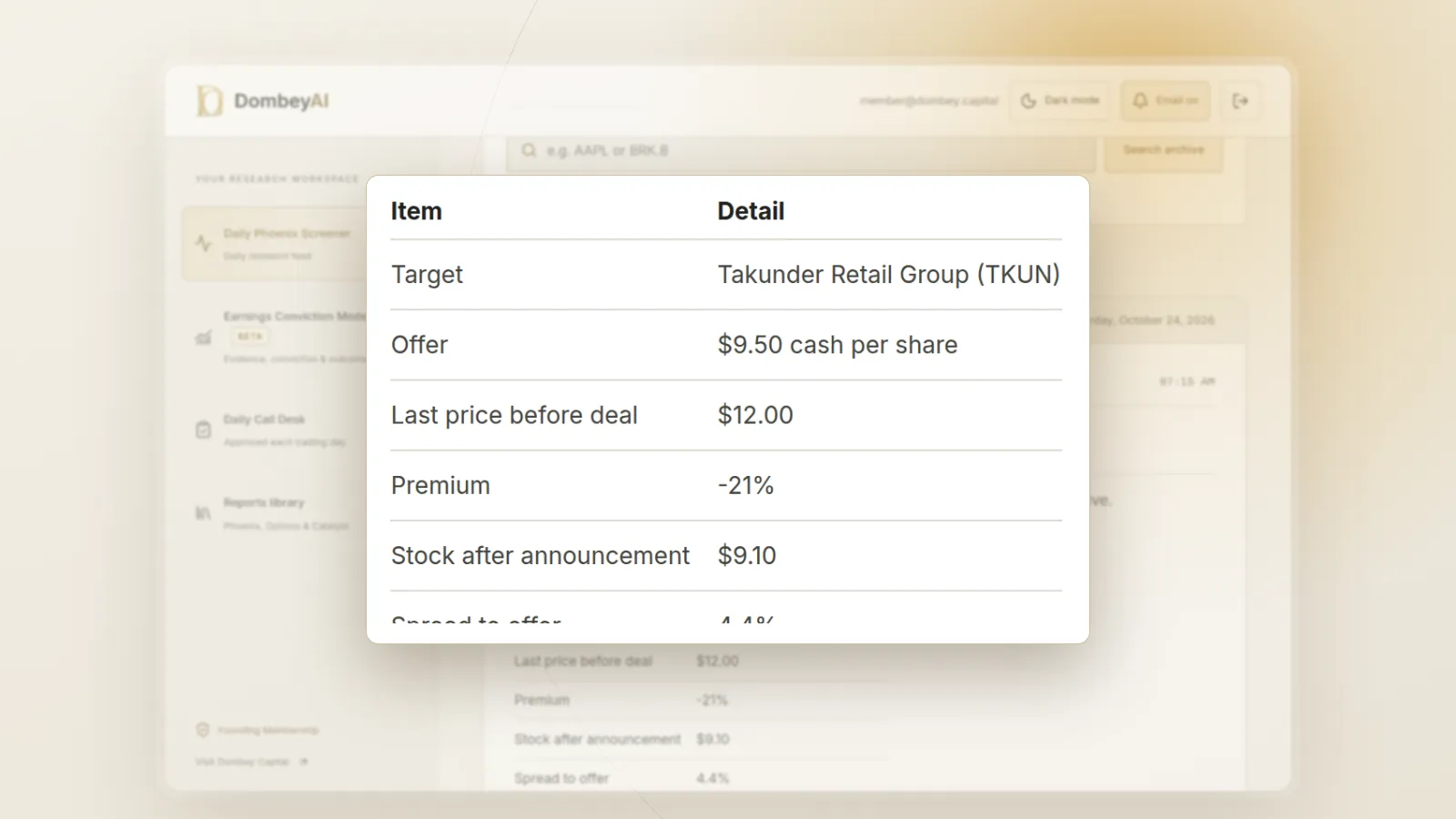
A worked example
The example shows the core tension. The market price before the deal was not a price anyone was willing to pay for the whole company. The deal price is. Whether the board's view is right depends on what the proxy reveals about the process and the alternatives.
The arbitrage spread in a take-under
Once announced, a take-under trades like any other deal: the stock settles near the offer price, with a spread that reflects time, risk and the chance of a better outcome. Our explainer on merger arbitrage and the guide to calculating a merger arbitrage spread cover the general method. Take-unders add some features:
- Vote risk is higher. Shareholders who bought above the offer have a reason to vote no, and short-term holders who bought after the announcement may vote yes. The mix of holders matters.
- Downside if the deal fails can be severe. In a financing-driven take-under, the alternative may be a bankruptcy or a dilutive rescue. The spread can be narrow because a failed deal is worse than the offer.
- Upside from a bump is possible but rare. Shareholder pressure, a rival bid during a go-shop or an appraisal threat can push the buyer to raise the price. Do not assume one.
- The spread can invert. If holders expect a higher bid, the stock can trade above the offer.
Shareholder options: vote, appraisal and litigation
Shareholders in a take-under have three tools.
The vote. Most mergers need approval by a majority of outstanding shares. Deals with a controlling holder often add a majority-of-the-minority vote, which gives unaffiliated holders a real veto. Check the proxy for support agreements that lock up votes in advance.
Appraisal. In Delaware, holders of a company acquired in a cash merger can generally petition the Court of Chancery to determine fair value, if they do not vote in favor, make a written demand before the vote and hold through closing. Our explainer on appraisal rights covers the steps. In a take-under, appraisal is more interesting than usual because the deal price is below a recent market price, but courts have often given weight to the deal price when the sale process was sound. Appraisal takes years, costs money and can return less than the deal price.
Litigation. Holders can sue the board for breach of fiduciary duty. Deals with conflicts, such as a controlling buyer or management rolling over equity, face more scrutiny, and courts look at whether the process included protections such as an independent special committee and an informed minority vote.
How to read a take-under proxy
The background of the merger section is where the board explains itself. Read it for:
- If many potential buyers were contacted and few bid, the low price is more credible.
- If the process was short and only one party was approached, the price is easier to challenge.
- If the financial advisor's fairness analysis shows a range that the deal price sits in only because of a liquidation or restructuring case, the board is pricing distress.
- If insiders roll over equity or receive new roles at the buyer, look for a special committee and how it was advised.
- If the projections in the proxy are well below what management said publicly a year earlier, ask why.
The 10 best investing newsletters for special situations include several that follow contested and distressed deals like these.
Where this goes wrong
Take-under analysis fails in a few common ways.
- Anchoring on the old price. The pre-deal price is a reference, not a value. If no buyer would pay it, it may never return.
- Assuming a bump. Shareholder anger does not always produce a higher price. Many take-unders close at the original terms.
- Underestimating the downside. In distressed sellers, the alternative to the deal may leave equity with little or nothing.
- Missing vote mechanics. Support agreements, tender offer structures and majority-of-the-minority conditions change who decides.
- Ignoring appraisal costs. Fair value claims take years and outcomes vary; the deal price is often a strong reference point in court.
Dombey's published research covers deals and their dated steps; see the research archive.
The bottom line
A take-under is a buyout priced below the target's market price, which boards accept when they believe the alternatives are worse. The stock usually falls toward the offer and then trades as a deal spread, with a vote, approvals and possibly appraisal ahead. Read the proxy's background section and fairness analysis to see what the board tried and why it settled. Then weigh the deal price against the realistic alternative, which in a distressed seller is often far lower than the price the stock traded at the day before.