

How a reverse stock split works
The company picks a ratio, such as 1-for-5, 1-for-20 or 1-for-50. On the effective date, the transfer agent and brokers replace the old shares with new ones at that ratio. The stock opens on a split-adjusted basis, usually under the same ticker but with a new CUSIP number, the identifier brokers use to track a security.
Nothing about the business changes. Cash, debt, revenue and assets are the same the morning after. What changes is the per-share math: earnings per share, book value per share and the share price all scale up by the ratio, and the share count scales down by it.
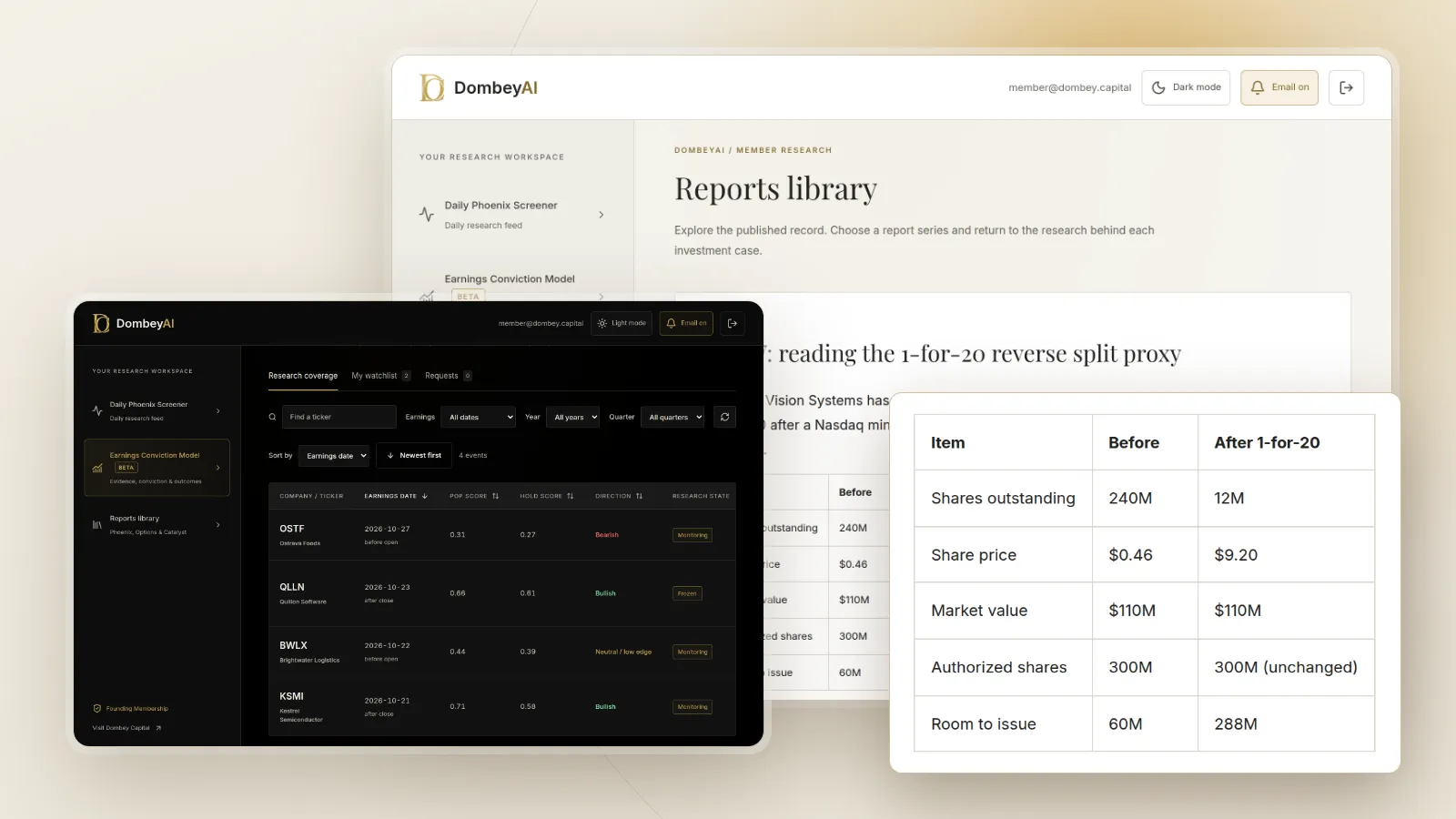
| Item | Before a 1-for-20 split | After the split |
|---|---|---|
| Shares outstanding | 200,000,000 | 10,000,000 |
| Share price | $0.40 | $8.00 |
| Market value | $80 million | $80 million |
| A holder's 2,000 shares | 2,000 shares, worth $800 | 100 shares, worth $800 |
| Loss per share (on $20 million annual loss) | $0.10 | $2.00 |
| Holder's ownership stake | 0.001% | 0.001% |
All figures are illustrative.
The opposite move, a forward split, raises the share count and lowers the price, usually after a stock has risen a long way. The two tend to happen to very different companies. A forward split usually follows success; a reverse split usually follows a long decline.
Why companies do reverse splits
To stay listed
This is the most common reason by far. Both major US exchanges set a $1.00 price floor in their continued listing standards.
- Nasdaq. If a stock's closing bid price stays below $1.00 for 30 consecutive business days, Nasdaq sends a deficiency notice. The company generally has 180 calendar days to regain compliance, which it does when the stock closes at $1.00 or more for at least 10 consecutive business days. Some Capital Market companies can qualify for a second 180-day period.
- NYSE. If the average closing price falls below $1.00 over 30 consecutive trading days, the company is notified and generally has six months to cure. It must tell the NYSE within 10 business days whether it intends to cure the deficiency, and if the cure needs a shareholder vote on a reverse split, the NYSE allows time for that vote.
A reverse split is the one tool that reliably lifts the price above $1 on a set date. The full process from deficiency notice to removal, including Form 25 and what happens to shares that move over the counter, is covered in the article on what a delisting means for shareholders.
To reach a wider set of buyers
Some mutual funds and institutions have rules against owning stocks below a set price, and many brokers will not lend against low-priced shares on margin. A company trading at $0.80 can find that a large part of the market cannot buy it. A higher share price can remove those barriers, though it cannot make the business more attractive to them.
To prepare for a capital raise or uplisting
Companies moving from the over-the-counter market to Nasdaq or the NYSE need to meet the exchange's initial listing price, which is higher than the continued listing floor. A reverse split often comes shortly before the uplisting. Others split ahead of an offering so that the new shares can be sold at a price that institutional buyers will accept.
To make room for more shares
This reason is rarely stated in the press release, and it matters most. A company's charter caps the number of shares it can issue, called authorized shares. If the reverse split reduces outstanding shares but leaves the authorized number unchanged, the company suddenly has far more room to issue new stock.
That extra room can fund the company's survival, but it can also mean heavy dilution of existing holders through warrants, convertibles and at-the-market programs.
The approval and filing trail
Most reverse splits require a charter amendment, which under most state laws needs a shareholder vote. The company files a proxy statement describing the proposal, the reasons and, usually, a range of ratios such as "between 1-for-5 and 1-for-30, at the board's discretion." Approving a range lets the board pick the final ratio closer to the effective date, based on where the price is. The guide on how to read a proxy statement shows where these terms sit.
State law shapes the vote. In 2023 Delaware amended its corporate law so that a listed company can approve a reverse split by a majority of votes cast, rather than a majority of shares outstanding, when the split is needed to keep the listing. Some states, including Nevada, allow a board to effect a reverse split without a shareholder vote in certain cases, generally when the authorized shares are reduced in the same proportion.
Once the board sets the ratio, the company files the charter amendment with its state and typically discloses it on Form 8-K under Item 5.03, which covers amendments to articles of incorporation. The 8-K or a press release states the ratio, the effective date, the new CUSIP and the treatment of fractional shares. Nasdaq also requires advance notice of a reverse split before the market effective date. The guide on reading an 8-K for catalysts covers where to find each item, and every filing is searchable on SEC EDGAR.
| Stage | Where it appears | What to check |
|---|---|---|
| Deficiency | Form 8-K, Item 3.01 | Which rule, which deadline |
| Proposal | Proxy statement | Ratio range, authorized share treatment, stated reasons |
| Vote | Form 8-K, Item 5.07 | Whether it passed and by how much |
| Effective date | Form 8-K, Item 5.03, press release | Final ratio, date, new CUSIP, fractional shares |
| Compliance | Form 8-K or press release | Whether the exchange confirmed compliance |
What it means for your account
Fractional shares. A holder whose shares do not divide evenly by the ratio ends up with a fraction. Most companies pay cash in lieu of it; some round up to a whole share. A holder of 1,030 shares in a 1-for-20 split receives 51 shares and cash for the remaining half share.
Very small holders. Someone who owns fewer shares than the ratio, for example 15 shares in a 1-for-20 split, may be cashed out entirely. Companies sometimes set a high ratio partly to reduce the number of small holders and the cost of serving them, a goal also seen in odd-lot tender offers.
Cost basis. Your total cost basis stays the same and is spread over fewer shares, less any amount allocated to a fractional share that was paid in cash. The split itself is generally not a taxable event in the US; cash received for a fractional share generally is. Check with a tax adviser for your own case.
Options. Listed options are adjusted so the contract keeps its economic value. A contract that covered 100 shares might now deliver 5 shares after a 1-for-20 split, plus cash for any fraction, under an adjusted symbol. These contracts often trade thinly, and new standard contracts are usually listed alongside them.
Charts and data. Historical prices are adjusted for the split in most data services, so a chart may show a stock that "traded at $40" when holders actually paid $2.
How the market tends to read it
A reverse split does not change the company's value, but the market rarely treats it as neutral. The companies that need one are usually those whose shares have already fallen 90% or more, often with losses, short cash runways and repeated equity raises. Many investors see the announcement as a sign that dilution is coming.
That pattern is why the split date can be a catalyst in its own right. A thin float after the split, combined with high short interest, can produce sharp moves in either direction in the days around the effective date. Those moves usually say more about trading conditions than about value.
There are exceptions. A company that has fixed its business, holds enough cash and splits to qualify for an uplisting or for institutional ownership is in a different position from one splitting to buy a few more months on the exchange. The split looks the same in both cases; the filings around it do not.
Questions to ask before you hold through a split
These questions sort most cases and fit naturally on a catalyst calendar:
- Why now? Is the split a response to a deficiency notice, or part of a plan such as an uplisting?
- How long can the company fund itself? The guide on estimating cash runway shows how to compare cash with quarterly burn.
- What happens to authorized shares? If they are not reduced, expect the room to be used.
- Is there an active shelf registration or at-the-market program? That is the channel through which new shares usually reach the market.
- Has the company split before? A second or third reverse split in a few years usually means the first one did not fix the cause.
- Is there a going-concern warning? If the auditor has flagged one, read what a going-concern warning means before relying on the listing to survive.
Investors who follow stressed small caps as special situations often compare notes through newsletters that cover special situations, since reverse splits cluster in the corners of the market that broad coverage skips.
Where this goes wrong
Treating the higher price as a recovery. A stock at $8 after a 1-for-20 split is the same company that traded at $0.40. Nothing has been fixed.
Missing the authorized share change. The headline is the ratio; the dilution risk sits in a line about authorized shares in the proxy.
Assuming the split ends the listing problem. Losses and new share issuance can push the price below $1 again. Under rules Nasdaq has adopted in recent years, a company that falls below $1 within a year after a reverse split, or that has done reverse splits with a combined ratio of 250-to-1 or more over two years, is generally not eligible for a new compliance period and moves directly to a delisting determination. Nasdaq also issues a delisting determination when a stock closes at $0.10 or less for 10 consecutive trading days. Check the current rulebook, as these standards have changed often.
Forgetting the options adjustment. Holders of adjusted contracts can find that the deliverable, liquidity and pricing are not what they expected.
Reading split-adjusted history as a real price. Adjusted charts hide how far the stock has fallen and how many times it has split, which can make a value trap look like a long-term holding that simply had a bad year.
Dombey's published research notes reverse split proposals alongside other dated events for the companies it covers; see the research archive.
The bottom line
A reverse stock split combines shares into fewer, higher-priced ones without changing the company's value or anyone's ownership stake. Most are done to meet the $1 price floor at Nasdaq or the NYSE, and the rest usually aim at institutional buyers, an uplisting or a capital raise. The split is mechanical; the signal sits in the filings around it, especially the treatment of authorized shares, the cash runway and any plan to issue new stock. Read those before deciding what the higher share price means.