

Rule 144 in brief
Securities sold in a public offering registered with the SEC can be resold freely. Two groups of shares cannot:
- Restricted securities, acquired in unregistered, private transactions, such as private placements, stock issued in some acquisitions and some employee stock plans.
- Control securities, held by an affiliate of the company, meaning a person who controls, is controlled by or is under common control with it. Officers, directors and large holders are often affiliates.
Rule 144 is a safe harbor that lets these holders sell publicly without registration if they meet its conditions. The main conditions are:
| Condition | What it requires |
|---|---|
| Holding period | For restricted securities of a company that has been an SEC reporting company for at least 90 days, six months; otherwise one year |
| Current public information | Adequate current information about the company must be available |
| Volume limit (affiliates) | In any three months, no more than the greater of 1% of outstanding shares or, for exchange-listed stock, the average weekly trading volume over the prior four weeks |
| Manner of sale (affiliates, equity) | Ordinary brokerage transactions or sales to a market maker, with no solicitation of buy orders |
| Notice | Form 144 when sales in three months exceed 5,000 shares or $50,000 |
Non-affiliates who have held restricted securities past the holding period face fewer conditions, and after one year can generally sell freely. Most Form 144 filings you will see come from affiliates.
What a Form 144 contains
The form is short. The fields that matter most for research are:
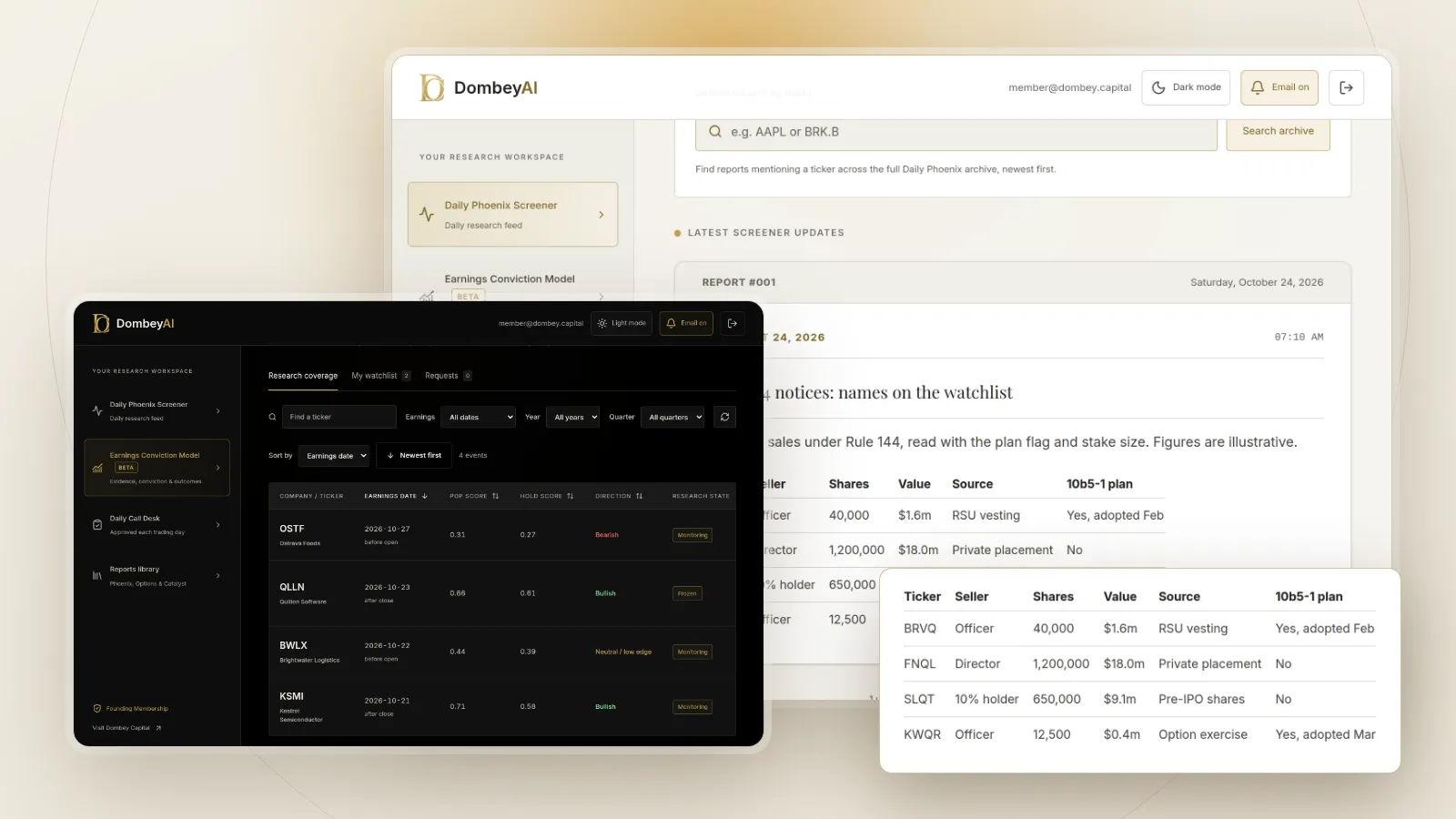
- Seller and relationship. The name of the person for whose account the shares are sold, and their relationship to the company, such as officer, director or 10% holder.
- Shares and value. The number of shares to be sold and their aggregate market value, as of a recent date.
- Shares outstanding. The company's outstanding shares, which lets you compare the sale with the total.
- Approximate date of sale and exchange. When and where the sale is expected.
- Broker. The firm handling the sale.
- How the shares were acquired. For example, an option exercise, restricted stock vesting, a private purchase or a gift, with dates.
- Sales in the past three months. Other sales by the same person, which add up toward the volume limit.
- Rule 10b5-1 plan. Whether the sale is made under a written trading plan and, if so, the date the plan was adopted or last modified.
Since April 2023, Form 144 notices for securities of SEC reporting companies must be filed electronically on EDGAR, so they appear in the company's filing list and can be searched. The 10b5-1 field came with the same round of changes and is the most useful single box on the form.
Form 144, Form 4 and the sale itself
One insider sale often leaves two filings.
| Feature | Form 144 | Form 4 |
|---|---|---|
| What it reports | A proposed sale under Rule 144 | A completed change in beneficial ownership |
| Who files | Affiliates and holders of restricted securities | Section 16 insiders: officers, directors and 10% holders |
| Timing | On or before the time the sell order is placed | Generally within two business days after the trade |
| Covers buys | No | Yes |
| Price shown | Estimated aggregate market value | Actual transaction prices |
| 10b5-1 plan flag | Yes, with adoption date | Yes, a check box |
So the Form 144 is the earlier signal, and the Form 4 is the record. A seller may sell all, part or none of the shares in the notice. If you track insider activity, our guide to tracking insider buying with Form 4 covers the second filing in detail, and the best tools for tracking insider buying compares services that collect both.
How to read a Form 144
A notice is one data point. Context decides what it means.
Questions that separate routine from notable:
- If the sale is under a 10b5-1 plan adopted months earlier, it was decided before recent news.
- If the shares came from vesting and the sale is small, tax withholding and diversification are likely reasons.
- If the sale is large against the seller's stake, or the seller is a director or early investor without a plan, it says more.
- If several insiders file around the same time without plans, look for what they might know or what changed.
- If the seller is a venture or private equity holder past a lock-up, the sale may be the start of an exit; see lockup expirations.
Compare the size with the stock's trading volume. A notice equal to several days of average volume can weigh on a thinly traded stock, while the same share count is noise in a liquid one.
Using Form 144 in your research process
Form 144 belongs in the same routine as other filings:
- Add Form 144 to the alert set for companies you follow, next to 8-K, 10-Q and Form 4. The best SEC filing tools and EDGAR alerts can do this.
- Record the notice, then wait for the Form 4 to see the actual price and size.
- Track sales against the insider's remaining stake over time, not one filing at a time.
- Weigh it with other evidence: guidance, buybacks, insider buying and the next dated catalyst.
For a list of platforms that bring filings and fundamentals together, see the best stock research tools for individual investors. Our guide to searching SEC EDGAR filings covers the free route.
Where this goes wrong
Form 144 is easy to misread.
- Treating intent as a sale. The notice is a plan. Some notices are never followed by a full sale.
- Ignoring the plan flag. Planned sales set months earlier say little about the current quarter.
- Reading one filing alone. A single sale tells you less than a pattern across insiders and quarters.
- Missing the acquisition history. A sale of shares from vesting differs from a sale of shares bought in the open market.
- Assuming silence means holding. Sales below 5,000 shares and $50,000 in three months need no notice, and holders outside Rule 144 do not file one.
Dombey's published research reviews insider filings as part of each case; see the research archive.
The bottom line
Form 144 is a notice that an affiliate or holder of restricted shares plans to sell under Rule 144, required when three-month sales exceed 5,000 shares or $50,000. It shows intent, not a completed trade; for Section 16 insiders, the Form 4 that follows shows what actually sold. Read each notice for its size against the holder's stake and the stock's volume, the source of the shares and whether a 10b5-1 plan covers it. Patterns across insiders and quarters say more than any single filing.