

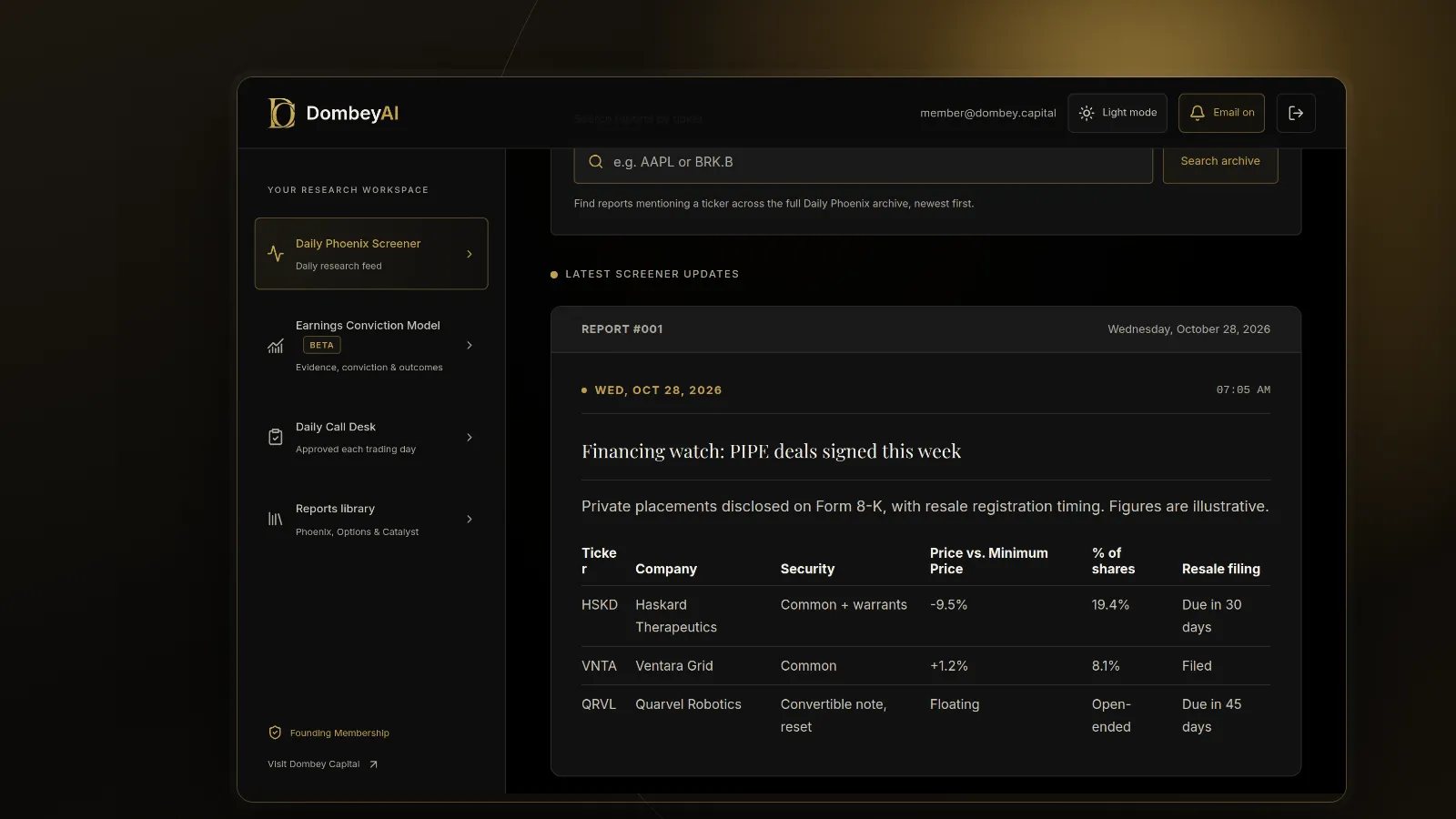
How a PIPE deal works
A PIPE has four moving parts.
- The placement agent and the wall-cross. A bank acting as placement agent contacts a short list of funds and asks whether they will receive confidential information. Investors who agree are "brought over the wall" and cannot trade the stock until the deal is announced.
- The securities purchase agreement. The company and investors sign an agreement setting the security, the price, the number of shares and any warrants. Closing usually follows within a few days, subject to conditions such as stock exchange approval or a shareholder vote.
- The exemption. The sale is not registered with the SEC at closing. Most PIPEs rely on Section 4(a)(2) of the Securities Act and the safe harbor in Regulation D Rule 506(b), which is why buyers are usually accredited or institutional investors. The company files a Form D notice within 15 days after the first sale.
- Registration rights. Because the shares are restricted, the agreement usually requires the company to file a resale registration statement, often on Form S-3 or an S-1, by a set date and to get it declared effective by another. Missing those dates can trigger cash penalties.
Once the resale registration is effective, PIPE investors can sell into the market. If it never becomes effective, Rule 144 generally lets non-affiliates of a reporting company that is current in its filings resell restricted shares after six months. Our explainer on Form 144 covers the notice affiliates file when they sell under that rule.
Types of PIPE
Not every PIPE is the same deal. The security sold decides who bears the risk.
| Structure | What investors buy | Price set | Main risk for existing holders |
|---|---|---|---|
| Common stock PIPE | Common shares | Fixed at signing | One-time dilution at the deal price |
| Common plus warrants | Shares plus warrants to buy more | Fixed, with a warrant strike | Extra dilution if the stock rises above the strike |
| Pre-funded warrants | Warrants with a nominal exercise price | Fixed | Same economics as shares, used to keep a buyer under an ownership cap |
| Convertible preferred or notes, fixed price | A security convertible at a set price | Fixed conversion price | Dilution on conversion, plus seniority over common |
| Structured or reset convertible | A convertible whose price adjusts down | Floats with the market | Dilution grows as the price falls |
The first three are usually called traditional PIPEs. The last is often called a structured PIPE. When the conversion price can reset with no floor, it is sometimes called a toxic or death spiral convertible, because conversions and resales can push the price lower and lead to still more shares.
The rules that shape a PIPE
Exchange shareholder approval limits
Nasdaq Rule 5635(d) generally requires shareholder approval for a private issuance of 20% or more of the common stock or voting power outstanding before the deal at a price below the Minimum Price. The Minimum Price is the lower of the Nasdaq Official Closing Price immediately before signing and the average Nasdaq Official Closing Price for the five trading days before signing. The NYSE has a comparable 20% rule.
This explains two common features of PIPE terms. Many deals are sized just under 20% of the share count, or priced at or above the Minimum Price, to avoid a vote. Others close in two tranches, with the second conditional on shareholder approval.
Disclosure
A PIPE usually produces a Form 8-K. Item 1.01 covers entry into a material definitive agreement, such as the purchase agreement. Item 3.02 covers unregistered sales of equity securities and applies once the sale reaches 1% of the class outstanding, or 5% for a smaller reporting company. Our guide to reading an 8-K for catalysts shows where the exhibits sit. The resale registration statement later names the selling holders and the number of shares each may sell.
Short selling around a PIPE
Investors who are wall-crossed hold material nonpublic information, and trading on it before announcement can be insider trading. The SEC staff has also taken the position that shares bought in a PIPE generally cannot be used to cover short sales made before the resale registration statement is effective. Both points are why a PIPE agreement often includes a representation that the investor has not traded the stock since being contacted.
PIPE compared with other ways to raise equity
A PIPE sits between a fully marketed deal and a quiet drip of shares. A secondary offering reaches a wider group of buyers but takes more time and announces itself. An at-the-market offering sells shares at market prices over weeks, with no single-day discount. A rights offering lets existing holders buy first, so they can avoid dilution if they take up their rights.
The PIPE's advantages for the company are speed, certainty and the chance to bring in a chosen investor. Its costs are the discount, any warrants, and the overhang of restricted shares that may come to market later.
PIPEs also appear in de-SPAC mergers, where investors commit cash alongside the SPAC trust. The SPAC trust value explainer walks through how a PIPE changes the cash per share in that setting.
A worked example
Now look at it from an existing holder's side.
- Ownership. Shares rise from 40 million to 47.6 million. A holder of 1% of the old count now owns about 0.84%.
- Cash per share. If Company A had $30 million of cash before the deal, it now has about $93.7 million, or about $1.97 per share against $0.75 before. For a company burning cash, that changes the cash runway and the near-term risk.
- Warrants. If the stock later trades above $11.00 and the warrants are exercised, the count rises to 51.4 million, and the company receives another $41.8 million.
- Overhang. When the resale registration statement goes effective, 7.6 million shares, about 16% of the new count, can be sold at once.
Now take Company B, also hypothetical, which sells a convertible note whose conversion price resets to 85% of the lowest recent price. At $4.00 a $10 million note converts into about 2.9 million shares. If the stock falls to $2.00, the same note converts into about 5.9 million. The dilution doubles exactly when the company is weakest, which is the core risk of a reset structure.
What a PIPE tells you about the stock
A PIPE is a dated event with several signals worth reading. Our explainer on dilution and share count changes covers how to measure the effect over time.
- If the lead investor is a long-term fund or a strategic partner, the deal may support the stock, because it validates the business and removes financing risk.
- If the discount is wide and the deal includes full warrant coverage, the company likely had few alternatives.
- If the security is a reset convertible, treat the share count as open-ended and read the conversion formula before anything else.
- If the deal closes in two tranches pending a vote, the second tranche is a separate dated catalyst with its own risk.
- If the resale registration statement has just gone effective, expect supply from investors who bought at a discount and may want to lock in a gain or hedge.
For recent examples of how financing news moves single stocks, see today's biggest stock moves.
Where this goes wrong
Reading only the headline price. A PIPE "at the market" with warrants and a fee can cost existing holders more than a smaller deal at a modest discount. Add up the fee, the discount and the warrant coverage.
Ignoring the resale registration date. The restricted shares do not disappear. Track when the registration statement is filed and when it goes effective, because that date can matter more for supply than the announcement.
Missing reset terms. Conversion price adjustments, most-favored-nation clauses and price protection on warrants can change the share count long after closing. They sit in the exhibits, not the press release.
Assuming a strategic investor means a takeover. A company buying a stake through a PIPE may simply want a partnership. Treat any change-of-control inference as speculation unless the filings say otherwise.
Counting proceeds as value created. Cash raised at a discount to fund losses can reduce value per share even as it lowers bankruptcy risk.
Dombey's published research reads PIPE terms and resale timing before each catalyst; see the research archive.
The bottom line
A PIPE is a private sale of a public company's securities to a few selected investors at a negotiated price, usually at a discount and often with warrants. It relies on the private placement exemption, so the shares start out restricted and become tradable once a resale registration statement is effective or Rule 144 applies. Exchange rules, such as Nasdaq's 20% rule, shape the size and price. Read the purchase agreement for the security and any reset terms, then track the resale registration date as its own event.