

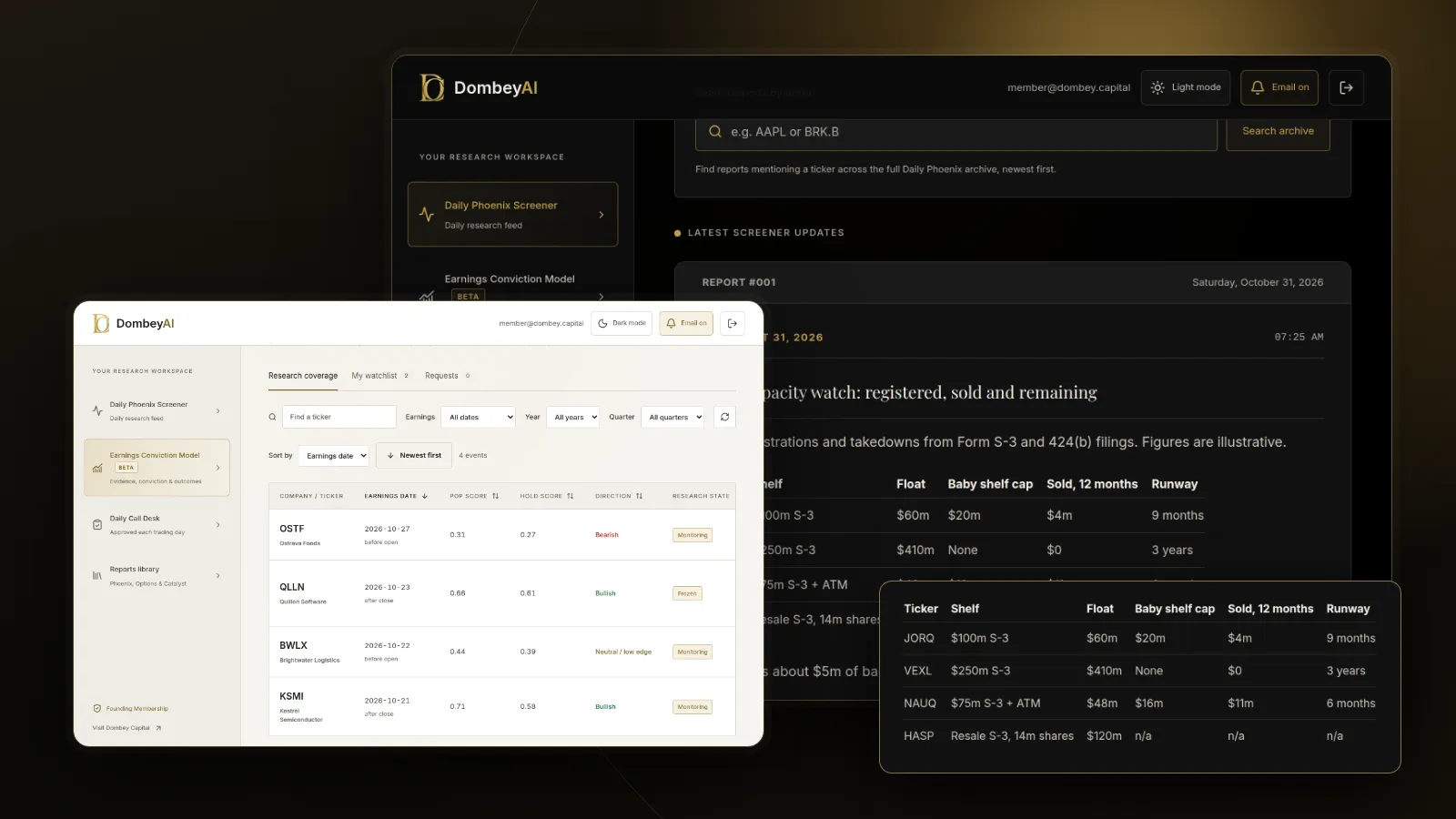
How a shelf registration works
SEC Rule 415 permits registration of securities to be offered on a delayed or continuous basis. The company files a base prospectus describing the types of securities it may sell, often common stock, preferred stock, debt, warrants and units, and a maximum dollar amount. Once the SEC declares the registration effective, the securities sit on the shelf.
When the company wants to raise money, it takes securities down from the shelf. It files a prospectus supplement under Rule 424(b) with the terms of that sale: the number of shares, the price, the underwriters and the use of proceeds. Because the registration is already effective, a sale can happen within a day.
Rule 415 limits the time: for automatic shelves and most primary shelf offerings on Form S-3, securities may be sold only within three years of the initial effective date. Companies that want to stay ready file a replacement shelf before the old one runs out.
Who can use Form S-3
Form S-3 is a short form because it incorporates the company's existing SEC reports by reference rather than repeating them. Eligibility has two parts: the company must qualify, and so must the transaction.
| Requirement | What it says | Why it matters to investors |
|---|---|---|
| Reporting history | Reporting under the Exchange Act for at least 12 calendar months | New public companies must use the longer Form S-1 |
| Timely filing | All required reports filed on time over the prior 12 months, with limited exceptions | A late 10-K or 10-Q can cost a company its S-3 eligibility |
| No material defaults | No missed preferred dividends or material debt defaults since the last audited year | Distressed companies may lose fast access to capital |
| Public float of $75 million or more | Unlimited primary offerings | Larger companies can raise as much as the market will take |
| Baby shelf, float under $75 million | Listed on a national exchange, not a shell, sales capped at one-third of float in 12 months | Caps how fast a small company can sell stock |
| Well-known seasoned issuer | $700 million of worldwide float, or $1 billion of non-convertible securities issued in three years, among other tests | Can file an automatic shelf effective on filing |
The timely filing test is easy to overlook. A company that files an NT 10-K and then misses the extended deadline can lose access to Form S-3 for a year, which forces any capital raise onto the slower Form S-1. Our explainer on the S-1 filing covers that longer form.
Types of shelf registration
- Universal shelf. Registers several types of securities up to one total amount, so the company can choose stock or debt later.
- Automatic shelf. Available to well-known seasoned issuers. It becomes effective on filing, without SEC review, and the company need not register a fixed amount.
- Resale shelf. Registers shares held by existing investors, typically buyers in a PIPE deal or holders of convertible securities, so they can sell freely. The company receives nothing from those sales.
- At-the-market program. A prospectus supplement off the shelf that lets the company sell shares gradually into the market. Our explainer on the at-the-market offering covers it in detail.
Takedowns and the prospectus supplement
The prospectus supplement is the document that matters when a sale happens. It names the offering type, which might be a marketed or overnight follow-on offering, a registered direct offering or an ATM. It states the size, any warrants attached and the use of proceeds.
On EDGAR, look for filings labeled 424B2, 424B3, 424B4 or 424B5, alongside an 8-K announcing the deal. Our guide on how to search SEC EDGAR filings shows how to set up alerts for a company's filings.
How to read a shelf filing
A shelf filing on EDGAR is short compared with an S-1, because most information is incorporated by reference. Five checks cover what matters:
- The amount and the securities. The fee table and cover page show the maximum dollar amount and whether the shelf covers stock, debt, warrants or all of them.
- The eligibility basis. If the prospectus mentions General Instruction I.B.6, the company is relying on the baby shelf and its sales are capped.
- Any sales agreement. A sales agreement or equity distribution agreement filed alongside the shelf means an ATM program is ready to start.
- Use of proceeds. Usually general corporate purposes, but a named use, such as repaying a loan or funding a trial, says where the cash is going.
- Selling stockholders. A resale shelf lists the holders and the number of shares each may sell.
What a shelf filing tells investors
The same filing means different things for different companies.
- If the company is large, profitable and has had a shelf in place for years, a renewal is routine and usually carries no signal.
- If the company is burning cash and its cash runway is under 18 months, a new shelf usually precedes a sale.
- If the company is close to the $75 million float line, check whether it is relying on the baby shelf and how much of its one-third capacity remains.
- If a resale shelf covers a large share of the float, expect new supply when it becomes effective.
- If the shelf is paired with a sales agreement for an ATM, assume shares will be sold gradually into the market.
Turn each figure into a per-share effect with our guide to dilution and share count changes.
Where this goes wrong
The shelf amount is a ceiling, not a plan. Companies often register far more than they ever sell, and large companies may never take anything down. Reading every shelf as an imminent sale will produce many false alarms. The opposite mistake is worse for small companies: assuming no sale is coming because nothing has been announced, when an ATM can sell shares for months before the next 10-Q reports them. The baby shelf cap also moves, because it is based on public float, which rises and falls with the share price.
For tools that track filings and capital raises, see our list of the best stock research tools for individual investors. Dombey's published research tracks shelf capacity and share count changes before each catalyst; see the research archive.
The bottom line
A shelf registration registers securities in advance so a company can sell them quickly later, and Form S-3 is the short form most reporting companies use. Eligibility depends on a year of timely reporting and, for unlimited primary sales, a $75 million public float, with the baby shelf cap for smaller listed companies. Read each shelf against the company's cash needs: for a well-funded company it is usually routine, while for a cash-burning one it often marks the next round of dilution.