

The formula
Enterprise value is the price of the whole business, independent of how it is financed:
Enterprise value = market capitalization + debt + preferred stock + minority interests − cash and short-term investments
When the cash term is larger than the other terms combined, the result is negative. In practice this happens almost only at small companies with few liabilities and a large cash balance, often after an asset sale, a failed drug trial, a wound-down business or a large financing that the market no longer trusts.
| Term | Where to find it | Common error |
|---|---|---|
| Shares outstanding | 10-Q or 10-K cover page | Using the weighted average, which lags |
| Market capitalization | Shares times current price | Ignoring a second share class |
| Debt | Balance sheet, debt note | Missing convertible notes |
| Preferred stock and minority interests | Balance sheet, equity note | Leaving them out entirely |
| Cash and investments | Balance sheet, investments note | Counting restricted cash |
| Leases and other claims | Lease note, contingencies note | Treating them as zero |
What negative enterprise value tells you
The plain reading is that the market thinks the business is worth less than nothing. That can be true. A business that loses money every quarter has a negative value to its owners, because it consumes the cash they would otherwise receive.
A second reading is about access. Shareholders do not own the cash directly. The board and management decide what happens to it. If they plan to spend it on a new venture, an acquisition or years of losses, shareholders may never see it. The discount prices that risk.
A third reading is neglect. Some of these companies are tiny, thinly traded and ignored by analysts and funds. Their price can sit below cash simply because no one large enough to correct it is looking. This is the case value investors hope for, and the hardest to confirm.
A worked example
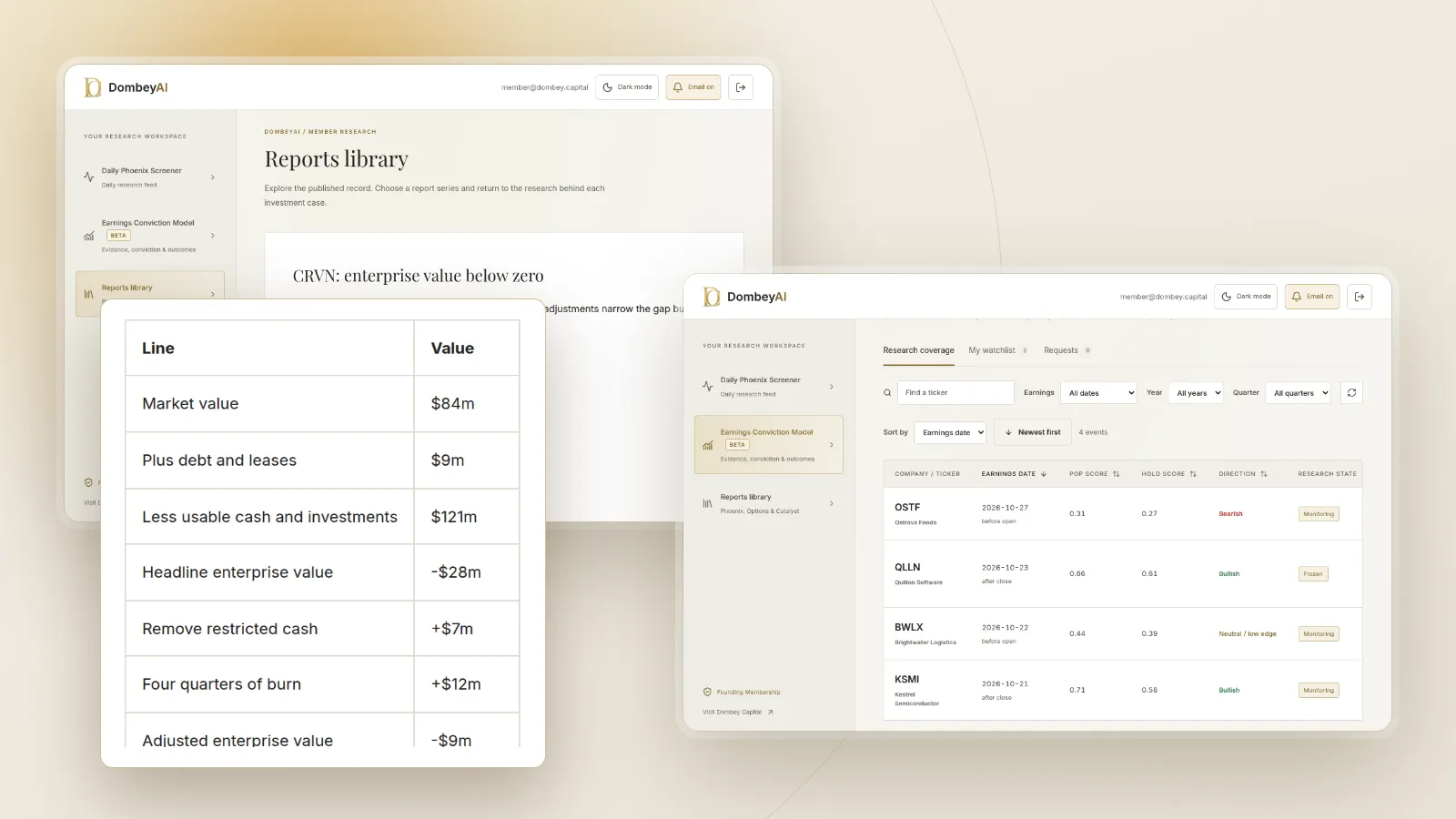
The headline says the market values the business at minus $40 million. Now adjust:
- The investments note shows $12 million of the cash is restricted as collateral. Usable cash falls to $138 million.
- The lease note shows $8 million of operating lease liabilities. Add them as a claim.
- The contingencies note discloses a lawsuit the company describes as reasonably possible to cost $15 million. It is not accrued, but a cautious reader includes it.
- The cash flow statement shows burn of $9 million a quarter. The company says a strategic review will take about four quarters, so expect about $36 million of cash to be spent before any outcome.
Adjusted figure: $100m + $10m + $8m + $15m − ($138m − $36m) = $31 million. On the adjusted numbers, enterprise value is positive. The market is not paying zero for the business; it is paying a modest price for a cash pile that is shrinking. This is the gap between a screen and a filing.
Why companies trade below cash
Most cases fall into a small set of reasons. Knowing which one applies tells you what would have to change.
- Cash burn. The most common reason. A company that loses money will reduce its cash until the discount disappears, without the share price moving.
- Failed core asset. A biotech after a failed trial, or a company that sold its only business. The market expects management to spend the cash on a new idea.
- Trapped cash. Cash held in a foreign subsidiary, in escrow, or as collateral is not freely available to shareholders.
- Legal or tax claims. Pending litigation, indemnities from an asset sale or tax disputes can consume a large share of the cash.
- Control. A founder or parent company with majority voting control may have no interest in returning cash.
- Neglect. Low volume, no analyst coverage, an exchange delisting or a foreign listing keep many investors away.
How to check a negative enterprise value stock
Start with the filings, not the screen. Our guide to finding stocks trading below net cash covers the screening step, and net cash per share covers the per-share math. Then work through these checks:
| Step | What to check | Where to find it |
|---|---|---|
| 1 | Current share count, including all classes | 10-Q or 10-K cover page |
| 2 | Restricted versus usable cash | Balance sheet, cash flow reconciliation |
| 3 | All claims ahead of common stock | Debt, lease, preferred and contingencies notes |
| 4 | Quarterly cash burn and the trend | Cash flow statement, year to date less prior |
| 5 | Dilution sources: options, warrants, convertibles | Equity note, 10-K exhibits |
| 6 | What management says it will do with the cash | MD&A liquidity section, 8-Ks, proxy |
| 7 | Who controls the vote | Proxy statement ownership table |
| 8 | Any dated event that would release the cash | 8-Ks, proxy, tender offer filings |
The 10-Q reading guide walks through steps 1 to 4 in detail, and how to search SEC EDGAR filings shows how to pull every filing you need.
What closes the gap
A discount to cash closes for one of four reasons, and only some of them help shareholders.
- If the company returns cash, through a special dividend, a tender offer or a buyback below net cash, the gap closes in shareholders' favor.
- If the company liquidates, shareholders receive the remaining cash after claims, often in stages. See what a liquidation play is for how wind-downs are valued.
- If the company is sold, a buyer usually pays at least the cash, though a tender offer or merger price can still come in below the cash figure an investor calculated.
- If the company spends the cash, the gap closes because the cash is gone. The share price may not move at all, or may fall.
The first three are catalysts. The fourth is the risk. A negative enterprise value without a likely catalyst is a special situation waiting for an event that may never come.
Where this goes wrong
The screen data is stale or incomplete. Data providers often lag a quarter, miss restricted cash or leave out leases and preferred stock. A company can show negative enterprise value on a screen and positive enterprise value in its latest filing.
Burn is underestimated. One quarter's burn is not a forecast. Severance, lease exits and legal costs often rise in the quarters after a company winds down a business.
Dilution arrives first. A company with negative enterprise value and ongoing losses may raise equity, which lowers value per share even if the cash per company rises.
Management has other plans. A board can use the cash for an acquisition outside its field, a reverse merger with a private company, or years of experiments. None of these returns cash to holders.
The discount is permanent. Some companies trade below cash for many years. Without a catalyst, the time cost can outweigh the discount.
Common mistakes
- Using total liabilities or only debt without deciding which. Pick a definition and apply it consistently. A conservative check subtracts all liabilities.
- Treating restricted cash as usable. It is committed to a purpose.
- Ignoring the share count date. A financing after quarter end can change the per-share figure sharply.
- Skipping the proxy. Ownership and board control often explain the discount better than the balance sheet.
- Confusing cheap with catalyzed. A cheap stock with no event can stay cheap.
Dombey's published research applies these adjustments before each catalyst; see the research archive.
The bottom line
Negative enterprise value means a company's cash exceeds its market value plus its debt and senior claims, so the market is pricing the business below zero. It is a prompt for research, not a conclusion. Adjust for restricted cash, leases, preferred stock, contingencies and burn, then look for the reason the discount exists. The cases worth attention are the ones with a dated event that would put the cash in shareholders' hands.