

How a rights offering works
The mechanics follow a set sequence. The prospectus filed with the SEC sets the dates and terms.
- Announcement. The company announces the offering, usually with a Form 8-K and a registration statement or prospectus supplement. It names the subscription price, the ratio of rights to new shares, the record date and the expiration date.
- Record date. Shareholders of record on this date receive the rights. The stock goes ex-rights around this date: buyers after that point do not receive rights.
- Subscription period. Holders decide what to do. The period is commonly a few weeks. If the rights are transferable, they trade separately, often on the same exchange as the stock.
- Expiration. Unexercised rights lapse. Brokers usually set an earlier internal deadline, so the real decision date can be several days before the official one.
- Allocation and issue. Shares are issued to holders who exercised, then any oversubscription requests are filled, then any backstop party buys what is left.
Transferable and non-transferable rights
Transferable rights, sometimes called renounceable rights, can be sold. A holder who does not want to invest more can sell the rights and recover most of the value of the discount. Non-transferable rights cannot be sold, so a holder who does not exercise simply loses the value. Non-transferable structures put more pressure on holders to participate or be diluted.
Oversubscription and backstops
An oversubscription privilege lets holders who exercise in full ask for extra shares that others leave on the table. A backstop is a commitment from one or more investors, often existing large holders, to buy any shares not taken up, so the company knows it will raise the full amount. Backstop parties usually receive a fee, paid in cash or extra shares.
The math: ex-rights price and the value of a right
The figures below are illustrative. Company A is hypothetical.
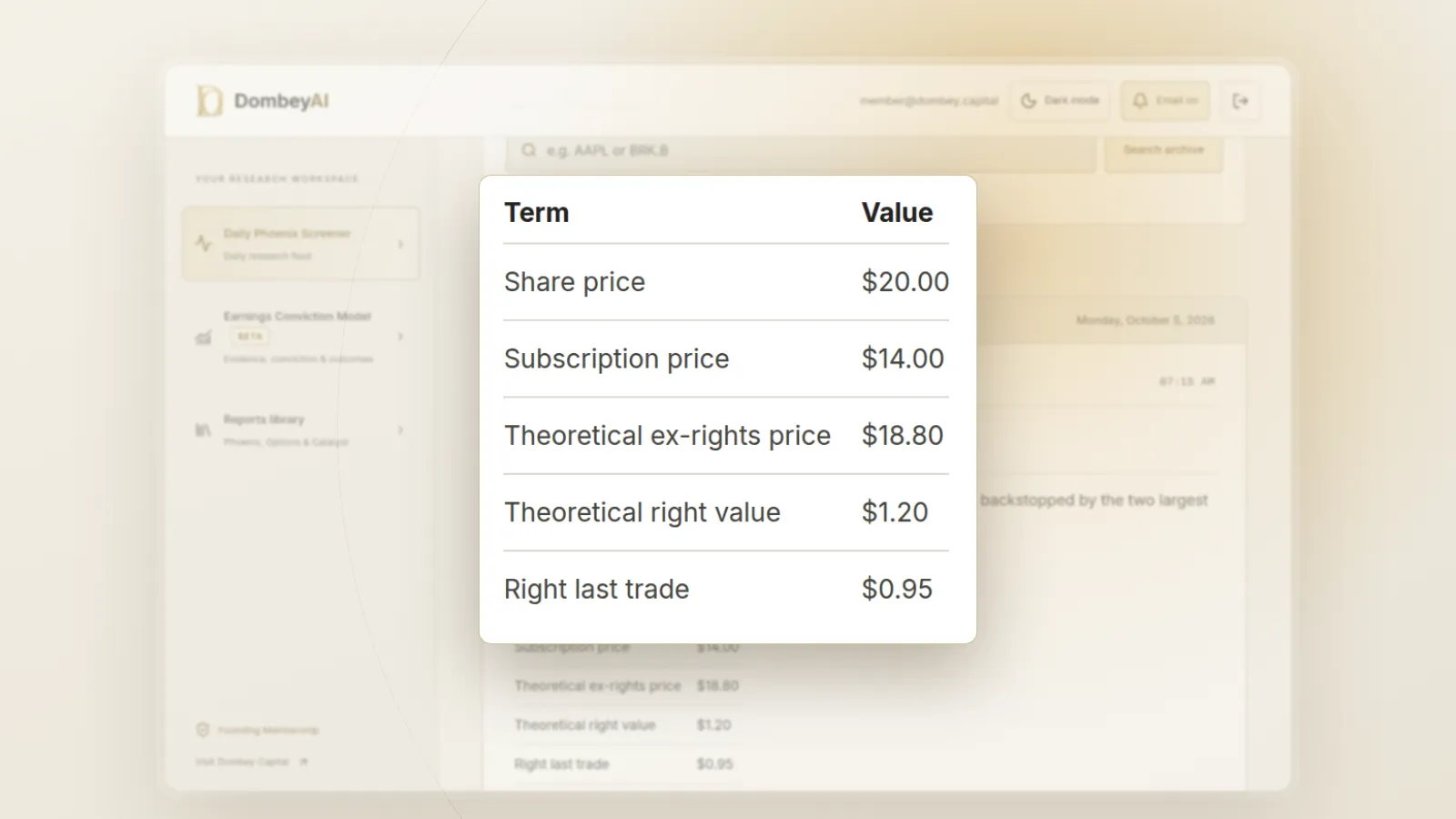
A holder of 400 shares starts with $8,000 of stock. After the stock goes ex-rights, the position is worth:
- Exercise: 500 shares at $18.80 = $9,400, after paying $1,400 in cash. Net wealth unchanged at $8,000 plus the $1,400 contributed.
- Sell the rights: 400 shares at $18.80 = $7,520, plus 400 rights at $1.20 = $480. Total $8,000. Wealth unchanged, ownership share reduced.
- Do nothing: 400 shares at $18.80 = $7,520. The $480 is lost.
The discount itself does not create value. It moves value between holders who participate and holders who do not. In practice, rights often trade away from their theoretical value, and the stock rarely sits exactly at the theoretical ex-rights price.
Quick reference: terms that change the outcome
| Term | What it means | Why it matters |
|---|---|---|
| Subscription price | Price paid per new share | A deeper discount raises the cost of not participating |
| Ratio | Rights needed per new share | Sets how much new capital each holder must commit |
| Transferable rights | Rights can be sold | Lets holders who will not invest recover value |
| Oversubscription privilege | Extra shares for full exercisers | Shifts ownership toward committed holders |
| Backstop and fee | Investor commits to buy unsold shares | Secures the raise; the fee is a cost to other holders |
| Record and expiration dates | Who gets rights and when they lapse | Missing the broker deadline means the rights expire |
| Use of proceeds | What the money is for | Separates growth funding from survival funding |
Why rights offerings can be special situations
Most rights offerings are routine capital raises. A few become opportunities, for reasons that follow from the structure.
Forced selling of rights. Many holders, especially index funds and investors in small positions, sell their rights or let them lapse rather than commit new money. When transferable rights trade, selling pressure can push them below their theoretical value, so buying rights can be a cheaper way into the stock than buying shares.
Restructuring rights offerings. In a Chapter 11 reorganization, creditors are often offered the right to buy new equity in the reorganized company at a discount to the plan's estimated value. Backstop parties commit to fund the offering and are paid a fee, frequently in shares. The equity can be priced conservatively because the plan value is negotiated among parties who want to buy in cheaply.
Signals about insiders. If directors and large holders exercise in full, or backstop the offering themselves, they are putting new money in at the same price as everyone else. If they do not, that is worth noting.
Underpriced deals for cash-rich companies. Occasionally a company with large assets, such as one trading below net cash per share, raises capital through rights at a deep discount, and holders who participate end up owning more of the same assets for less.
Rights offerings sit close to two other corporate actions that use similar mechanics: tender offers, where the company buys shares rather than sells them, and spin-offs, where shareholders receive a pro rata distribution of a new company.
What to check before deciding
| Step | What to check | Where to find it |
|---|---|---|
| 1 | Subscription price, ratio and expiration date | Prospectus supplement, Form 8-K |
| 2 | Whether rights are transferable and where they trade | Prospectus, exchange notice |
| 3 | Your broker's internal deadline | Broker corporate actions notice |
| 4 | Use of proceeds | Prospectus, MD&A liquidity section |
| 5 | Backstop parties, fees and their allocation | Backstop agreement, filed as an exhibit |
| 6 | Insider participation | Prospectus, later Form 4 filings |
| 7 | Cash and debt before and after | Latest 10-K and 10-Q |
- If the money funds survival and the business is still burning cash, treat the offering as a warning and ask how long the new cash lasts.
- If the rights trade below their theoretical value and you want exposure to the stock, compare the cost of buying rights and exercising with buying shares outright.
- If a backstop party receives a large fee in shares, include those shares when calculating dilution.
- If you do not want to invest more and the rights are transferable, selling them usually beats letting them lapse.
Where this goes wrong
- Missing the deadline. Broker deadlines come before the official expiration, and lapsed rights are worth nothing.
- Assuming the discount is a gift. The discount only offsets dilution for holders who participate. It is not a free gain.
- Ignoring the reason for the raise. A company that needs money to stay solvent can need more later. Read the liquidity section of the filings, not just the offer terms.
- Overlooking backstop economics. Fees paid in shares and preferential allocations can transfer value from ordinary holders to the backstop group.
- Thin trading in the rights. Rights on small companies can be illiquid, with wide spreads that erase any mispricing.
- Tax and account issues. Rights in tax-advantaged or foreign accounts can be handled differently by brokers. Check before the deadline, not after.
Dombey's published research reads the offering documents, backstop terms and liquidity together before any capital raise it covers; see the research archive.
The bottom line
A rights offering lets existing shareholders buy new shares in proportion to their holdings, usually at a discount to market. The discount moves value from holders who do nothing to holders who exercise or sell their rights, so doing nothing is the only certain way to lose. The theoretical ex-rights price and right value are simple to calculate, but backstops, oversubscription and transferability decide who owns the company afterward. Read the prospectus, the use of proceeds and the backstop terms before the broker deadline.