

Why companies wind down
A board chooses to liquidate when it believes shareholders will get more from selling the pieces than from running the business or selling it whole. Common triggers:
- A failed drug trial or product leaves a company with cash and no path forward.
- A strategic review finds no buyer at a price above the value of the assets.
- A holding company or closed-end vehicle reaches the end of its stated life.
- A business has sold its main operations and holds mostly cash and leftover assets.
In each case the company usually trades near or below its cash, which is why liquidations often surface on a below net cash screen.
How a voluntary liquidation works
The sequence for a US corporation is broadly the same across states, though the details follow state law and the company's own plan.
- Board approval. The board adopts a plan of complete liquidation and dissolution, often after a strategic review.
- Proxy and vote. The company files a proxy statement describing the plan, the expected range of distributions and the risks, then holds a shareholder vote. Our guide to reading a proxy statement covers where these figures sit.
- Certificate of dissolution. After approval, the company files with its state. Many companies close their stock transfer books at this point, so the shares stop trading.
- Asset sales and claims. The company sells what it owns, settles known liabilities and sets aside a reserve for contingent and unknown claims.
- Distributions. It pays an initial distribution, then further ones as assets are sold and claims expire.
- Final distribution. Once the reserve is no longer needed, the remainder is paid and the company ends.
The accounting changes too. Once liquidation is imminent, US GAAP requires the liquidation basis of accounting. Instead of a normal balance sheet, the company reports a statement of net assets in liquidation, with assets at the amount it expects to collect and accrued costs of the wind-down recorded up front.
Valuing the payout: a worked example
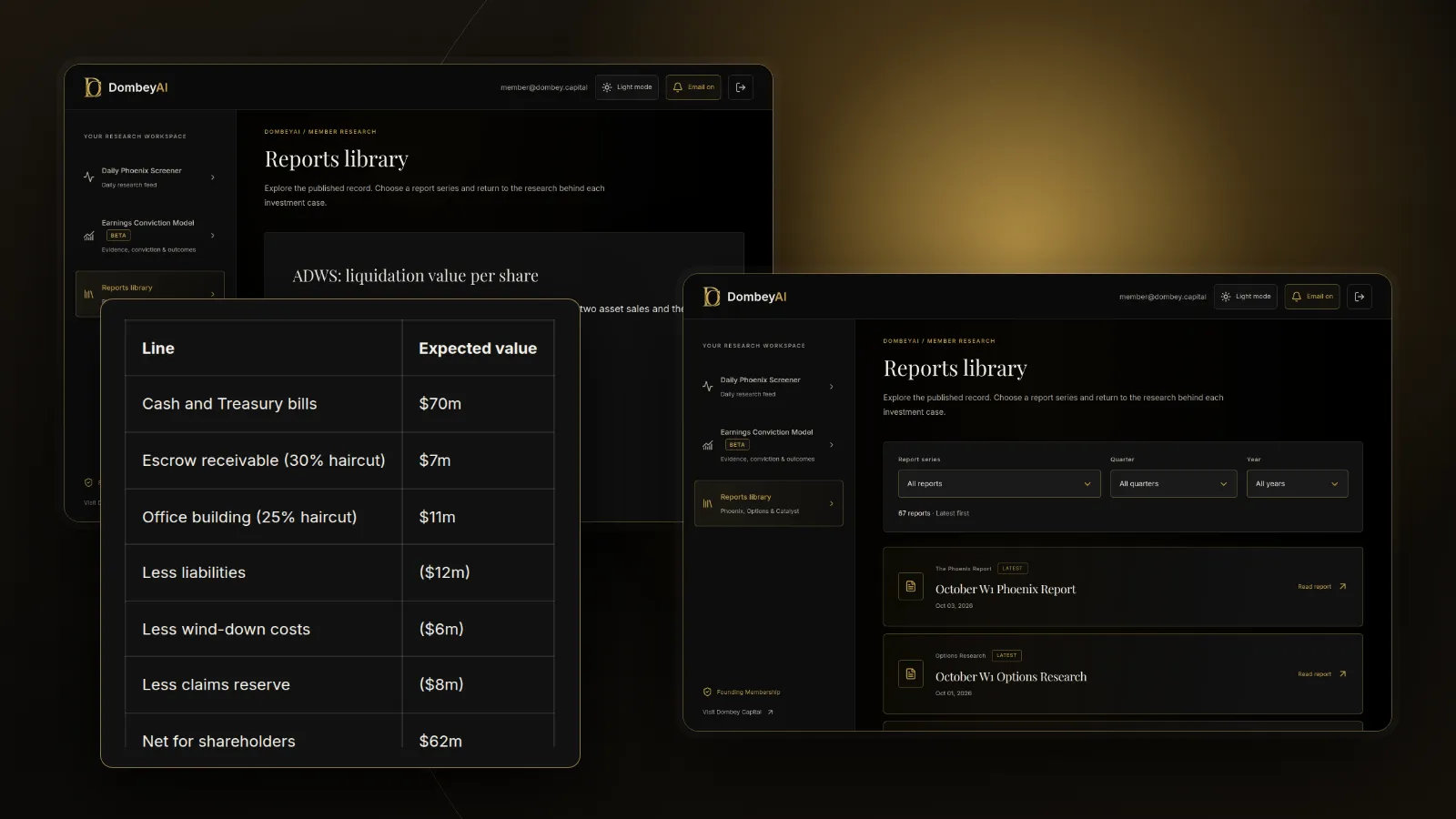
The figures below are illustrative. Company A is hypothetical.
Company A has sold its operating business and adopted a plan of dissolution. It has 20 million shares outstanding and trades at $4.00.
| Line | Book value | Haircut | Expected value |
|---|---|---|---|
| Cash and Treasury bills | $70m | 0% | $70m |
| Receivable from asset sale escrow | $10m | 30% | $7m |
| Office building | $15m | 25% | $11m |
| Patents and other assets | $5m | 80% | $1m |
| Total liabilities | ($12m) | none | ($12m) |
| Wind-down costs (staff, legal, audit, insurance) | none | none | ($6m) |
| Reserve for contingent claims | none | none | ($8m) |
| Net amount for shareholders | $63m |
That works out to $63m divided by 20 million shares, or $3.15 a share. At $4.00, the stock is already above it, so on these assumptions the market is more optimistic than the estimate. Change the haircuts and the answer moves: with no haircut on any asset and the full reserve released, the total is $82m, or $4.10 a share. The $4.00 price sits close to that best case.
The steps generalize:
- Start from the statement of net assets in liquidation, or the latest balance sheet if the company has not switched yet.
- Apply a haircut to every asset that is not cash, based on how easy it is to sell.
- Subtract all liabilities at face value, plus wind-down costs and the claims reserve.
- Divide by shares outstanding from the cover page of the latest filing.
- Split the total into dated payments and discount each to today.
Where the value comes from
The haircuts carry most of the judgment. A simple guide by asset type:
- Cash and short-term Treasuries. Close to face value. Check for restricted cash, which may not be available.
- Receivables and escrows. Discount for collection risk and for any indemnity claims the buyer of the business could make against the escrow.
- Real estate. Depends on the local market and the type of property. Specialized buildings sell slowly and at a discount.
- Inventory and equipment. Often sold well below book value in a forced sale.
- Intellectual property. Highly uncertain. Many liquidations assign it little or nothing and treat any sale as upside.
- Tax assets. Net operating losses usually have no value in a liquidation, since there will be no future income to shelter.
This is the same discipline as calculating net cash per share, extended to the non-cash assets and to the costs of closing down. It also explains why a stock can trade well below book value: price to book uses accounting values, while a liquidation pays out realized values.
Reading the plan and the proxy
The proxy for the dissolution vote is the most useful single document. Look for:
- The estimated range of distributions per share, with the assumptions behind the low and high ends.
- The timing of the first distribution and the expected life of the wind-down.
- The contingency reserve, how it is sized and when it can be released.
- Wind-down costs, including retention bonuses and severance for the remaining staff.
- Trading and reporting plans, such as when the transfer books close and whether the company will keep filing reports with the SEC.
- Known claims, including litigation, lease obligations and indemnities given to buyers of earlier assets.
Later filings, such as each quarterly report during the wind-down, update the statement of net assets in liquidation. Compare each update with the last one to see whether the estimate is rising or falling.
Where this goes wrong
- Asset sales take longer than planned. Every extra year cuts the present value of the payout, even if the total is unchanged.
- Costs creep up. Legal, audit, insurance and staff costs run every month the company exists. A two-year wind-down can cost far more than a six-month one.
- Claims appear. Litigation, warranty or environmental claims, or indemnities owed to past buyers can absorb the reserve and more.
- Reserves are held back. Boards and directors have reasons to be cautious, and the final distribution can arrive years after the first.
- Liquidity dries up. Once the transfer books close, you cannot sell. You hold a claim on future payments, not a tradable share.
- The vote fails or the plan changes. Shareholders can reject the plan, or a buyer can appear with a different deal, which may be better or worse than the liquidation estimate.
Liquidation plays at a glance
| Question | Where to find it | What to check |
|---|---|---|
| How much cash is there? | Balance sheet or statement of net assets in liquidation | Restricted cash, short-term investments |
| What will the other assets fetch? | Notes, MD&A, asset sale agreements | Buyer terms, escrow and indemnity clauses |
| What does closing down cost? | Proxy, liquidation basis accruals | Retention bonuses, leases, insurance |
| How large is the claims reserve? | Proxy, later quarterly reports | Release dates, pending litigation |
| When will cash be paid? | Proxy, 8-K announcements of distributions | Record dates, payment dates |
| Can I still trade the stock? | Proxy, certificate of dissolution announcement | Transfer book closing date |
How it fits with other special situations
A liquidation sits between a stock trading below cash and a deal with a fixed payout. Like merger arbitrage, the outcome is defined by documents and dates, and the analysis rests on what is paid and when. Unlike a merger, there is no single closing price; the payout arrives in pieces and its total is an estimate. Many liquidation candidates also show a low or negative enterprise value, which is often how they are first found.
Dombey's published research applies this same asset-by-asset method before each catalyst; see the research archive.
The bottom line
A liquidation play earns the gap between today's price and the cash a winding-down company will return. Value it from the assets down: cash, haircut asset sales, all liabilities, wind-down costs and a claims reserve, divided by the share count. Then put dates on each payment and discount them, because time is the most common reason a cheap-looking liquidation disappoints. The proxy and the statement of net assets in liquidation tell you most of what you need.