

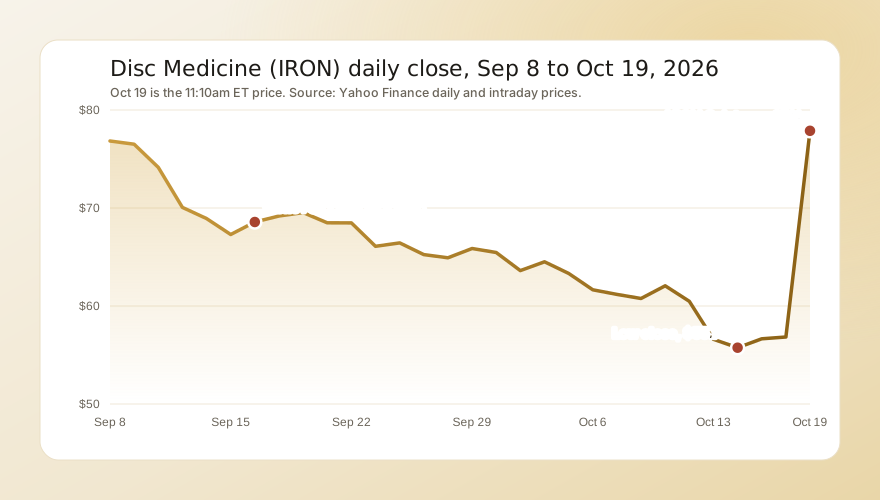
Oct 19, 2026: a premarket run, a fade, then a climb to the day's high
The stock moved before any results were out. Its first premarket trade at 4am was $62.80, 10.5% above Friday's close, and by about 6am it was up roughly 30%. Seeking Alpha and GuruFocus both tied that early rise to the company's notice of an 8am webcast on the APOLLO results, which investors read as a sign the data were in.
The 8-K with the results was accepted by the SEC at 7:08am. In thin premarket trading the stock briefly printed as high as $102.75, then slid back, and the last premarket trade before the bell was $73.00. It opened at $72.70, fell to its low of $69.98 at 9:46am, and then climbed for the rest of the morning to a high of $80.22 at 11:01am. At 11:10am it was $77.88 on 5.0 million shares, about eight times its 20-day average volume.
What pushed it up:
- Every endpoint hit. Both co-primary endpoints and all three secondary endpoints were statistically significant, including a 71% cut in the rate of painful phototoxic reactions.
- The FDA's objection answered. The complete response letter asked for evidence on clinical endpoints from an adequate and well-controlled trial. APOLLO measured time in light without pain directly.
- Short sellers on the wrong side. Short interest stood at 7.27 million shares, 25.8% of the float, or about 15 days of normal volume. Our explainer on short interest and squeeze risk covers why that adds fuel to a move like this.
The move was company news, not a sector rally. At 11:10am:
| Stock or fund | Change |
|---|---|
| Disc Medicine (IRON) | +37.0% |
| Agios Pharmaceuticals (AGIO) | +4.2% |
| Protagonist Therapeutics (PTGX) | +1.3% |
| Keros Therapeutics (KROS) | +0.3% |
| SPDR S&P Biotech ETF (XBI) | +1.7% |
| iShares Biotechnology ETF (IBB) | +0.8% |
After the jump, RSI(14) stood at 69, the shares sat 9.5% above their 50-day average and 10.9% above their 200-day average, and they remained 21.3% below the 52-week high of $99.50 set on Dec 8, 2025. More of today's biggest stock moves are on our market page.
The results, in numbers
APOLLO enrolled 183 patients aged 12 and older, 91 on 60 mg of bitopertin and 92 on placebo, for six months. The results from the company's presentation:
| Measure | Result against placebo | p-value |
|---|---|---|
| Whole-blood PPIX at month 6 | -41.4% | <0.0001 |
| Time in light without pain, month 6 | +12.2 hours a month | 0.0010 |
| Rate of phototoxic reactions | -71% | <0.0001 |
| Time in sun before warning symptoms (adults) | +56 minutes | 0.0077 |
Patients' own ratings of change and severity also improved, both with p-values below 0.0001. CEO John Quisel called the result "a potential breakthrough in the science and treatment of EPP."
Why February matters: the rejection and the recovery
On Feb 13, 2026, the FDA issued a complete response letter. It accepted that bitopertin lowers PPIX, but said the earlier AURORA and BEACON trials "did not show evidence of association between percent change in PPIX and sunlight exposure-based endpoints." The stock fell 21.9% that day to $55.95 and touched $40.00, its 52-week low. Our guide to regulatory approvals as catalysts explains how a letter like this resets the timeline.
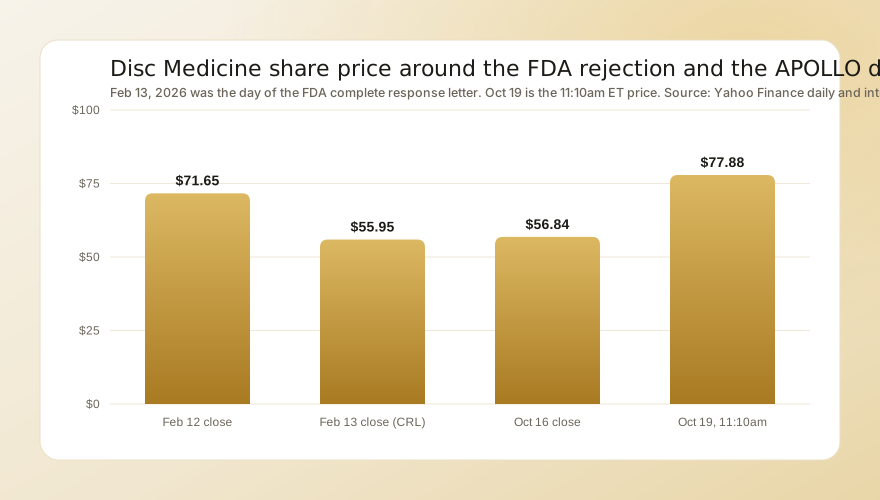
The shares never recovered the loss before today. They closed at $56.84 on Oct 16, and the low close of the past six weeks was $55.74 on Oct 14. One day of trading erased the February drop. At $77.88 the company is worth about $3.0 billion, up from about $2.2 billion on Friday.
The bull case
- A cleaner path at the FDA. The letter's main deficiency was the missing clinical evidence. At a Type A meeting reported in July, Disc said the FDA agreed that a successful APOLLO could serve as the basis of its response.
- No dropouts on the drug. No patient on bitopertin left the study for any reason, and none stopped because of a side effect.
- Cash. $717.7 million at June 30 against a second-quarter net loss of $59.5 million. Cash per share is about $18.70. Our guide on estimating cash runway shows how to check a company's own estimate.
- Room to the targets. The average analyst target is $106, with a range of $86 to $128, 36% above the 11:10am price. Wells Fargo analyst Derek Archila raised his target to $86 from $79 on Sep 16 and kept an Overweight rating.
The risks
- Dizziness. 45 of 91 patients on bitopertin (50%) reported dizziness against 11% on placebo. Nausea (20% against 11%) and fatigue (17% against 7%) also ran higher. The company says the dizziness was mild or moderate and mostly at the start of treatment, but it will be on the label and in prescribers' minds.
- The FDA has said no once. A second review is not a formality, and the decision is not expected until mid-2027. Our page on how FDA decision dates work covers what happens between a resubmission and a decision.
- A share sale. Biotech companies often raise money after a trial win. TIKR's author suggested Disc may add to its cash ahead of a launch. A sale would add dilution, and insiders sold about $106.5 million of stock over the past year, per GuruFocus.
- Sales start small. Analysts expect revenue of $34.9 million in 2027 and $144.2 million in 2028, so the value still rests on years of future sales.
What comes next
- The NDA resubmission, by December 31, 2026. Watch for the FDA's acceptance and a new decision date.
- Full APOLLO data at a medical meeting. The company has not named the meeting. Watch the adolescent results and how long dizziness lasted.
- More selcodebart (DISC-0974) data in myelofibrosis anemia, due in the fourth quarter, with an end-of-Phase 2 FDA meeting expected by year end.
- Any share offering. It would appear first as an 8-K and a prospectus filing. For a way to weigh outcomes like these, see probability-weighted valuation for binary events, and for another biotech waiting on trial news, our note on SELLAS.