

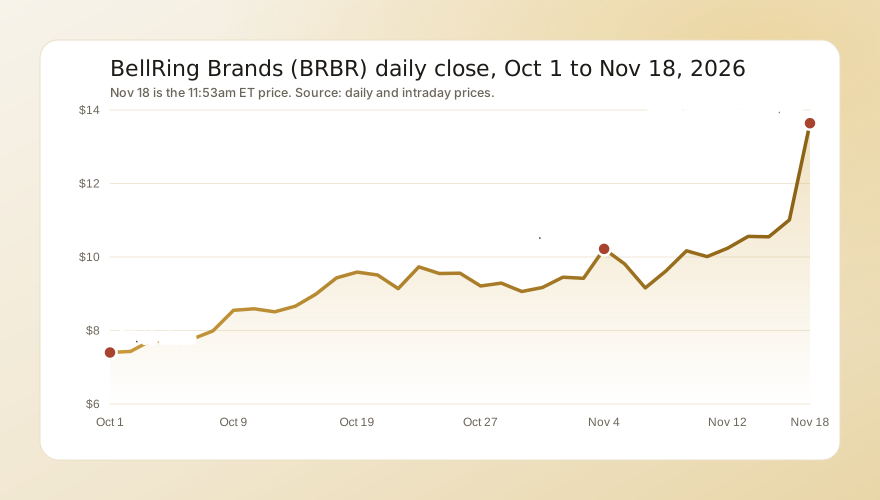
Nov 18, 2026: a 24% jump at the open that held
BellRing closed Tuesday, Nov 17, at $11.01, up 4.4% that day. Extended trading that evening slipped to $10.73. The release came at 7am on Wednesday, and premarket trading first dipped to $10.87 at 6:20am before the outlook drew buyers, reaching $13.53 at 8:55am, 22.9% above the close.
The stock opened at $13.21 and touched $14.02 in the first minutes, 27.3% above the close. It pulled back to $12.82 at 10:05am as some buyers took profits, then recovered. At 11:53am it was $13.64, up 23.8%, on 7.0 million shares, twice its 20-day average for a full session.
What pushed it up:
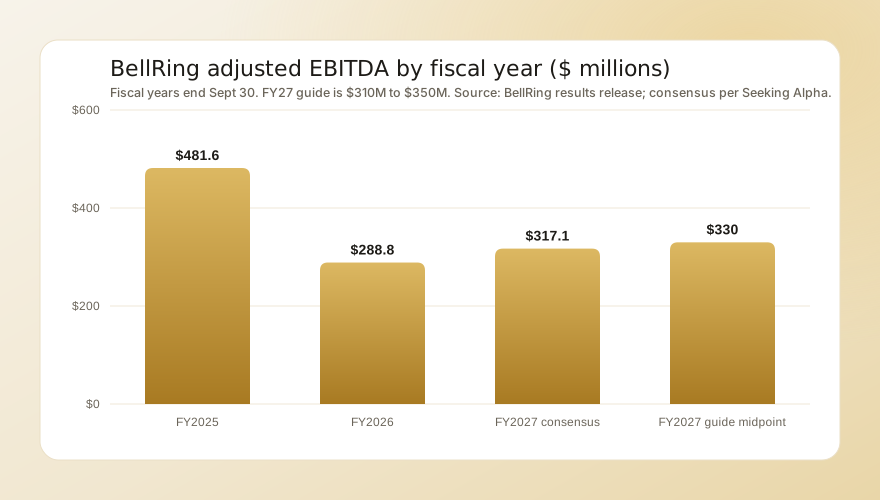
- Profit guidance above estimates. Adjusted EBITDA of $310 million to $350 million has a $330 million midpoint, against the $317.1 million consensus, Seeking Alpha reported.
- A sales beat. Fourth-quarter sales of $692.0 million topped the $658.5 million estimate, on 14.9% higher volume.
- A plan for margins. Management expects nearly 400 basis points of gross margin expansion in fiscal 2027, about $25 million of savings from a program targeting at least $100 million over three years, and a first-quarter adjusted EBITDA margin just under 17%, the call transcript showed.
- Short sellers. About 12.9% of the float was sold short, about four days of average trading, so some of the buying was likely shorts covering. Our explainer on short interest and squeeze risk covers how that adds to a move.
Other packaged food and drink names rose far less: Celsius gained 4.4% and Simply Good Foods 3.4% by late morning. Our explainer on why guidance changes move stocks covers why a guide can outweigh the quarter, and the rest of the session's movers are in today's biggest stock moves.
After the jump, RSI(14) stood at 81, the shares sat 50% above their 50-day average and 11% above their 200-day average, volume ran 2.0 times its 20-day average, and the stock was 59% below its 52-week high of $33.56.
The numbers
| Measure | Q4 fiscal 2026 | Q4 fiscal 2025 |
|---|---|---|
| Net sales | $692.0M | $648.2M |
| Volume | +14.9% | |
| Price and mix | -8.1% | |
| Adjusted gross margin | 20.1% | 29.7% |
| Adjusted EBITDA | $66.4M | $117.4M |
| Adjusted EPS | $0.22 | $0.51 |
The fourth quarter shows the problem the price increase is meant to fix. BellRing sold more shakes, but at lower prices after heavier promotions, while protein, freight and tariff costs rose. About $16 million of inventory charges, including reserves for slow-moving stock and trade spending to clear excess shake bottles, took 230 basis points off the gross margin. For the full year, adjusted EBITDA fell to $288.8 million from $481.6 million on sales up 3.5% to $2.398 billion. Our explainer on what gross margin changes signal covers why a 9.6 point drop like this one matters more than the sales line.
Operating cash flow was $126.0 million for the year, including a $90 million litigation settlement payment, and year-end cash fell to $20.1 million from $71.8 million as revolver borrowing rose. Interest expense was $80.0 million for the year.
The bull case
Premier Protein is still the top ready-to-drink protein brand, and its consumption rose 8.8% in the quarter, with club consumption turning slightly positive. Chief executive Mike Axelrod, who joined on July 29, said fiscal 2027 "will be a year of strengthening our foundation, sharpening our execution and driving cost savings," and the new finance chief, Travis Leonard, was finance chief at Hostess Brands. Larger competitors raised prices earlier in 2026, management said, so a shake price increase may hold. If the margin recovers to the guided 14% and leverage falls, Axelrod said buybacks "can be an attractive use of that capital." At about 9 times forward earnings, the stock is cheap if the plan works.
The risks
- Price elasticity. Management expects demand to fall by more than the percentage price increase, which is why sales are guided from down 3% to up 1%. Shipments are also expected to trail consumption by a mid-single-digit amount.
- Promotions. Chief financial officer Paul Rode called competitive promotion "pretty intense" earlier in the year and said it is "too early to tell" how fiscal 2027 plays out.
- Costs. The plan assumes high single-digit commodity inflation, and proteins are only about two-thirds to 70% hedged.
- Leverage and litigation. Net leverage of 3.6 times leaves little room, and shareholder law firms have advertised claims against the company since October. Our explainer on net debt to EBITDA covers how lenders read that ratio.
What comes next
- Leonard starts as finance chief, Dec 1. Rode stays as an adviser through Feb 28, 2027.
- Fiscal first-quarter results, expected in early February 2027. The company guided low single-digit sales growth and an adjusted EBITDA margin just under 17%; this is the first quarter with the new prices.
- The strategy update, May 2027. BellRing plans to give new long-term targets on its fiscal second-quarter call.