

A short definition
Insiders such as directors, officers and large holders often know things the market does not. That makes any trade they place open to the charge that it was based on inside information. Rule 10b5-1, adopted by the SEC in 2000 under the Securities Exchange Act, offers a way out.
The insider signs a binding contract, instruction or written plan that sets the amount, price and dates of trades, or gives a formula or a third party the discretion to decide them. Once the plan is in place, the insider cannot influence the trades. If the plan meets the rule's conditions, the insider can show that the decision to trade was made before any inside information existed.
Real examples
| When | What happened | Why it matters |
|---|---|---|
| 2000 | SEC adopts Rule 10b5-1 | Creates the affirmative defense for prearranged trades |
| Dec 2022 | SEC adopts amendments to the rule | Adds cooling-off periods, certifications, limits on overlapping and single-trade plans |
| Feb 2023 | Amendments take effect | New plans must meet the tighter conditions |
| 2023 | Company filings begin quarterly plan disclosures under Item 408 of Regulation S-K | Investors can see adoptions and terminations by directors and officers |
| Mar 2023 | Prosecutors charge Ontrak's then chief executive over trades made through plans | First criminal case built only on 10b5-1 plan trades |
| Jun 2024 | Jury convicts him | Shows a plan is no defense if adopted while holding inside information |
The direction of travel is clear. The rule started as a safe harbor with few guardrails, and the SEC and prosecutors spent two decades closing the gaps.
How the rules work today
The 2022 amendments tightened the conditions a plan must meet for the defense to apply.
| Condition | Directors and officers | Other persons (not the company) |
|---|---|---|
| Cooling-off before first trade | Later of 90 days after adoption or 2 business days after the 10-Q or 10-K for the quarter of adoption, up to 120 days | 30 days |
| Written certification | Must certify no material nonpublic information and good faith | Not required |
| Overlapping plans | Generally not allowed, with narrow exceptions such as sell-to-cover for taxes on vesting | Same |
| Single-trade plans | One per 12 months | Same |
| Good faith | Must act in good faith for the life of the plan | Same |
A change to the amount, price or timing of trades counts as terminating the old plan and adopting a new one, so it restarts the cooling-off period. That closes the old tactic of adjusting a plan after learning news.
Where to find plan information
Quarterly disclosure. Item 408 of Regulation S-K requires companies to state in the 10-Q and 10-K whether any director or officer adopted or terminated a 10b5-1 plan during the quarter. The disclosure gives the person's name and title, the date, the duration and the total shares covered, but not prices. Look in Part II, Item 5 of the 10-Q, under "Other Information". How to read a 10-Q for special situations shows where it sits.
Form 4. Insiders report trades within two business days on Form 4. Since 2023 the form includes a checkbox showing the trade was made under a plan intended to satisfy the rule, and the footnotes usually give the adoption date. How to track insider buying with Form 4 explains how to read the filing.
Form 144. An affiliate planning to sell restricted or control stock files Form 144, which also states whether the sale is under a plan and the plan's adoption date.
What plan activity tells you
Routine plan sales are mostly noise. An executive selling the same number of shares each month under a plan adopted last year is probably diversifying, paying taxes on vested stock or funding a house.
The signals sit around the plan:
- If a director or officer adopts a new plan with large sales soon after a strong run, it may say they think the price is full, though it could also be ordinary planning.
- If several officers adopt plans in the same quarter, the pattern is worth noting, especially ahead of a known event such as a lockup or a major contract renewal.
- If an insider terminates a sale plan, they may expect better prices ahead, and the termination is disclosed in the next 10-Q.
- If insiders buy in the open market outside any plan, the purchase reflects a current judgment and usually carries more weight than any scheduled sale.
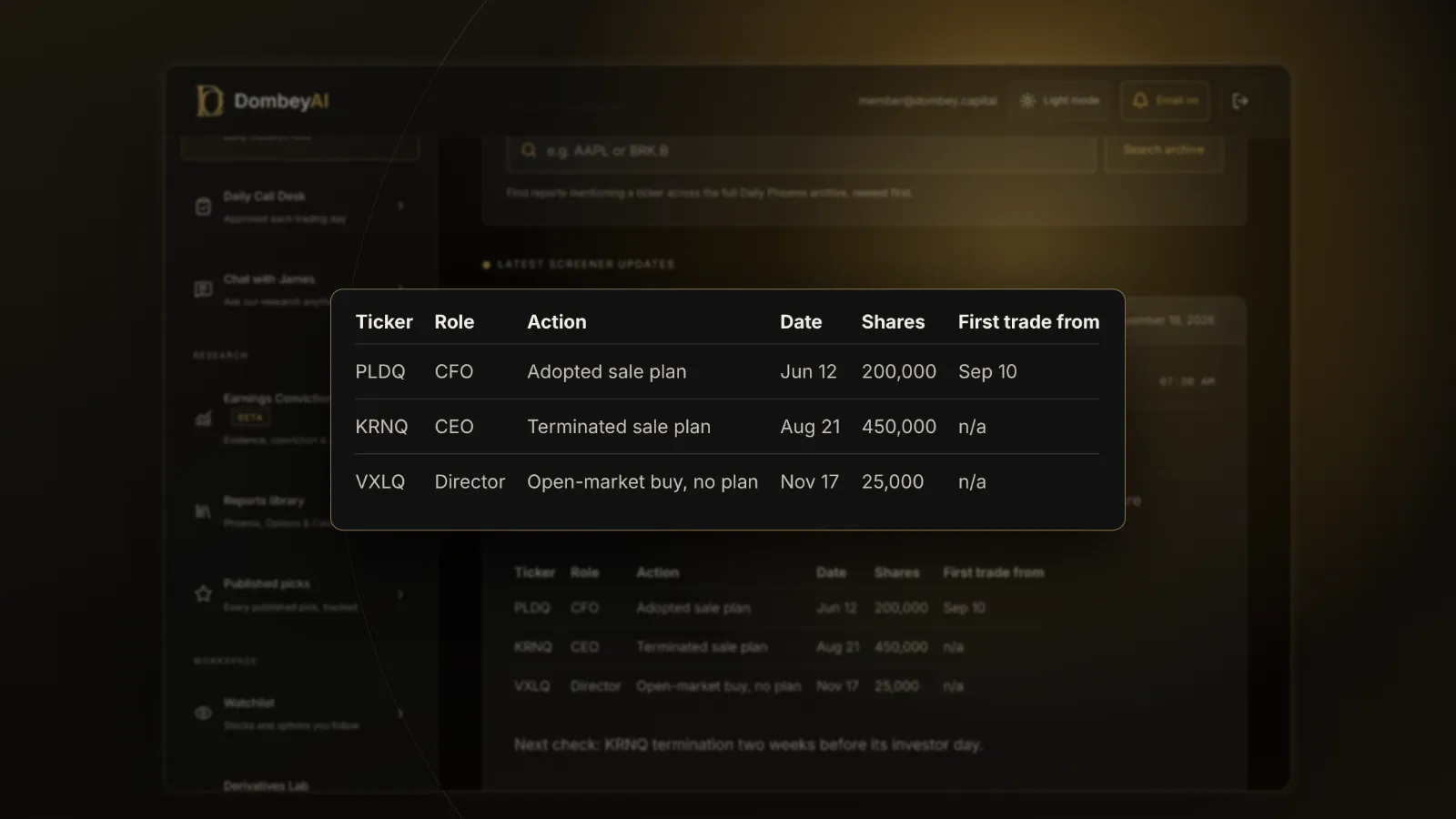
A worked example
If Company A then announces a large contract loss in October, the CFO's sales in September and October are not, by themselves, evidence of a problem: the decision dates to June. The questions to ask are whether anything was known in June, and whether the plan was changed after that.
For event-driven work, the best tools for tracking insider buying and SEC filing alert tools help collect these filings across many companies. Dombey's published research reviews insider activity around each catalyst; see the research archive.
Where this goes wrong
- Reading every plan sale as bearish. Scheduled sales were decided months earlier and often for personal reasons. Treating them as a verdict on the stock overreads the data.
- Ignoring the company's own plans. Issuers can use 10b5-1 plans for buybacks. They are not subject to the director and officer cooling-off rules, and a buyback plan says more about capital allocation than about any insider's view. Buybacks as catalysts covers how to read them.
- Missing terminations. A cancelled plan can be the most informative event of all, but it only appears in the next periodic report, weeks later.
- Assuming the plan proves innocence. The defense fails if the plan was adopted while the insider held inside information or was not operated in good faith. Enforcement cases since 2023 show prosecutors will test that.
For how dated filings can drive a stock, see the market coverage of recent moves.
The bottom line
A 10b5-1 plan lets insiders trade on a schedule set when they had no inside information, which gives them a defense against insider trading claims. Since 2023, directors and officers face a cooling-off period of at least 90 days, must certify good faith, and have their adoptions and terminations disclosed each quarter. For investors, routine plan sales carry little information. Adoptions, terminations and open-market purchases outside a plan are where the signal is.