

A short definition
Most drugs are approved on evidence that they help patients feel better, function better or live longer. That evidence can take years to collect. Accelerated approval, created by FDA regulation in 1992 and written into law in 2012, allows approval earlier when the condition is serious and a measurable marker is reasonably likely to predict the benefit.
The marker is called a surrogate endpoint. Examples include tumor response rate in cancer, viral load in HIV and amyloid plaque in Alzheimer's disease. An intermediate clinical endpoint, a clinical measure taken earlier than the final outcome, can serve the same role.
The approval comes with a condition: a confirmatory trial to verify the clinical benefit. The label says the indication was approved under accelerated approval and that continued approval may depend on that verification.
Real examples
| Year | Drug | What happened |
|---|---|---|
| 1992 | Program created | FDA regulations allowed approval on surrogate endpoints for serious conditions, first used heavily for HIV drugs |
| 2011 to 2023 | Makena | Approved under accelerated approval for preterm birth; the confirmatory trial did not show benefit, and the FDA withdrew approval in 2023 |
| 2016 | Exondys 51 | Approved for Duchenne muscular dystrophy based on increased dystrophin, over the objections of FDA review staff, with a confirmatory trial required |
| 2021 | Checkpoint inhibitor indications | An FDA advisory committee reviewed several cancer indications whose confirmatory trials had not shown benefit; sponsors withdrew a number of them |
| 2021 | Aduhelm | Approved for Alzheimer's disease based on amyloid reduction; uptake was limited and the sponsor discontinued the drug in 2024 |
| 2023 | Leqembi | Received accelerated approval in January and was converted to traditional approval in July after the confirmatory trial |
Each case shows a different outcome of the same pathway: conversion, a long dispute, a voluntary withdrawal or a forced withdrawal.
How the pathway works
Eligibility. The drug must treat a serious or life-threatening condition and offer a meaningful advantage over existing treatments. The sponsor usually discusses the surrogate endpoint with the FDA early in development.
The application. The sponsor files a new drug application or biologics license application relying on the surrogate. Review follows the normal timeline, standard or priority. Accelerated approval changes the evidence standard, not the review clock, so the PDUFA date still applies.
Advisory committee. The FDA may convene an outside panel, especially when the surrogate is contested. Our explainer on FDA advisory committee meetings covers how panels vote and what the vote does and does not decide.
Approval with conditions. The approval letter sets postmarketing requirements, including the confirmatory trial, its milestones and its completion date.
Confirmation or withdrawal. If the confirmatory trial verifies benefit, the sponsor can seek conversion to traditional approval. If it does not, or if the sponsor fails to run it with due diligence, the FDA can withdraw the approval for that use.
What changed in 2022
The Food and Drug Omnibus Reform Act of 2022, known as FDORA, passed as part of a year-end spending law, tightened the pathway after criticism of confirmatory trials that ran late or never finished. It gave the FDA authority to:
- Require that a confirmatory trial be underway before granting accelerated approval.
- Require sponsors to report progress on confirmatory trials every 180 days.
- Use expedited procedures to withdraw an approval, with notice and an opportunity for the sponsor to respond.
For investors, the change shortens the gap between approval and the confirmatory readout and makes withdrawal a more credible threat than before.
Why it matters for investors
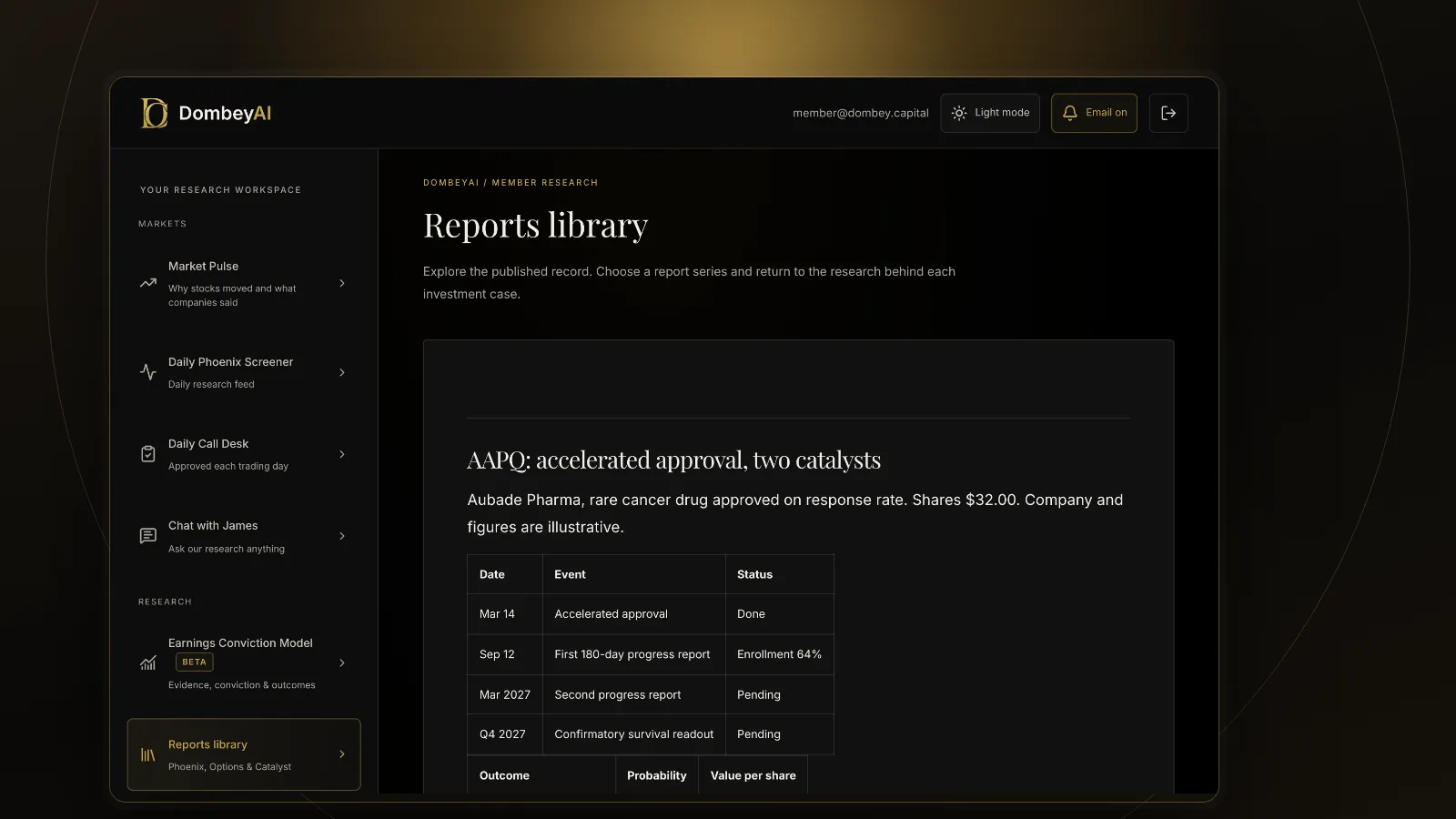
Accelerated approval creates a sequence of dated events rather than one.
| Event | What to check | Where to find it |
|---|---|---|
| Filing acceptance | Whether the FDA accepted the surrogate and the review type | Company 8-K or press release |
| Advisory committee | Panel questions on the surrogate | FDA meeting materials |
| Approval decision | The label, any restrictions, the confirmatory requirement | Approval letter on Drugs@FDA |
| Confirmatory trial start | Enrollment status, required before approval in many cases | Trial registry, company filings |
| Confirmatory readout | Whether clinical benefit is verified | Company press release, 8-K |
| Conversion or withdrawal | Traditional approval or loss of the indication | FDA announcement, company filing |
A complete response letter at the first stage ends the near-term story. An approval starts a second clock. Our guide to valuing a biotech pipeline shows how to weight each stage, and clinical trial readouts covers how confirmatory data tends to move a stock.
How to read an accelerated approval
- Read the label. Look for the accelerated approval statement and the exact population. A narrow label limits sales even if the drug is approved.
- Find the confirmatory trial. Check its design, endpoint, size and completion date in the approval letter and trial registry. A trial already fully enrolled is far less risky than one that has not started.
- Compare the surrogate with the outcome. Some surrogates, such as viral load in HIV, have a strong record of predicting benefit. Others, especially new ones, carry more risk.
- Check payer response. Insurers and government programs may restrict coverage for drugs approved on surrogates, which caps sales until confirmation.
- Watch the 180-day reports. Progress updates now give earlier warning of delays.
Trackers that list approval dates and readouts are compared in our review of FDA calendars and biotech catalyst trackers. For how individual stocks have moved on these decisions, see the Dombey market pages.
Where this goes wrong
Treating approval as the end. The confirmatory readout can undo the approval. A stock priced as if the drug is permanent carries risk the price may not show.
Assuming withdrawal is quick. Before FDORA, some withdrawals took years. The new procedures are faster, but disputes and hearings still take time, and sales can continue in the meantime.
Assuming withdrawal is rare. Many accelerated approvals convert, but a meaningful number of indications have been withdrawn, especially in oncology, when confirmatory trials did not show benefit.
Confusing designations. Breakthrough therapy designation, fast track and priority review are different from accelerated approval. A press release that lists several can blur which one affects the evidence standard.
Ignoring competition. If a rival wins traditional approval in the same indication, the FDA and payers may view the surrogate-based drug differently, and the unmet need that justified the pathway can shrink.
The bottom line
FDA accelerated approval lets a drug for a serious condition reach patients earlier, based on a surrogate endpoint reasonably likely to predict benefit. It comes with a confirmatory trial, and since the 2022 reforms the FDA has firmer tools to require that trial and to withdraw approval if it fails. For an investor, the approval is the first of two dated catalysts. Read the label and the confirmatory requirement, model both outcomes, and give the readout date the same weight as the approval date.